Infinite Multiverses: Exploring Parallel Realities
The concept of infinite multiverses and parallel realities has captivated humanity for centuries, transitioning from science fiction to a serious subject of theoretical physics. It posits that our universe isn’t the only one, but rather one among countless others, each potentially governed by different physical laws, or even identical to our own, playing out myriad alternate histories. This fascinating idea challenges our fundamental understanding of existence and pushes the boundaries of cosmic exploration.
💡 Key Takeaways
- The multiverse concept suggests our universe might be just one of many, possibly infinite, universes.
- Different multiverse theories, like the M-theory or Many-Worlds Interpretation, offer varying perspectives on parallel realities.
- While unproven, the idea of multiverses challenges our understanding of space, time, and causality.
- Exploring multiverses encourages a deeper look into the fundamental nature of existence and the cosmos.
“The multiverse isn’t just a sci-fi trope; it’s a profound implication of our most cutting-edge physics. It forces us to reconsider the uniqueness of our own existence and the boundless possibilities of reality itself.”
— Astrid Bellweather, Astrophysicist & Science Communicator
For those delving into Cosmic Queries: Probing the Mysteries of the Universe, the multiverse stands as one of the most intriguing and mind-bending propositions.
In This Article
- → Infinite Multiverses: Exploring Parallel Realities
- — 💡 Key Takeaways
- → Understanding the Multiverse Concept
- — 💡 Defining the Infinite
- — 🔭 A Brief History of the Idea
- → Leading Theories of Parallel Realities
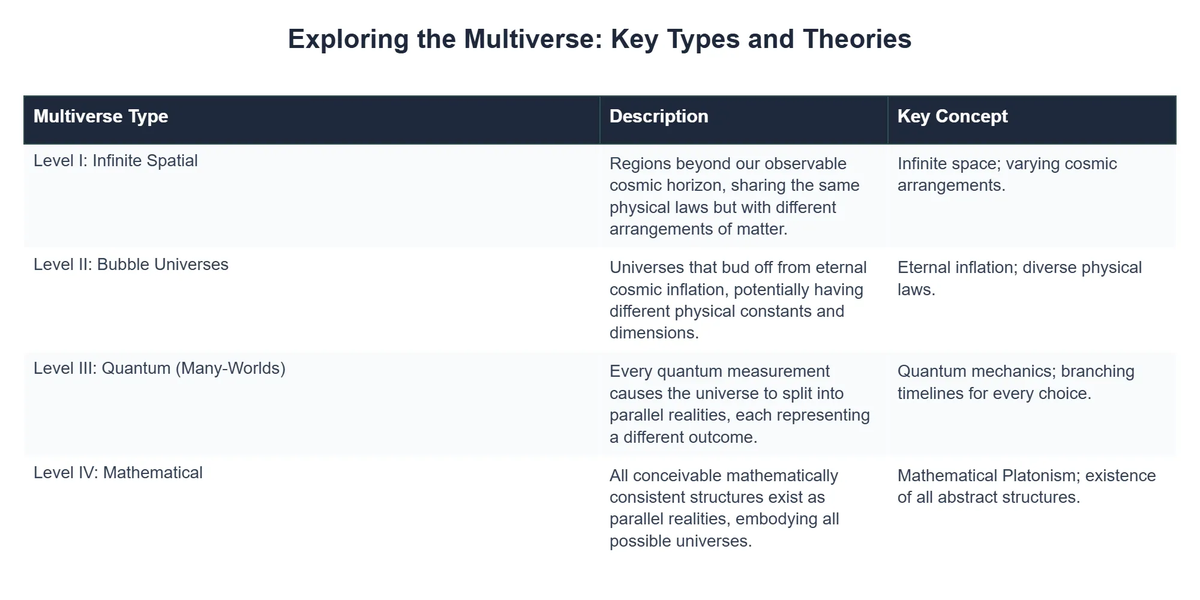
- — ➡️ The Quilted Multiverse (Level I Multiverse)
- — ⚛️ The Many-Worlds Interpretation (Level III Multiverse)
- — 🌌 Brane Worlds and String Theory (Level II Multiverse)
- — 🧮 The Mathematical Multiverse (Level IV Multiverse)
- → Evidence and Implications: Probing the Infinite
- — 🔍 Searching for Cosmic Clues
- — 💫 Impact on Our Understanding of Reality
- → The Philosophical and Scientific Debate
- — ⚖️ The Case For and Against
- — 🔬 The Path Forward in Research
- → Exploring the Cosmic Frontiers
- — ✨ What’s Next in Multiverse Research?
Understanding the Multiverse Concept
At its core, the multiverse hypothesis suggests the existence of multiple universes. These aren’t just distant galaxies within our own cosmos; rather, they are entirely separate spaces and times, potentially inaccessible to us. The term “multiverse” serves as an umbrella for various theoretical models, each presenting a distinct way these other universes might exist.
💡 Defining the Infinite
While the idea of other worlds isn’t new, modern physics gives it a scientific framework. Instead of a single, isolated cosmic canvas, the multiverse paints a picture of a vast, interconnected (or perhaps fundamentally disconnected) cosmic tapestry. This concept arises from diverse fields, including quantum mechanics, cosmology, and string theory, each offering unique perspectives on how such other universes could form or coexist.
🔭 A Brief History of the Idea
The seeds of the multiverse concept can be traced back to ancient philosophy and recurring themes in literature. However, its scientific modern resurgence began in the mid-20th century, particularly with Hugh Everett III’s “Many-Worlds Interpretation” of quantum mechanics. Since then, various cosmological models, notably inflationary cosmology, have provided compelling theoretical grounds for the existence of multiple universes, fueling the ongoing debate within the scientific community.
Leading Theories of Parallel Realities
The landscape of multiverse theory is rich with diverse ideas, each attempting to explain aspects of our universe or resolve perplexing paradoxes in physics. While none are definitively proven, they offer fascinating glimpses into what reality beyond our observable cosmos might entail.
➡️ The Quilted Multiverse (Level I Multiverse)
This is arguably the simplest and most intuitive type of multiverse. If space is infinite and the distribution of matter within it is uniform and statistically repeats itself (which current cosmological data supports), then there must be regions far enough away where the arrangements of particles repeat, creating identical “patches” or “bubble universes.” Essentially, if you travel far enough, you’ll encounter a copy of yourself and everything around you.
- ✅ Based on standard cosmological assumptions (infinite space, uniform matter distribution).
- ✅ Doesn’t require new physics, just extreme distances.
- ✅ Implies exact duplicates of our universe could exist beyond our cosmic horizon.
⚛️ The Many-Worlds Interpretation (Level III Multiverse)
Originating from quantum mechanics, the Many-Worlds Interpretation (MWI) proposes that every time a quantum measurement is made, the universe “splits” or “branches” into multiple new universes. In one universe, one outcome occurs, and in another, a different outcome occurs. This resolves the perplexing issue of wave-function collapse in quantum mechanics by suggesting all possibilities are realized in their own distinct universes. For more on this, see our article on Many-Worlds Theory: Exploring Parallel Realities.
- 💡 Resolves the measurement problem in quantum mechanics.
- 💡 Every quantum possibility leads to a new universe.
- 💡 Constantly branching, creating an enormous, ever-expanding collection of parallel realities.
🌌 Brane Worlds and String Theory (Level II Multiverse)
Derived from string theory and M-theory, the Brane Multiverse model suggests that our entire universe is a “brane” (a multidimensional membrane) existing within a higher-dimensional space, often called the “bulk.” Other branes, representing other universes, could exist in this bulk, potentially floating near each other or even colliding. Such collisions could explain events like the Big Bang. Dive deeper into this at Multiverse and Parallel Dimensions: Theories and Possibilities.
- ✅ Our universe is a 3D “membrane” in a higher-dimensional space.
- ✅ Other “brane universes” could exist near us.
- ✅ Collisions between branes might be the origin of Big Bang-like events.
🧮 The Mathematical Multiverse (Level IV Multiverse)
This highly abstract theory, championed by cosmologist Max Tegmark, posits that all mathematically consistent structures exist as actual universes. If a structure can be precisely described mathematically, then it corresponds to a real, existing universe. This is the most expansive type of multiverse, suggesting that every possible mathematical framework represents a distinct reality.
- ➡️ All mathematically consistent structures represent actual universes.
- ➡️ Removes the need for physical laws as we understand them, replacing them with pure mathematical existence.
- ➡️ A very radical and difficult-to-falsify hypothesis.
Evidence and Implications: Probing the Infinite
While direct observational evidence for infinite multiverses remains elusive, certain theoretical arguments and cosmological observations hint at the possibility. The implications, if any of these theories prove true, would be profound, reshaping our understanding of physics, existence, and our place in the cosmos.
🔍 Searching for Cosmic Clues
Scientists look for subtle “fingerprints” that could indicate the presence of other universes. These might include anomalies in the Cosmic Microwave Background (CMB) – the afterglow of the Big Bang – that could be explained by gravitational interactions with other universes. Another compelling, albeit indirect, argument is the “fine-tuning problem” of our universe, where physical constants seem perfectly calibrated for life. A multiverse could explain this: if there are countless universes with varying constants, it’s not surprising we find ourselves in one where life is possible.
- ✅ Anomalies in the Cosmic Microwave Background (CMB) radiation.
- ✅ The “fine-tuning” of physical constants for the existence of life.
- ✅ Gravitational effects or “echoes” from collisions with other branes.
It’s crucial to understand that these are not direct proofs, but rather suggestive observations that align with multiverse hypotheses, providing avenues for further research.
💫 Impact on Our Understanding of Reality
If any multiverse theory gains stronger footing, the implications for science and philosophy would be immense:
- 1. Rethinking Cosmic Uniqueness: Our universe would no longer be a singular entity but one of many, fundamentally changing our cosmic perspective.
- 2. Unified Theories: Some multiverse theories, like those derived from string theory, could offer paths toward a “Theory of Everything,” unifying fundamental forces.
- 3. Probabilistic Explanations: Events that seem incredibly improbable in a single universe could become highly probable across an ensemble of universes.
- 4. Existential Questions: It would deepen questions about identity, free will, and the very nature of reality itself.
The Philosophical and Scientific Debate
The concept of parallel realities sparks intense debate within the scientific and philosophical communities. While alluring, multiverse theories face significant hurdles, primarily concerning their testability and falsifiability.

⚖️ The Case For and Against
Arguments in favor often highlight:
- ✅ Their ability to resolve deep problems in physics (e.g., fine-tuning, quantum measurement).
- ✅ The natural conclusions drawn from established theories like eternal inflation.
- ✅ The elegance and simplicity of certain interpretations, like MWI’s approach to quantum mechanics.
Conversely, criticisms frequently cite:
- ➡️ Lack of direct observational evidence.
- ➡️ The problem of falsifiability: if a theory cannot be proven wrong, is it truly scientific?
- ➡️ Ockham’s Razor: the principle that the simplest explanation is usually the best, questioning the introduction of infinitely many unobservable universes.
For more insights into these discussions, explore Multiverse Theory: Exploring Multiple Universes.
🔬 The Path Forward in Research
Despite the challenges, research continues. Physicists are actively exploring potential observable signatures, however subtle, that could differentiate between different multiverse models or provide indirect evidence. Theoretical work aims to refine these models, making them more predictive and, ideally, more testable. The quest for empirical validation remains paramount.
You can find discussions and resources on this topic from various communities, such as those that explore [https://medium.com/@awaisshah.ist110/multiverses-parallel-worlds-infinite-possibilities-ebb22fdd6c42](Multiverses: Parallel Worlds, Infinite Possibilities) on platforms like Medium.
Recommended Video
Exploring the Cosmic Frontiers
The pursuit of understanding infinite multiverses pushes the boundaries of human thought and scientific inquiry. It forces us to reconsider the very nature of our existence, the universe we inhabit, and the countless possibilities that might lie beyond our current comprehension.
✨ What’s Next in Multiverse Research?
The future of multiverse research lies in continued theoretical refinement, particularly in areas like quantum gravity and string theory, and the diligent search for any conceivable empirical signature. Breakthroughs in cosmology, particle physics, or even new interpretations of quantum mechanics could provide the crucial insights needed to move these theories from the realm of speculation into verifiable science. As Stephen Hawking once explored, the multiverse remains a profound area of study, echoing his final cosmic visions about the nature of our universe. For more, read about Stephen Hawking’s Multiverse Theory: A Final Cosmic Vision.
What is the multiverse theory?
The multiverse theory posits that our universe is just one of many, or even infinitely many, universes that exist. These universes may have different physical laws or conditions.
Are parallel realities scientifically proven?
No, parallel realities and the multiverse are currently theoretical concepts, not scientifically proven. However, various theories within physics lend support to the possibility, such as quantum mechanics and string theory.
What are the main types of multiverse theories?
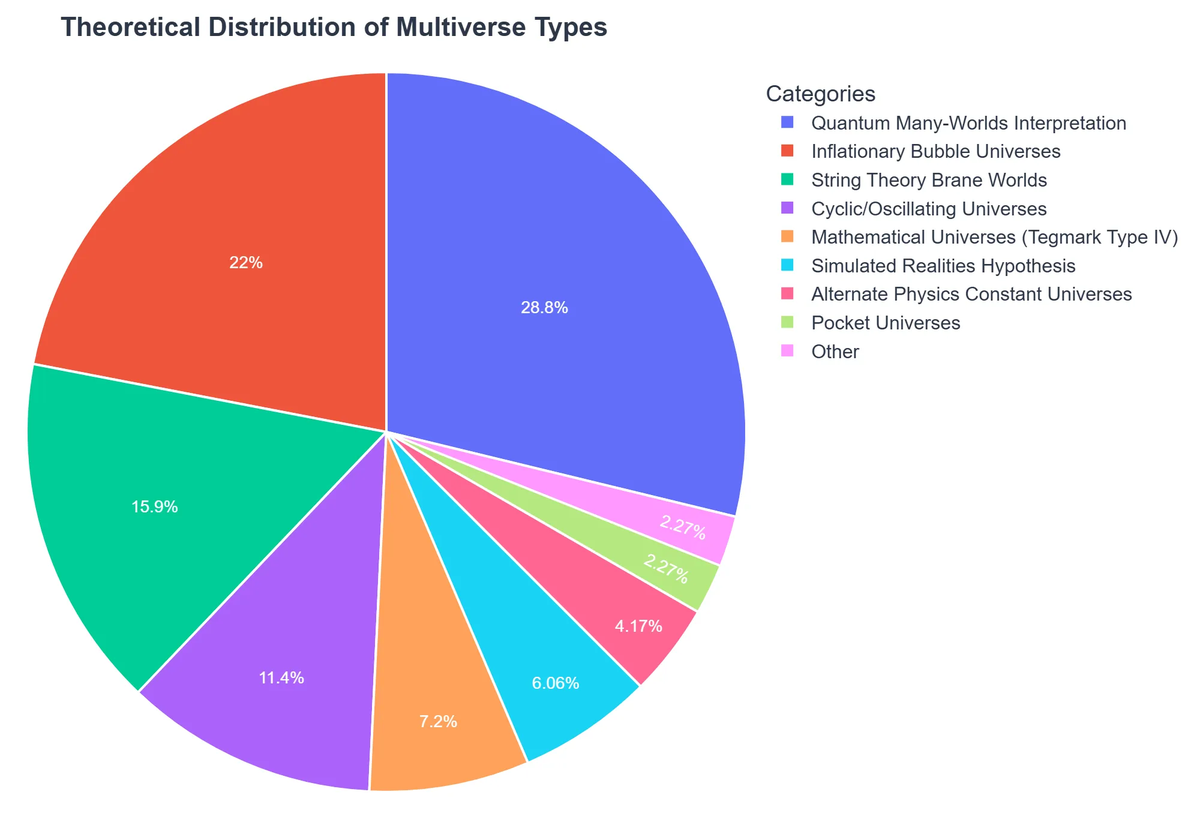
Common theories include the Many-Worlds Interpretation (from quantum mechanics), the bubble universe theory (from inflation), the M-theory (string theory), and mathematical multiverses.
Could we ever visit a parallel universe?
Under current scientific understanding, there is no known mechanism or technology that would allow travel to a parallel universe. It remains purely within the realm of theoretical physics.