


Unearthing the Past: Why Exploring Historical Sites Matters
In our ever-accelerating modern world, the echoes of the past offer profound insights, invaluable lessons, and an unparalleled sense of connection to human history. Visiting historical sites is more than just tourism; it’s an immersive journey that allows us to walk in the footsteps of those who came before us, witnessing the tangible remnants of their triumphs, struggles, innovations, and cultures.
💡 Key Takeaways
- Discover a curated selection of globally significant historical sites.
- Understand the unique historical and cultural importance of each location.
- Gain practical tips for planning visits to historical landmarks.
- Appreciate the profound impact these sites have on our understanding of human history.
“Every historical site is a living archive, a tangible link to our ancestors’ triumphs and struggles. To walk among these ruins or stand where pivotal events unfolded is to truly feel the pulse of the past.”
— Sebastian Thorne, Historian & Field Archaeologist
These venerable locations, whether grand monuments or humble ruins, serve as powerful touchstones, revealing the intricate tapestry of civilizations, empires, and everyday lives that have shaped our present. They are open-air museums, living classrooms, and silent storytellers, each brick, stone, or artifact whispering tales of antiquity, medieval sagas, or revolutionary change. For a deeper dive into the broader context of humanity’s hidden narratives, explore our comprehensive guide: Lost Worlds & Forgotten Histories: Unearthing the Past’s Greatest Riddles.
In This Article
- → Unearthing the Past: Why ExploringHistorical SitesMatters
- — 💡 Key Takeaways
- → Ancient Wonders: Journey Through Time’s Earliest Civilizations
- — 🏛️ The Pyramids of Giza, Egypt
- — 🗿 Stonehenge, England
- — 🏛️ The Acropolis of Athens, Greece
- — ⚔️ The Colosseum, Rome, Italy
- — 🏯 Petra, Jordan
- → Medieval Marvels and Revolutionary Echoes
- — 🏰 European Castles: From Neuschwanstein to Edinburgh
- — ⛪ Grand Cathedrals: Chartres and Notre-Dame
- — 🗽 Sites of Revolution: From Philadelphia to Paris
- → America’s Enduring Legacy: UnderstandingNational Historic Sites
- — 🦅 Iconic Landmarks of American History
- → Tracing Expeditions: NotableLincoln Historical Sitesand Trails
- — 🏠 Lincoln’s Boyhood National Memorial, Indiana
- — 🏛️ Lincoln Home National Historic Site, Illinois
- — 🎭 Ford’s Theatre National Historic Site, Washington D.C.
- — 🗽 Lincoln Memorial, Washington D.C.
- → Global Crossroads: DiverseHistoric SitesWorth Exploring
- — 🏯 East Asia’s Imperial Grandeur: The Great Wall and Forbidden City
- — 🌋 South America’s Mystical Ruins: Machu Picchu and Teotihuacan
- — 🌍 Africa’s Ancient Kingdoms: Lalibela and Great Zimbabwe
- → The Synergistic Role ofMuseum and Historical Sites
- → Planning Your Visit: Tips for Maximizing Your Experience
- — 🗓️ Best Time to Visit
- — 🎒 What to Pack
- — 🤔 Researching Before You Go
- — 📸 Respectful Photography
- — ♿ Accessibility Considerations
- → Beyond Tourism: The Preservation and Future of History
Ancient Wonders: Journey Through Time’s Earliest Civilizations
The dawn of civilization left an indelible mark on our planet, with structures and cities that continue to defy time and inspire awe. These ancient historic sites are testaments to early human ingenuity, artistry, and societal complexity.
-
🏛️ The Pyramids of Giza, Egypt
Standing as iconic symbols of ancient Egypt’s pharaonic might, the Pyramids of Giza, particularly the Great Pyramid of Khufu, remain one of the most astonishing engineering feats in history. Built as monumental tombs for pharaohs, these structures, alongside the enigmatic Sphinx, reflect a profound belief in the afterlife and the immense power wielded by ancient rulers. Their precision and sheer scale continue to fascinate archaeologists and visitors alike.
-
🗿 Stonehenge, England
Nestled on the Salisbury Plain, Stonehenge is a prehistoric monument composed of massive standing stones arranged in a circular pattern. Its purpose remains a subject of intense debate, theories ranging from an ancient astronomical observatory to a ceremonial burial ground. Its construction, requiring immense effort and knowledge from a Neolithic society, speaks volumes about the communal organization and sophisticated understanding of their environment possessed by its builders.
-
🏛️ The Acropolis of Athens, Greece
Perched high above the modern city, the Acropolis of Athens is a citadel of immense historical and architectural significance. Home to masterpieces like the Parthenon, Erechtheion, and Propylaea, it embodies the golden age of classical Greece, serving as a center of religious life and democratic ideals. These structures are not merely ruins but foundations of Western philosophy, art, and governance.
-
⚔️ The Colosseum, Rome, Italy
A symbol of Imperial Rome’s power and grandeur, the Colosseum, or Flavian Amphitheatre, was the largest amphitheater ever built. Hosting gladiatorial contests, public spectacles, and dramatic re-enactments, it provided entertainment for hundreds of thousands. Its innovative architecture and enduring presence offer a visceral connection to the brutal yet sophisticated society of ancient Rome.
-
🏯 Petra, Jordan
Carved directly into vibrant red sandstone cliffs, Petra, the “Rose City,” was once the bustling capital of the Nabataean kingdom. Its intricate facades, including the famous Al-Khazneh (The Treasury) and Ad Deir (The Monastery), reveal advanced hydraulic engineering and artistic prowess. This hidden city, a crucial trade hub in antiquity, remains one of the world’s most breathtaking archaeological sites.

Five Iconic Global Historical Sites
Medieval Marvels and Revolutionary Echoes
From the grandeur of medieval castles to the birthplaces of modern republics, these historical sites tell stories of shifting powers, spiritual devotion, and profound societal upheavals.
-
🏰 European Castles: From Neuschwanstein to Edinburgh
Europe’s landscape is dotted with thousands of castles, each narrating tales of feudal lords, sieges, and royal intrigue. While Neuschwanstein in Germany captivates with its fairy-tale aesthetics, inspiring Disney, castles like Edinburgh Castle in Scotland or Carcassonne in France offer glimpses into strategic fortifications and centuries of continuous human occupation. They represent periods of both brutal warfare and exquisite craftsmanship.
-
⛪ Grand Cathedrals: Chartres and Notre-Dame
The great cathedrals of Europe, such as Chartres Cathedral in France with its stunning stained glass, or the resilient Notre-Dame de Paris, are monumental achievements of Gothic architecture and profound expressions of medieval faith. Their construction spanned centuries, involving entire communities and pushing the boundaries of engineering and artistic design. They served as spiritual centers, community hubs, and symbols of urban pride.
-
🗽 Sites of Revolution: From Philadelphia to Paris
The late 18th and early 19th centuries were marked by revolutionary fervor, giving birth to new nations and political ideals. Independence Hall in Philadelphia, where the Declaration of Independence and the U.S. Constitution were debated and adopted, stands as a crucible of American democracy. Similarly, sites in Paris like the Bastille (though largely demolished) and the Tuileries Palace grounds echo the tumultuous French Revolution, foundational to modern European political thought. These historic sites symbolize the pursuit of liberty and self-governance.
America’s Enduring Legacy: Understanding National Historic Sites
The United States boasts a rich tapestry of history, meticulously preserved through its system of national historic sites. These locations are managed by the National Park Service (NPS) and designated for their exceptional national significance, offering insights into pivotal moments, influential figures, and cultural heritage.
Unlike National Parks, which preserve natural landscapes, national historic sites primarily focus on historical and cultural resources. They educate the public, protect vital artifacts, and ensure that the stories of America’s past remain alive for future generations. For a comprehensive overview of how these treasures are recognized, delve into our guide on National Historic Landmarks: America’s Treasures.
🦅 Iconic Landmarks of American History
- ✅ Gettysburg National Military Park, Pennsylvania: The site of the pivotal Civil War battle, Gettysburg offers a somber yet profound experience, immersing visitors in one of the most significant conflicts in American history. The preserved battlefield, monuments, and museum powerfully convey the sacrifices made and the profound impact of the war.
- ➡️ Independence National Historical Park, Pennsylvania: Encompassing Independence Hall and the Liberty Bell, this park in Philadelphia is the birthplace of the United States. It’s where the Declaration of Independence was signed and the Constitution was drafted, making it a cornerstone of American identity.
- 💡 Statue of Liberty National Monument, New York: A universal symbol of freedom and democracy, the Statue of Liberty welcomed millions of immigrants to American shores. Located on Liberty Island, it represents the hopes and dreams of those seeking a new life and the enduring ideals of the nation.
- 🗺️ Pearl Harbor National Memorial, Hawaii: Commemorating the tragic attack that propelled the U.S. into World War II, this site includes the USS Arizona Memorial, offering a poignant tribute to those who lost their lives. It serves as a powerful reminder of wartime sacrifices and international conflict.
Tracing Expeditions: Notable Lincoln Historical Sites and Trails
Abraham Lincoln, the 16th President of the United States, left an indelible mark on American history. Numerous lincoln historical sites across the country preserve his legacy, from his humble beginnings to his tragic assassination.
-
🏠 Lincoln’s Boyhood National Memorial, Indiana
This site preserves the farm where Abraham Lincoln spent his formative years (ages 7-21). It offers a glimpse into the challenging frontier life that shaped his character and values. Visitors can explore a replica cabin and a living history farm, understanding the roots of a future president.
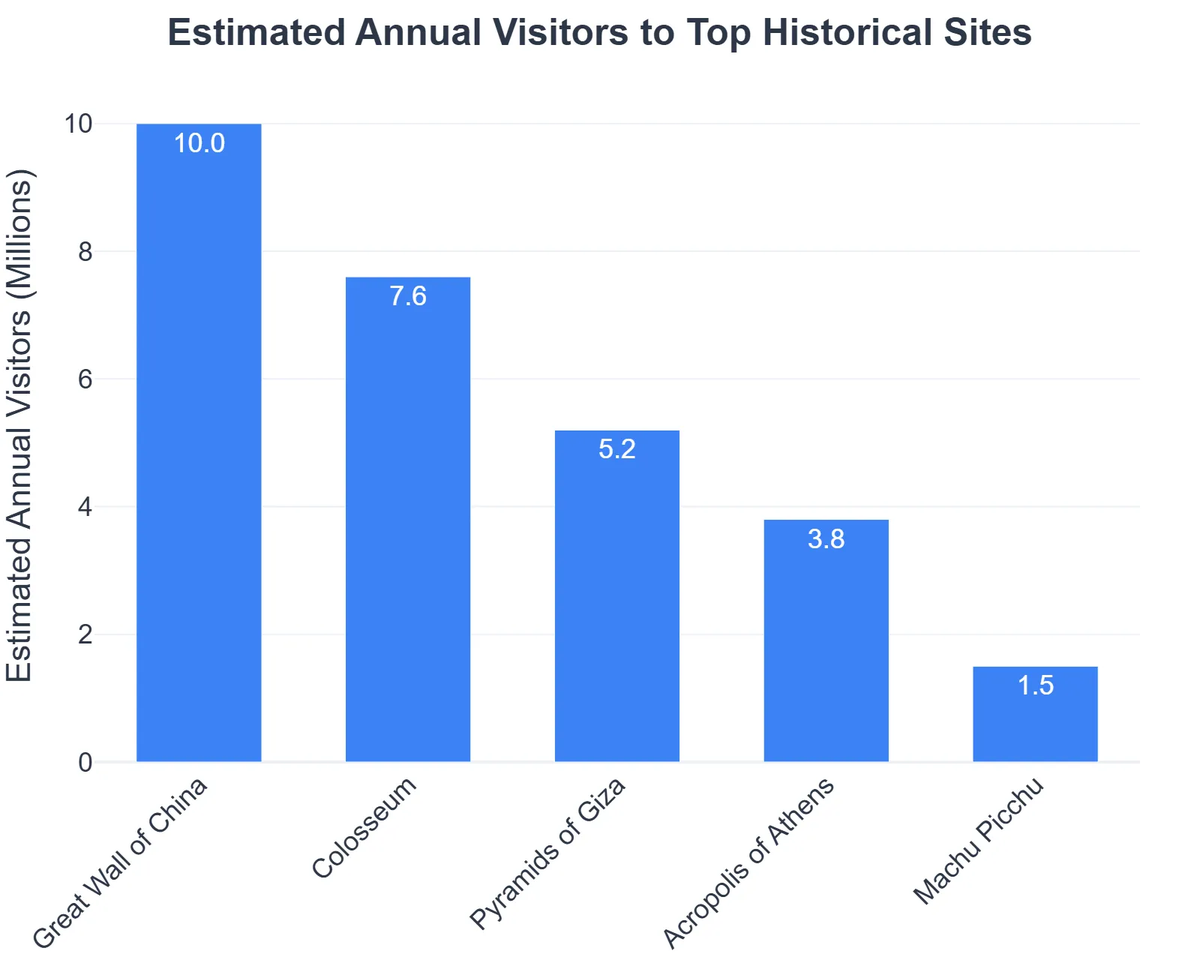
Estimated Annual Visitors to Top Historical Sites -
🏛️ Lincoln Home National Historic Site, Illinois
Located in Springfield, Illinois, this meticulously preserved home is the only house Abraham Lincoln ever owned. It provides an intimate look into his family life before he became president, showcasing the domestic sphere of a man who would lead the nation through its greatest crisis.
-
🎭 Ford’s Theatre National Historic Site, Washington D.C.
The site of Lincoln’s assassination, Ford’s Theatre is a somber yet vital historical landmark. It functions as both a working theater and a museum dedicated to Lincoln’s life, presidency, and tragic death. The Petersen House across the street, where he died, is also part of the site, offering a poignant end to his story.
-
🗽 Lincoln Memorial, Washington D.C.
While not a “site” in the same vein as a home or battlefield, the Lincoln Memorial is one of the most recognized monuments to Lincoln. Its powerful statue and monumental architecture symbolize his enduring legacy of unity and freedom, a place where historic speeches like Martin Luther King Jr.’s “I Have a Dream” have resonated.
Beyond individual sites, the spirit of exploration and nation-building is also reflected in grand historical trails. For those interested in the pioneering spirit that helped define American expansion, exploring Lewis and Clark National Historic Trail: Retracing the Expedition offers another profound connection to historical journeys.
Global Crossroads: Diverse Historic Sites Worth Exploring
History isn’t confined to one continent. The world abounds with spectacular historic sites that tell universal stories of human endeavor, belief, and conflict.
-
🏯 East Asia’s Imperial Grandeur: The Great Wall and Forbidden City
China’s Great Wall, an astonishing feat of defensive architecture stretching thousands of miles, embodies centuries of imperial ambition and protection. It’s a testament to human perseverance and large-scale engineering. In Beijing, the Forbidden City, the former imperial palace, represents the pinnacle of traditional Chinese architecture and served as the political and ceremonial center of China for over 500 years, showcasing the opulent lifestyle of emperors.
-
🌋 South America’s Mystical Ruins: Machu Picchu and Teotihuacan
Perched high in the Andes Mountains of Peru, Machu Picchu is an ancient Inca city, renowned for its sophisticated dry-stone construction and stunning setting. Its purpose remains somewhat mysterious, adding to its allure as a symbol of Inca civilization. In Mexico, Teotihuacan, with its massive Pyramids of the Sun and Moon, was once one of the largest cities in the ancient world, predating the Aztecs. Its monumental structures and intricate urban planning reveal a complex pre-Columbian society.
-
🌍 Africa’s Ancient Kingdoms: Lalibela and Great Zimbabwe
In Ethiopia, the eleven monolithic rock-hewn churches of Lalibela are an extraordinary example of religious devotion and architectural genius. Carved directly out of living rock, these churches are still active places of worship. Further south, Great Zimbabwe, a sprawling ruined city, served as the capital of the Kingdom of Zimbabwe during the Late Iron Age. Its impressive stone enclosures stand as a symbol of indigenous African architectural prowess and a testament to a powerful pre-colonial civilization. For more global must-sees, check out this list of historical landmarks around the world.
Visiting Historical Sites: Pros and Cons
Pros
- ✔Deepens understanding of history and diverse cultures.
- ✔Offers unique, immersive, and inspiring experiences.
- ✔Contributes to the preservation of global heritage.
- ✔Provides aesthetic beauty and architectural marvels.
Cons
- ✖Can be crowded, leading to diminished visitor experience.
- ✖Often involves significant travel and admission costs.
- ✖May have strict viewing or access limitations.
- ✖Some sites can feel over-commercialized.
The Synergistic Role of Museum and Historical Sites
Often, the deepest understanding of a historic site comes when it is paired with a museum. The interaction between museum and historical sites provides a richer, more comprehensive educational experience.
- ➡️ Contextualizing the Experience: While a site allows you to physically explore a location, a museum provides the essential context. Exhibits can display artifacts found at the site, offer detailed narratives, provide maps, and present interactive displays that bring the history to life, bridging gaps in imagination.
- ✅ Preservation and Research: Museums often serve as repositories for artifacts unearthed from historical sites, ensuring their preservation and enabling ongoing research. This behind-the-scenes work is crucial for continually deepening our understanding of the past.
- 💡 Educational Outreach: Many museum and historical sites offer educational programs for schools, guided tours, and public lectures. This combined approach makes history accessible and engaging for diverse audiences, from young students to seasoned historians.
- 📚 Visitor Experience Enhancement: Imagine visiting a Roman amphitheater; a nearby museum might display gladiatorial armor, explain the types of spectacles, and detail the lives of the people who built and used it. This greatly enhances the visitor’s appreciation and comprehension of the site itself.
Planning Your Visit: Tips for Maximizing Your Experience
To truly appreciate the depth and significance of historical sites, thoughtful planning is key. Here’s how to make the most of your journey:
-
🗓️ Best Time to Visit
Consider the weather, crowds, and local events. Off-season travel (shoulder months like spring or fall) often means fewer tourists and more pleasant temperatures. Check the site’s official website for peak times and operational hours.
-
🎒 What to Pack
Comfortable walking shoes are non-negotiable, as many sites involve extensive walking or uneven terrain. Carry water, sunscreen, a hat, and appropriate clothing for the climate. A small backpack for essentials is also recommended.
-
🤔 Researching Before You Go
A little pre-trip research goes a long way. Read up on the history of the site, its key features, and any significant events associated with it. This knowledge will enhance your appreciation and help you identify what you want to focus on during your visit. Many sites have official guides or audio tours that can be downloaded beforehand.
-
📸 Respectful Photography
While photography is often encouraged, always be mindful of restrictions, especially in religious sites or areas with delicate artifacts. Use discretion, avoid flash where prohibited, and be respectful of other visitors and the sanctity of the location.
-
♿ Accessibility Considerations
Not all historic sites are fully accessible due to their age and original design. If you or someone in your party has mobility challenges, check the site’s official accessibility information beforehand. Many sites are working to improve access, but it’s always best to be prepared.
Recommended Video
Beyond Tourism: The Preservation and Future of History
The continued existence and accessibility of historical sites depend heavily on ongoing preservation efforts and responsible tourism. Organizations like UNESCO (United Nations Educational, Scientific and Cultural Organization) play a crucial role in identifying, protecting, and preserving sites of outstanding universal value. However, the responsibility also lies with individual visitors.
Climate change, urban development, and irresponsible tourism pose significant threats to these irreplaceable treasures. By supporting responsible tourism, adhering to site rules, and advocating for conservation, we contribute to ensuring that future generations can also experience the profound connection to the past that these sites offer. The narratives embedded in these ancient stones and preserved landscapes are not just relics; they are living testaments to the human story, guiding us as we navigate our present and shape our future.
What makes a historical site a ‘must-visit’?
Must-visit historical sites typically possess significant cultural, architectural, or historical importance, offering profound insights into past civilizations, events, or traditions.
How can I prepare for a visit to a historical site?
Research the site’s history, check opening hours and accessibility, wear comfortable shoes, and consider hiring a local guide for deeper insights.
Are historical sites preserved globally?
Many historical sites are protected by international bodies like UNESCO, national governments, and local organizations, dedicated to their preservation for future generations.
What are some of the oldest historical sites in the world?
Göbekli Tepe, Stonehenge, and the Pyramids of Giza are among the oldest, showcasing remarkable ancient human ingenuity and cultural development.