

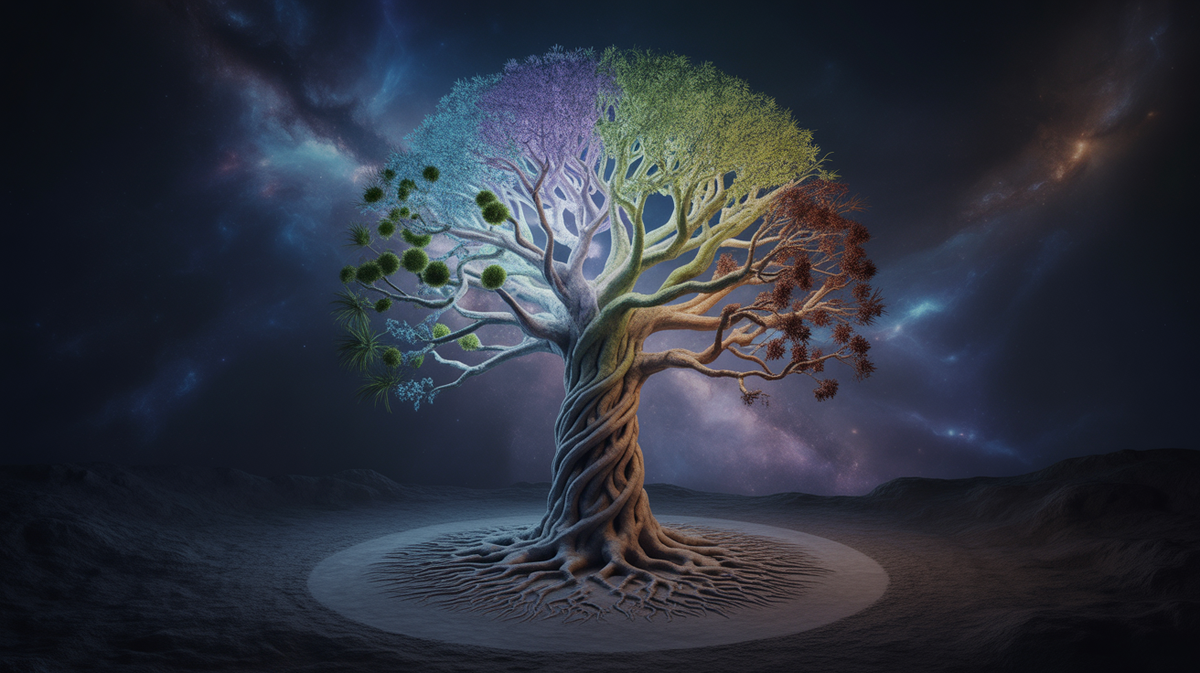
What is the Evolution Concept? Defining Life’s Enduring Change
At its core, the concept of evolution describes the process by which life forms on Earth change over successive generations. It’s not just about a single event, but a continuous, dynamic process that has shaped every living organism we see today, from the smallest bacterium to the largest whale. This fundamental biological principle explains the vast diversity of life and how species adapt to their environments over time.
💡 Key Takeaways
- Evolution is the process by which life forms change over generations through genetic variation and natural selection.
- Natural selection favors traits that enhance survival and reproduction in a given environment, leading to adaptation.
- All life on Earth shares a common ancestor, with diversity arising from millions of years of evolutionary divergence.
- Understanding evolution is crucial for fields ranging from medicine to conservation.
“Evolution isn’t just a theory; it’s the fundamental mechanism driving the astounding diversity and intricate adaptations we observe in all living things, from microbes to mammals. It’s the grand narrative of life.”
— Julian Aris, PhD, Geneticist & Evolutionary Biologist
Evolution, in essence, is defined as a change in the heritable characteristics of biological populations over successive generations. These characteristics are the expressions of genes that are passed on from parent to offspring. Changes in these genes, and the traits they produce, accumulate over vast stretches of time, leading to new species and intricate ecosystems.
Understanding this process is crucial for comprehending The Code of Life: Decoding Genetics, Evolution, and Existence itself, as it provides the framework for how biological systems develop and persist.
In This Article
- → What is the Evolution Concept? Defining Life’s Enduring Change
- — 💡 Key Takeaways
- → 🌍 The Pillars of Evolutionary Change: How it Works
- — ➡️ Natural Selection: The Driving Force
- — 💡 Genetic Mutation: The Source of Novelty
- — ⚙️ Genetic Drift: Random Changes
- — ➡️ Gene Flow: Migration and Mixing
- → ⏳ A Brief History of the Evolution Theory
- — 🌱 Charles Darwin and Alfred Russel Wallace
- — 🧬 Modern Synthesis: Genetics Meets Evolution
- → 📊 Evidence for Evolution: What the Science Shows
- → 💡 Misconceptions and the Ongoing Evolution of Life
🌍 The Pillars of Evolutionary Change: How it Works
Evolution isn’t a single, monolithic force, but rather a complex interplay of several key mechanisms. These mechanisms introduce variation into populations and then act upon that variation, driving directional changes over time.
The Concept of Evolution: Pros and Cons
Pros
- ✔Provides a foundational framework for all biological sciences.
- ✔Explains the diversity and adaptation of life on Earth.
- ✔Crucial for advancements in medicine, agriculture, and conservation.
- ✔Supported by a vast body of scientific evidence from various fields.
Cons
- ✖Its complexity and vast timescales can be challenging to fully comprehend.
- ✖May conflict with some traditional religious or philosophical perspectives.
- ✖Prone to misinterpretation and misuse in non-scientific contexts.
➡️ Natural Selection: The Driving Force
Often considered the most significant mechanism, natural selection is a cornerstone of the evolution theory, famously championed by Charles Darwin. It describes how individuals within a population who are better suited to their environment tend to survive and reproduce more successfully than their less well-adapted peers. This leads to an increase in the frequency of advantageous traits in the population over generations.
- ✅ Variation: Individuals in a population show differences in their traits.
- ✅ Heritability: Many of these traits are heritable, meaning they can be passed down from parents to offspring.
- ✅ Differential Survival & Reproduction: Due to environmental pressures, some individuals with specific traits are more likely to survive and reproduce than others.
- ✅ Adaptation: Over time, the population becomes better suited to its environment as beneficial traits become more common.
This process is central to the Charles Darwin’s Theory of Evolution: A Comprehensive Guide and is explored in detail in our article on Natural Selection: Darwin’s Theory of Evolution Explained.
💡 Genetic Mutation: The Source of Novelty
Mutations are random changes in the DNA sequence of an organism. They are the ultimate source of new genetic variation within a population. While many mutations are neutral or even harmful, some can be beneficial, providing the raw material upon which natural selection can act.
- ✅ Random occurrence, not goal-directed.
- ✅ Can introduce entirely new traits into a gene pool.
- ✅ Essential for long-term evolutionary change.
⚙️ Genetic Drift: Random Changes
Genetic drift refers to random fluctuations in the frequency of gene variants (alleles) in a population. Unlike natural selection, which is directional, genetic drift is a chance event, particularly impactful in small populations. It can lead to the loss of some alleles and the fixation of others, regardless of their adaptive value.
How ‘MarketFlow Analytics’ Evolved for 35% Revenue Growth
❓The Challenge
MarketFlow Analytics faced declining client retention as their traditional strategies struggled to adapt to the rapidly shifting digital landscape and emerging platforms.
💡The Solution
Inspired by the ‘Evolution Concept’ from the article, MarketFlow initiated a dynamic, adaptive approach: they introduced constant ‘mutations’ in their service offerings (new tactics), rigorously ‘selected’ for the most effective campaigns through continuous A/B testing, and ‘adapted’ their core strategies based on real-time market performance and client feedback.
🏆The Result
This continuous strategic ‘evolution’ led to a 35% increase in annual client revenue and a 25% improvement in client project success rates within a year.
- ✅ Stronger effect in smaller populations.
- ✅ Can lead to a reduction in genetic diversity.
- ✅ Examples include the “bottleneck effect” and “founder effect.”
➡️ Gene Flow: Migration and Mixing
Gene flow, or migration, is the transfer of genetic material from one population to another. When individuals move between populations and interbreed, they introduce new alleles or change the frequency of existing alleles in the recipient population. This can increase genetic variation within a population and reduce genetic differences between populations.
⏳ A Brief History of the Evolution Theory
While the idea that life changes over time has ancient roots, the modern scientific evolution theory began to take shape much more recently. Early thinkers like Jean-Baptiste Lamarck proposed ideas about inherited acquired characteristics, though these were later disproven.
🌱 Charles Darwin and Alfred Russel Wallace
The true turning point arrived in the mid-19th century with the independent work of Charles Darwin and Alfred Russel Wallace. Both naturalists, observing diverse flora and fauna in different parts of the world, independently arrived at the same groundbreaking mechanism for evolution: natural selection.
Darwin’s seminal work, On the Origin of Species (1859), provided overwhelming evidence and a comprehensive framework for how the `darwin concept of evolution` through natural selection could explain the adaptation and diversification of life. For a comprehensive look into this pivotal moment, explore our article on Charles Darwin’s Theory of Evolution: A Comprehensive Guide.
🧬 Modern Synthesis: Genetics Meets Evolution
In the early 20th century, Darwin’s ideas were integrated with Mendelian genetics, a development known as the “Modern Evolutionary Synthesis.” This powerful combination demonstrated how inheritance (genes) provided the mechanism for the variation that Darwin observed, solidifying the evolution theory as the unifying principle of biology. This synthesis marked a crucial step in understanding Evolution Theories: Beyond Darwin’s Initial Insights.
📊 Evidence for Evolution: What the Science Shows
The scientific community accepts evolution as a foundational theory, not merely a hypothesis, due to the vast and diverse body of evidence supporting it. This evidence comes from multiple disciplines, all converging on the same conclusion: life has changed and continues to change over time.
- ✅ Fossil Record: Fossils provide a chronological record of life on Earth, showing transitional forms and the gradual development of new species over geological time. For more on the patterns of life’s history, you can explore resources like The history of life: looking at the patterns.
- ✅ Comparative Anatomy: Similarities in the skeletal and limb structures of different species (homologous structures), despite differing functions, suggest common ancestry. Vestigial structures (e.g., human appendix, whale pelvis) also point to evolutionary remnants.
- ✅ Embryology and Development: The similar embryonic development patterns across diverse species (e.g., presence of gill slits and tails in early vertebrate embryos) indicate shared developmental pathways inherited from a common ancestor.
- ✅ Molecular Biology: The most powerful evidence comes from DNA and protein analysis. All life uses the same genetic code, and the degree of genetic similarity between species directly correlates with their evolutionary relatedness. The closer two species are genetically, the more recently they shared a common ancestor.
- ✅ Biogeography: The geographical distribution of species around the world makes sense in light of evolution and continental drift. Closely related species tend to be found in the same geographical areas, even if those areas are now separated by oceans or mountain ranges.
- ✅ Direct Observation: Evolution can be observed in real-time, particularly in organisms with short generation times. Examples include the rapid evolution of antibiotic resistance in bacteria, pesticide resistance in insects, and viral evolution (e.g., influenza, SARS-CoV-2).

Recommended Video
💡 Misconceptions and the Ongoing Evolution of Life
Despite the overwhelming evidence, several common misconceptions about the evolution theory persist. Addressing these is key to a complete understanding.
- ✅ “Evolution is just a theory”: In scientific terms, a “theory” is a well-substantiated explanation of some aspect of the natural world, based on a body of facts that have been repeatedly confirmed through observation and experiment. It’s not a guess or a hunch. Learn more at Misconceptions about evolution.
- ✅ “Humans evolved from monkeys”: Humans and modern apes share a common ancestor, but humans did not evolve directly from monkeys. We are cousins on the evolutionary tree.
- ✅ “Evolution has a goal or is progressive”: Evolution is not striving towards a “perfect” or “more advanced” form. It’s simply adaptation to current environmental conditions.
- ✅ “Individuals evolve”: Populations evolve, not individuals. An individual’s genes do not change within their lifetime in a way that contributes to evolution; rather, the frequency of genes within a population changes over generations.
Evolution is not a process that occurred only in the distant past; it is ongoing. Life continues to adapt and diversify in response to changing environments, new challenges, and genetic mutations. From the rapid changes in pathogens to the subtle shifts in animal populations due to climate change, we are witnessing Ongoing Evolution: How Life Continues to Adapt Today. This continuous adaptation further emphasizes the dynamic nature of Biological Evolution: Understanding Life’s Diversity and its profound impact on life on Earth.
What is the core idea of evolution?
The core idea of evolution is that all life on Earth shares a common ancestor and has diversified over millions of years through a process of gradual change, primarily driven by natural selection.
How does natural selection work?
Natural selection is a key mechanism of evolution where individuals with traits better suited to their environment are more likely to survive and reproduce, passing those advantageous traits to their offspring. Over time, these beneficial traits become more common in the population.
Is evolution still happening today?
Yes, evolution is an ongoing process. We can observe it in real-time, for instance, in the development of antibiotic resistance in bacteria, pesticide resistance in insects, or even changes in human populations.
What is the difference between microevolution and macroevolution?
Microevolution refers to small-scale changes in gene frequencies within a population over a few generations. Macroevolution refers to large-scale evolutionary changes that occur over long periods, leading to the formation of new species and larger taxonomic groups.