


Our brains are incredible processing machines, constantly sifting through vast amounts of information to make sense of the world. Yet, this efficiency often comes with a subtle cost: mental shortcuts that can lead to predictable patterns of irrationality. These patterns are known as cognitive bias, and understanding them is a crucial step in gaining greater clarity over our thoughts and decisions.
💡 Key Takeaways
- Cognitive biases are systematic errors in thinking that affect our judgments and decisions.
- Understanding common biases like confirmation bias, anchoring, and availability heuristic can improve rational thought.
- Biases often stem from our brain’s effort to simplify information processing.
- Recognizing and actively challenging biases is crucial for more objective analysis and better outcomes.
“Cognitive biases are not flaws, but rather efficient shortcuts our brains employ. The true power lies in understanding these shortcuts, allowing us to navigate complex realities with greater clarity and conscious intent, thereby unlocking enhanced human potential.”
— Dr. Eleanor Vance, PhD, Cognitive Neuroscientist & Human Potential Researcher
In the vast landscape of human thought, these biases aren’t flaws, but rather inherent features of our mental architecture. They simplify complex situations, allowing us to make quick judgments, but sometimes at the expense of accuracy and objectivity.
In This Article
- — 💡 Key Takeaways
- → What is Cognitive Bias?
- → Common Categories of Cognitive Bias
- → Key Types of Cognitive Biases: Understanding Specific Distortions
- — Confirmation Bias
- — Anchoring Bias
- — Availability Heuristic
- — Framing Effect
- — Fundamental Attribution Error
- — Sunk Cost Fallacy
- → Why Understanding These Distortions Matters
What is Cognitive Bias?
At its core, a cognitive bias is a systematic error in thinking that occurs when people are processing and interpreting information in the world around them, leading them to affect decisions and judgments. Unlike random errors, these are predictable patterns of deviation from rational judgment.

These biases stem from our brain’s attempt to simplify information processing, using heuristics or mental shortcuts. While often helpful for quick decisions, they can also lead to skewed perceptions, distorted reasoning, and illogical interpretations. Understanding The Human Enigma: Unlocking the Secrets of Our Body and Mind requires acknowledging these fundamental aspects of our mental machinery.
For a deeper dive into how these shortcuts function, explore our detailed guide on Cognitive Biases: Understanding Mental Shortcuts and Heuristics.
Common Categories of Cognitive Bias
While there are hundreds of documented cognitive biases, they can often be grouped into broad categories based on the type of mental process they influence. Recognizing these overarching themes can help in identifying and mitigating their effects:
- ✅ Information Processing Biases: How we interpret and recall information. These biases often lead us to pay attention to or remember certain details over others.
- ➡️ Decision-Making Biases: How we make choices and assess risks. These influence everything from financial investments to daily personal choices.
- 💡 Social Biases: How we perceive ourselves and others in social contexts. These affect our interactions, judgments of character, and group dynamics.
- ⚙️ Memory Biases: How our memories are formed, stored, and recalled. Our past isn’t always as accurate as we believe it to be.
These categories are not mutually exclusive; many biases can fall into multiple groups, highlighting the intricate way our minds operate.
Key Types of Cognitive Biases: Understanding Specific Distortions
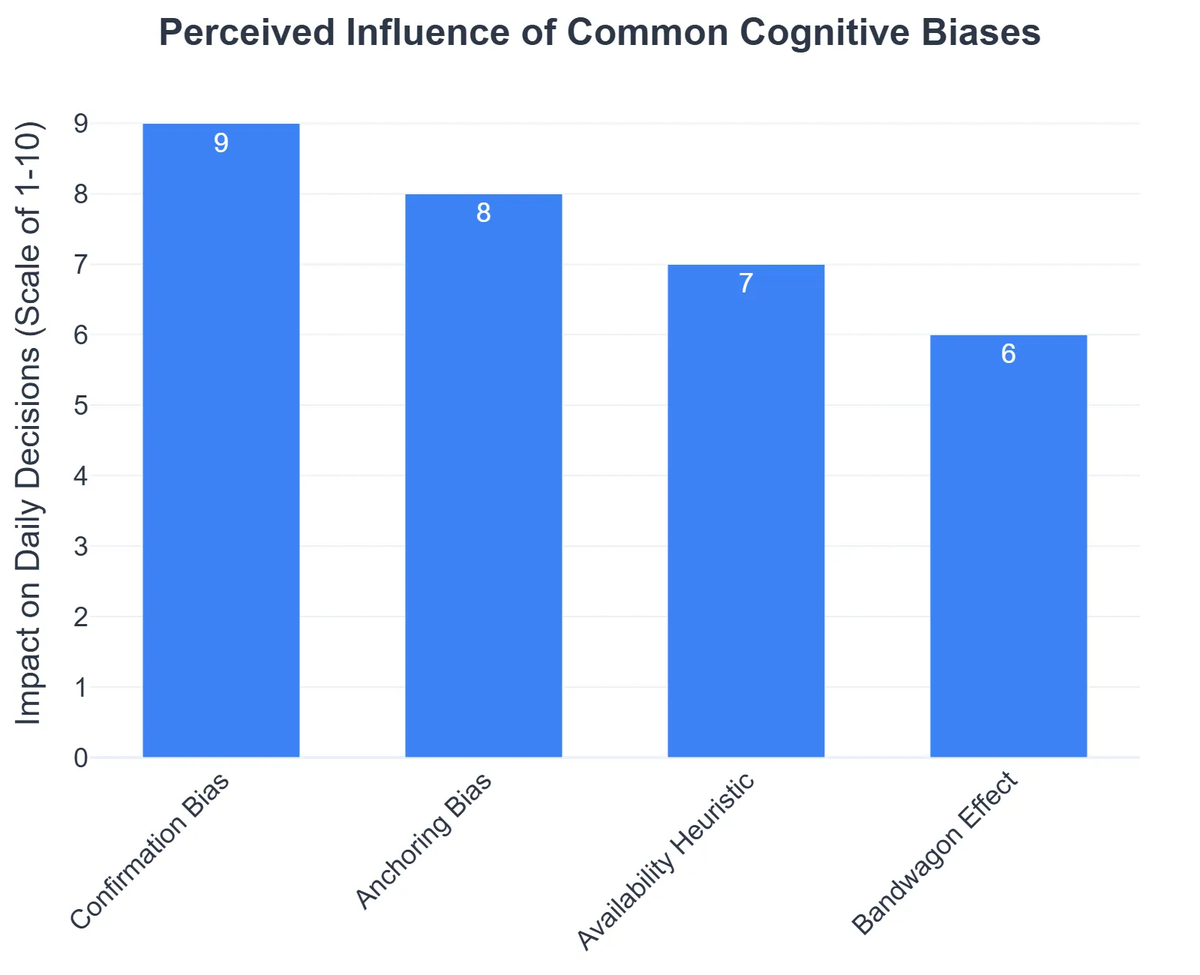
Let’s delve into some of the most common and impactful types of cognitive bias that shape our daily perceptions and decisions.
Confirmation Bias
Definition: The tendency to search for, interpret, favor, and recall information in a way that confirms one’s pre-existing beliefs or hypotheses. It makes us resistant to contradictory evidence.

- ➡️ Example: A person who believes a certain political ideology will primarily seek out news sources and social media that reinforce their views, dismissing or ignoring information that challenges them.
- 💡 Impact: Can lead to echo chambers, reinforce stereotypes, and hinder critical thinking.
Anchoring Bias
Definition: The tendency to rely too heavily on the first piece of information offered (the “anchor”) when making decisions, even if that information is irrelevant. Subsequent judgments are then adjusted around this anchor.
- ➡️ Example: A car salesman suggests a very high initial price for a car. Even if you negotiate it down significantly, the initial high price might make the final price seem more reasonable than it is.
- 💡 Impact: Influences negotiations, price perception, and quantitative estimations.
Availability Heuristic
Definition: The tendency to overestimate the likelihood of events that are more readily available in our memory, often because they are more vivid or recent. If something can be recalled, it must be important.
- ➡️ Example: After seeing news reports about plane crashes, you might believe air travel is more dangerous than car travel, even though statistics prove the opposite.
- 💡 Impact: Affects risk assessment, decision-making, and fear responses. This concept is closely tied to various different types of cognitive bias stemming from mental shortcuts.
Framing Effect
Definition: The tendency to react to a particular choice in different ways depending on how it is presented or “framed” – e.g., as a loss or as a gain.
Understanding Cognitive Biases: Benefits and Challenges
Pros
- ✔Enhances critical thinking and objective reasoning.
- ✔Improves personal and professional decision-making.
- ✔Fosters self-awareness and empathy for others’ perspectives.
- ✔Increases resilience against misinformation and manipulation.
Cons
- ✖Biases are deeply ingrained and challenging to fully eliminate.
- ✖Awareness alone doesn’t guarantee bias correction.
- ✖Can lead to overthinking or analysis paralysis.
- ✖Risk of ‘bias blind spot,’ believing oneself immune to biases.
- ➡️ Example: People are more likely to choose a surgical procedure if told it has a “90% survival rate” than if told it has a “10% mortality rate,” even though the outcomes are identical.
- 💡 Impact: Significantly influences marketing, public policy, medical decisions, and communication strategies. Our article on Framing Effect: How Presentation Shapes Decisions provides a deeper dive.
Fundamental Attribution Error
Definition: The tendency to explain other people’s behavior by overemphasizing dispositional or personality-based explanations while underemphasizing situational explanations. Conversely, when it comes to our own behavior, we tend to do the opposite.
- ➡️ Example: Seeing someone trip and fall, you might immediately think they are clumsy (dispositional), rather than considering the uneven pavement (situational). If you trip, you blame the pavement.
- 💡 Impact: Affects how we judge others, resolve conflicts, and understand social dynamics. Learn more in our guide to Fundamental Attribution Error: Understanding Cognitive Biases.
Sunk Cost Fallacy
Definition: The tendency to continue an endeavor or investment simply because one has already invested time, money, or effort into it, even when continuing is clearly not the best course of action.
- ➡️ Example: Continuing to pour money into a failing business or relationship because you’ve already invested so much, even when it’s clear it won’t succeed.
- 💡 Impact: Leads to irrational economic decisions, prolongs unproductive efforts, and prevents cutting losses.
For an extensive list of cognitive biases, you can consult Wikipedia’s List of Cognitive Biases, which catalogs many more subtle and pervasive distortions.

Why Understanding These Distortions Matters
Acknowledging the existence of different types of cognitive bias isn’t about blaming ourselves for irrationality; it’s about gaining self-awareness and improving our decision-making. These biases are part of the human condition, but their impact can be profound:
- ✅ Better Personal Decisions: From financial planning to career choices, recognizing biases helps us make more rational and effective decisions.
- ➡️ Improved Relationships: Understanding biases like the Fundamental Attribution Error can lead to greater empathy and less judgment of others.
- 💡 Enhanced Critical Thinking: Being aware of our own biases, and those of others, allows us to analyze information more objectively and challenge assumptions.
- ⚙️ Effective Problem Solving: By identifying how biases might skew our perception of a problem, we can devise more robust and unbiased solutions.
While eliminating biases entirely might be impossible, developing strategies to recognize and counteract their influence is a powerful step towards more logical and informed thought processes. It requires a commitment to metacognition – thinking about our thinking – and a willingness to challenge our own assumptions, even when it’s uncomfortable. For more on the distortions in our thinking, explore resources like Psychology Tools’ guide on Cognitive Distortions.

Recommended Video
What is cognitive bias?
Cognitive bias refers to systematic patterns of deviation from norm or rationality in judgment. They are mental shortcuts our brains use to make sense of the world, often leading to predictable errors in thinking.
How do cognitive biases affect daily life?
Cognitive biases impact decisions in all aspects of life, from personal choices and financial investments to professional judgments and social interactions. They can lead to poor decisions, misunderstandings, and reinforce existing beliefs.
Can cognitive biases be overcome?
While completely eliminating biases is challenging, increasing self-awareness, practicing critical thinking, seeking diverse perspectives, and employing ‘debiasing’ techniques can help mitigate their negative effects.
What is the most common cognitive bias?
While difficult to definitively name one ‘most common,’ confirmation bias (the tendency to seek out and interpret information that confirms existing beliefs) is widely recognized and highly pervasive in everyday thinking.