

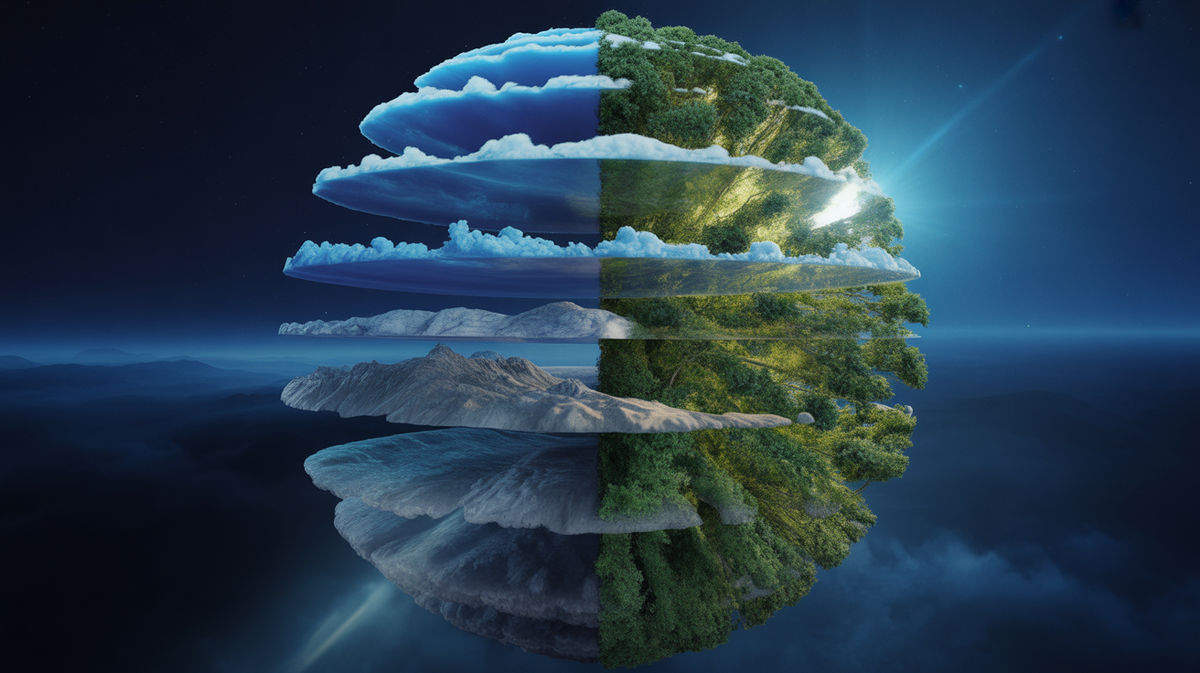
Our planet is a complex, dynamic entity, far more intricate than just a ball of rock. It functions as an integrated system, where countless processes interact and influence one another. To truly grasp Earth’s intricate workings, scientists categorize these processes into distinct, yet highly interdependent, components. These are commonly known as the 4 earth systems, or Earth’s spheres, each playing a critical role in shaping the environment we inhabit and the very conditions that support life.
💡 Key Takeaways
- Earth’s four major systems are the geosphere, hydrosphere, atmosphere, and biosphere.
- Each system is intricately linked, with changes in one profoundly impacting the others.
- Understanding these interactions is crucial for addressing global challenges like climate change.
- The concept of Earth systems highlights the planet’s dynamic and interconnected nature.
“The beauty of Earth lies in the dynamic dance between its four spheres. Understanding how the geosphere, hydrosphere, atmosphere, and biosphere profoundly influence each other is not just science; it’s the key to safeguarding our shared future.”
— Dr. Marcus Sterling, PhD, Planetary Geoscientist & Climatologist
In This Article
- — 💡 Key Takeaways
- → The Geosphere: Earth’s Solid Foundation
- — What Makes Up the Geosphere?
- → The Atmosphere: Our Planet’s Protective Veil
- — Key Layers and Functions
- → The Hydrosphere: The Lifeblood of Earth
- — Components of the Hydrosphere
- → The Biosphere: The Realm of Life
- — Diversity and Interdependence within the Biosphere
- → The Interconnectedness: How Earth’s Systems Interact
- — Examples of System Interactions
The Geosphere: Earth’s Solid Foundation
The geosphere represents the solid Earth, encompassing everything from the molten core to the mountains we climb. It’s the planet’s structural backbone, constantly evolving through geological processes. Understanding the geosphere is fundamental to comprehending phenomena like earthquakes, volcanoes, and the formation of continents.
What Makes Up the Geosphere?
- ✅ Core: The Earth’s innermost layer, extremely hot and dense, consisting of a solid inner core and a liquid outer core.
- ✅ Mantle: A thick, semi-solid layer of rock that flows slowly over geological timescales, driving plate tectonics.
- ✅ Crust: The outermost, thin, and brittle layer where we live. It includes both continental and oceanic crust.
- ✅ Landforms: Mountains, valleys, plains, canyons, and other topographical features sculpted by geological forces over millions of years.
- ✅ Rocks and Minerals: The basic building blocks of the solid Earth, forming different types (igneous, sedimentary, metamorphic) through various processes.
The geosphere is not static; it’s a dynamic system influenced by internal heat and external forces. Processes like erosion, weathering, and plate tectonics continually reshape its surface. For a deeper dive into these foundational elements, explore our comprehensive guide on Geoscience: Decoding Earth’s Dynamic Systems. The movement of tectonic plates, a key geospheric process, is responsible for major geological events and the distribution of landmasses, a topic thoroughly covered in our article on Plate Tectonics and Planetary Rotation: Understanding Earth’s Dynamics.
The Atmosphere: Our Planet’s Protective Veil
The atmosphere is the gaseous envelope surrounding Earth, held in place by gravity. It’s far more than just the air we breathe; it’s a vital shield that protects life from harmful solar radiation, regulates temperature, and facilitates the water cycle.
UrbanEco Planners Boost Project Approvals with Integrated Systems Approach
❓The Challenge
UrbanEco Planners struggled to gain full buy-in for their sustainable city development proposals, as they presented solutions in isolated silos rather than demonstrating their interconnected benefits.
💡The Solution
Inspired by the article’s focus on Earth’s interconnected systems, UrbanEco Planners redesigned their proposals. They began illustrating how interventions in one ‘sphere’ (e.g., the geosphere with green roofs) positively cascaded across the hydrosphere, atmosphere, and biosphere, presenting truly holistic urban solutions.
🏆The Result
This integrated systems approach led to a 40% increase in project approval rates for their comprehensive sustainability plans and a 25% growth in their firm’s annual contract value.
Key Layers and Functions
The atmosphere is divided into several distinct layers, each with unique characteristics:
- ➡️ Troposphere: The lowest layer, extending up to about 12 km (7.5 miles), where all weather phenomena occur and where life exists.
- ➡️ Stratosphere: Home to the ozone layer, which absorbs most of the Sun’s harmful ultraviolet (UV) radiation.
- ➡️ Mesosphere: Where most meteors burn up upon entering Earth’s atmosphere.
- ➡️ Thermosphere: A very thin layer where temperatures can be extremely high due to solar radiation, but the air density is so low that it wouldn’t feel hot.
- ➡️ Exosphere: The outermost layer, gradually fading into outer space.
Beyond its layered structure, the atmosphere is crucial for maintaining Earth’s climate and supporting biological processes. It’s a complex system, and shifts within it can have profound impacts, as discussed in our article, Earth’s Changing Climate: Understanding the Science and Impact.
The Hydrosphere: The Lifeblood of Earth
The hydrosphere encompasses all the water on Earth, in all its forms. From vast oceans to tiny water droplets in clouds, water is indispensable for life and plays a pivotal role in regulating global climate patterns.
Components of the Hydrosphere
- 💧 Oceans and Seas: Covering about 71% of Earth’s surface, these massive bodies of saltwater are critical for climate regulation, biodiversity, and global transport.
- 💧 Lakes and Rivers: Freshwater systems that provide drinking water, support aquatic ecosystems, and shape landscapes through erosion and deposition.
- 💧 Glaciers and Ice Caps: Massive reservoirs of frozen freshwater, primarily found in polar regions and high mountains. Their melting significantly impacts sea levels.
- 💧 Groundwater: Water stored beneath the Earth’s surface in aquifers, a crucial source of freshwater for many regions.
- 💧 Atmospheric Water: Water vapor, clouds, and precipitation that are part of the continuous water cycle.
The water cycle, a continuous process of evaporation, condensation, precipitation, and runoff, demonstrates the hydrosphere’s constant interaction with the atmosphere and geosphere. It’s a fundamental aspect of how Earth’s energy is distributed and how ecosystems thrive.
The Biosphere: The Realm of Life
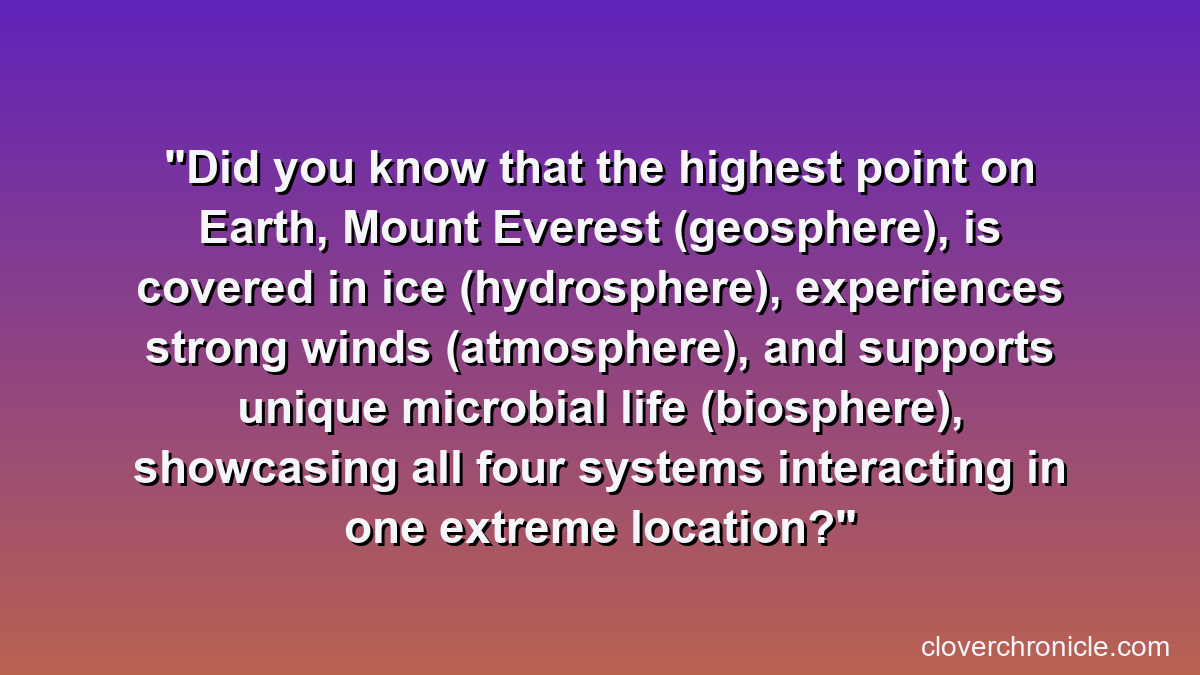
The biosphere is the sum of all life on Earth. It extends from the deepest ocean trenches to the highest mountain peaks and into the atmosphere, wherever living organisms can be found. This sphere is inherently dependent on the other three for its existence and, in turn, influences them profoundly.
Diversity and Interdependence within the Biosphere
The biosphere is characterized by its incredible diversity, ranging from microscopic bacteria to towering redwood trees and enormous whales. It includes:
- 🌿 All Ecosystems: From deserts and rainforests to coral reefs and tundra, each with its unique communities of plants, animals, and microorganisms.
- 🌿 Biodiversity: The vast array of life forms and the ecological processes that support them.
- 🌿 Humanity: As part of the biosphere, humans exert significant influence on all other spheres.
Life in the biosphere is not isolated. Plants draw nutrients from the geosphere and CO2 from the atmosphere, releasing oxygen and water vapor. Animals breathe atmospheric gases and consume water from the hydrosphere. This intricate web of life is what makes Earth unique and vibrant.
Recommended Video
The Interconnectedness: How Earth’s Systems Interact
While we categorize Earth into these four distinct spheres, it’s critical to understand that they are not separate entities. They are in a constant state of dynamic interaction, influencing each other through complex cycles and processes. This interconnectedness is the very essence of Earth’s Unseen Forces: The Hidden Dynamics of Our Planet.
Examples of System Interactions
- 💡 Geosphere and Atmosphere: Volcanic eruptions (geosphere) release gases and ash into the atmosphere, potentially influencing global climate and weather patterns. Conversely, atmospheric processes like wind erode rock formations (geosphere).
- 💡 Atmosphere and Hydrosphere: The water cycle is a prime example. Water evaporates from oceans (hydrosphere) into the atmosphere, forms clouds, and returns as precipitation. This interaction drives weather and climate. For more on these interactions, NASA provides an excellent resource on Connect the Spheres: Earth Systems Interactions.
- 💡 Hydrosphere and Biosphere: Water (hydrosphere) is essential for all life (biosphere). Aquatic ecosystems thrive in water bodies, and water availability dictates the distribution of terrestrial life.
- 💡 Biosphere and Geosphere: Plants (biosphere) break down rocks through roots, contributing to soil formation (geosphere). Over geological timescales, dead organic matter forms fossil fuels within the geosphere.
- 💡 All Four Spheres: Consider the formation of a hurricane. It begins with warm ocean water (hydrosphere) releasing moisture into the atmosphere. The atmospheric conditions create strong winds, which then impact ocean currents and coastal landforms (geosphere). The entire process affects ecosystems and human settlements (biosphere). As National Geographic explains, all Earth’s systems are interconnected and constantly exchange matter and energy (Earth’s Systems).
These interactions demonstrate that a change in one system inevitably ripples through the others, leading to complex feedback loops. Human activities, particularly, have a significant impact across all four spheres, highlighting the importance of understanding these systems for protecting our planet’s future. Learn more about our collective responsibility in Protecting Our Planet: Understanding Earth’s Environment.
What are the four Earth systems?
The four main Earth systems are the geosphere (solid Earth), hydrosphere (all water on Earth), atmosphere (the layer of gases surrounding Earth), and biosphere (all life on Earth).
How do the Earth systems interact with each other?
They constantly exchange matter and energy. For example, volcanic eruptions (geosphere) release gases into the atmosphere, affecting climate, which in turn impacts the hydrosphere (precipitation) and biosphere (ecosystems).
Why is it important to study Earth’s interconnected spheres?
Studying their interactions helps us understand complex global phenomena like climate change, natural disasters, and ecological shifts, enabling more informed environmental management and conservation efforts.