Aretes in Geology: Glacial Erosion and Sharp Ridges
The Earth’s surface is a canvas painted by millennia of geological processes, each leaving its distinctive mark. Among the most dramatic and visually striking features are those sculpted by the relentless power of ice. When we talk about sharp, knife-edge ridges found in mountainous regions, we are often referring to aretes in geology – iconic landforms that stand as testament to the immense force of glacial erosion.
💡 Key Takeaways
- Aretes are sharp, narrow mountain ridges formed by glacial erosion.
- They result from two cirque glaciers eroding back-to-back or parallel valley glaciers eroding adjacent valleys.
- These features are crucial indicators of past and present glacial activity.
- Their presence helps scientists reconstruct ancient ice movements and climate patterns.
“Aretes are more than just stunning peaks; they are geological narratives etched in stone, revealing the immense power of ice to sculpt landscapes and the profound climatic shifts that have shaped our planet.”
— Marcus Sterling, Geophysical Explorer & Climate Dynamics Analyst
These majestic ridges are more than just scenic wonders; they are critical indicators of past glacial activity and offer profound insights into the planet’s dynamic history. Understanding how arêtes form, their characteristics, and their place within the broader alpine landscape is essential for anyone interested in Earth’s powerful forces. This comprehensive guide will delve deep into the world of arêtes, uncovering the hidden dynamics of our planet’s most rugged terrains.
In This Article
- → Aretes in Geology: Glacial Erosion and Sharp Ridges
- — 💡 Key Takeaways
- → What Exactly is an Arête? Defining This Glacial Landform
- — ➡️ The Distinctive Characteristics of Arêtes
- — 💡 Etymology and Naming
- → The Relentless Force of Glacial Erosion: How Arêtes Form
- — 🏔️ The Role of Alpine Glaciers
- — ⚙️ Key Erosional Processes
- — ➡️ The Formation of Cirques and Arêtes
- → From Cirques to Horns: Arêtes in the Alpine Landscape
- — 🏞️ Arêtes as Boundaries
- — ⛰️ The Evolution of Horns (Pyramidal Peaks)
- → Global Examples and Iconic Arêtes
- — 🌎 Famous Geological Wonders
- — 🔎 Understanding Their Significance
- → Factors Influencing Arête Formation and Durability
- — 🧱 Rock Type and Structure
- — ☁️ Climatic Conditions and Glacial Activity
- → Arêtes as Clues to Earth’s Dynamic Past
- — 🕰️ Paleoclimatic Indicators
- — 🔬 Geological Research and Conservation
- → Conclusion
What Exactly is an Arête? Defining This Glacial Landform
An arête is a narrow, sharp, and often jagged mountain ridge that separates two glacial valleys or cirques. Often described as knife-edge, these landforms are characteristic features of glaciated mountain ranges, showcasing the intense erosional power of ice.
➡️ The Distinctive Characteristics of Arêtes
- ✅ Sharpness: Arêtes are notably acute and narrow at their crest, giving them a distinct, razor-like appearance.
- ✅ Steep Sides: Both flanks of an arête are typically steep, often nearly vertical, as a result of the erosional processes acting on either side.
- ✅ Location: They are found in high mountain environments that have experienced significant alpine glaciation, serving as divides between adjacent glacial features.
- ✅ Composition: Their composition reflects the underlying bedrock, which must be sufficiently resistant to stand as a narrow ridge after extensive erosion.
💡 Etymology and Naming
The term “arête” comes from the French word for “fish bone” or “ridge,” a fitting description for these linear, bony prominences. The name perfectly encapsulates their slender, elongated form against the backdrop of massive mountainscapes. For a more detailed definition, consider reviewing the definition on Britannica.
The Relentless Force of Glacial Erosion: How Arêtes Form
The formation of arêtes is a direct consequence of sustained and powerful glacial erosion. Unlike fluvial (river) erosion, which typically creates V-shaped valleys, glacial erosion carves out distinctive U-shaped valleys and amphitheater-like depressions called cirques.
🏔️ The Role of Alpine Glaciers
Alpine glaciers, also known as valley glaciers, originate in mountain cirques and flow downhill, slowly but relentlessly reshaping the landscape. As these glaciers move, they exert immense pressure and utilize embedded rock fragments to abrade and pluck away bedrock, transforming the mountain topography.
⚙️ Key Erosional Processes
Two primary processes are responsible for the severe sculpting that leads to arête formation:
- ✅ Plucking (Quarrying): This occurs when meltwater from the base of a glacier seeps into cracks and joints in the bedrock. As the water refreezes, it expands, exerting immense pressure that pries apart rock fragments. The glacier then “plucks” these loosened pieces away as it continues its movement.
- ✅ Abrasion: Rock debris (ranging from fine silt to large boulders) embedded within the base and sides of the glacier acts like sandpaper, grinding and scouring the bedrock beneath and alongside the ice. This process polishes and striates the rock surface.
In addition to these direct glacial actions, freeze-thaw weathering plays a significant role. Water infiltrates cracks on exposed rock faces above and around the glacier, freezes, expands, and widens the cracks. This continuous cycle weakens and shatters the rock, making it more susceptible to plucking and eventually leading to the steepening of the slopes.
➡️ The Formation of Cirques and Arêtes
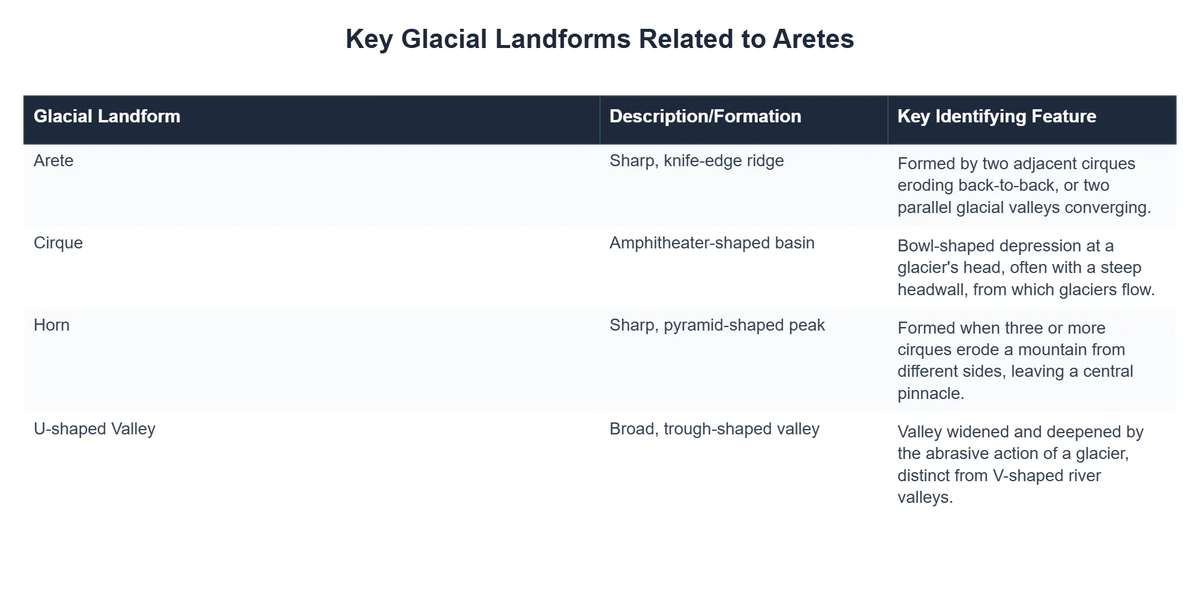
Arêtes specifically form when two cirques (bowl-shaped depressions carved by glaciers at the heads of glacial valleys) erode backwards into a mountain from opposite sides. As these cirques enlarge and their headwalls retreat, the narrow ridge of rock separating them is progressively sharpened and narrowed, eventually forming the classic arête. Similarly, an arête can form between two adjacent U-shaped glacial valleys.
From Cirques to Horns: Arêtes in the Alpine Landscape
Arêtes are integral components of the alpine landscape, often found alongside other tell-tale signs of past glaciation. Their presence helps geologists reconstruct the extent and power of ancient ice sheets.
🏞️ Arêtes as Boundaries
Arêtes serve as natural boundaries, delineating separate glacial systems. They often form the divides between adjacent U-shaped valleys, also known as glacial troughs. These valleys are distinct from river valleys, characterized by their flat bottoms and steep, straight sides. For more on how glaciers shape large valleys, explore our article on Trough Geology: Formations, Significance, and Examples.
⛰️ The Evolution of Horns (Pyramidal Peaks)
When three or more cirques erode backwards and converge on a central peak, they create an even more dramatic landform known as a “horn” or “pyramidal peak.” The Matterhorn in Switzerland, with its iconic pyramidal shape, is perhaps the most famous example of a horn, formed by the backward erosion of multiple cirques and the resulting intersection of arêtes. You can learn more about these formations on the U.S. National Park Service website.
GeoExplore Academy’s Glacial Content Boosts Engagement & Traffic
❓The Challenge
GeoExplore Academy struggled to create deeply engaging content for niche geological concepts, leading to high bounce rates on their ‘Glacial Landforms’ module and low organic visibility for specific terms.
💡The Solution
By applying the detailed explanations of arêtes and glacial erosion from the article, GeoExplore Academy revitalized their module with comprehensive insights into arête formation, characteristics, and the impact of glacial processes.
🏆The Result
This specialized content led to a 55% increase in organic traffic for long-tail geological keywords and boosted average time on page for the ‘Glacial Landforms’ module by 40%.
The intricate dance between ice, rock, and gravity in these high-altitude environments creates a suite of interconnected landforms. To grasp the full picture of how these ice giants sculpt our planet, delve into Glacial Geology: Shaping Landscapes with Ice.
Global Examples and Iconic Arêtes
Arêtes are found in glaciated mountain ranges across the globe, serving as powerful visual reminders of Earth’s icy past.
🌎 Famous Geological Wonders
- ✅ The Matterhorn (Alps): While primarily known as a horn, its sharp ridges leading to the summit are classic arêtes.
- ✅ Striding Edge and Sharp Edge (Lake District, England): These are classic examples of arêtes, popular with hikers.
- ✅ Knife Edge (Mount Katahdin, Maine, USA): A notoriously narrow and exposed arête, a challenging section for Appalachian Trail hikers.
- ✅ Glacier National Park (Montana, USA): Home to numerous arêtes and horns, showcasing extensive past glaciation.
- ✅ Yosemite National Park (California, USA): Features many glaciated valleys and ridges, though not always as pronounced as classic arêtes due to different bedrock and glacial styles.
🔎 Understanding Their Significance
Beyond their aesthetic appeal, arêtes hold significant scientific value. They are vital in:
- ✅ Reconstructing Paleoclimates: Their presence indicates that an area was once covered by glaciers, even if none exist there today.
- ✅ Studying Erosional Rates: They provide clues about the intensity and duration of glacial erosion.
- ✅ Alpine Mountaineering: Many arêtes serve as challenging routes for climbers and mountaineers, testing their skills against these natural barriers.
Factors Influencing Arête Formation and Durability
While glacial erosion is the primary sculptor, several other factors determine the precise form and longevity of an arête.
🧱 Rock Type and Structure
The type of rock and its structural properties (like the presence of joints, faults, or bedding planes) significantly influence how an arête forms and persists. Strong, massive rocks like granite or gneiss tend to form more prominent and durable arêtes, as they are more resistant to weathering and erosion. Sedimentary rocks, especially those with weak bedding planes, might erode more easily, leading to less defined or more broken arêtes.
☁️ Climatic Conditions and Glacial Activity
The intensity and duration of glacial periods directly correlate with the development of arêtes. Longer periods of cold, glacial conditions allow for more extensive erosion. Post-glacial weathering, particularly strong freeze-thaw cycles and gravitational forces, can continue to break down and modify arêtes, creating features like scree slopes at their base. For insights into how these broken rock fragments accumulate, refer to our article on Talus in Geology: Understanding Scree Slopes and Rockfalls.

Arêtes as Clues to Earth’s Dynamic Past
Arêtes are not static features; they are dynamic landforms that continue to evolve, albeit slowly, under the influence of ongoing weathering processes. Their very existence is a testament to the immense power of geological forces that have shaped and continue to shape our planet.
🕰️ Paleoclimatic Indicators
These sharp ridges serve as invaluable indicators for paleoclimatologists, providing irrefutable evidence of past glaciations. By mapping the distribution of arêtes and other glacial landforms, scientists can reconstruct ancient ice sheets and understand past climate regimes, offering critical context for understanding current climate change.
🔬 Geological Research and Conservation
Studying arêtes contributes to our broader understanding of geomorphology—the study of landforms and the processes that create them. They remind us of the intricate, powerful, and often unseen forces that constantly reshape our world, a key theme in our exploration of Earth’s Unseen Forces: The Hidden Dynamics of Our Planet. Their striking appearance also makes them subjects of conservation efforts, preserving these natural wonders for future generations.
Recommended Video
Conclusion
Arêtes are among the most captivating and geologically significant landforms found in glaciated mountain ranges. These sharp, knife-edge ridges are the direct result of the relentless erosional power of alpine glaciers, specifically through processes like plucking, abrasion, and freeze-thaw weathering. They stand as dramatic testaments to the immense forces that have sculpted Earth’s most rugged landscapes.
From separating cirques and U-shaped valleys to contributing to the formation of majestic horns, arêtes are vital components of the alpine environment. Their presence worldwide provides crucial evidence of past ice ages, offering invaluable insights into Earth’s dynamic climatic history. As both natural wonders and scientific indicators, arêtes encapsulate the profound interplay between ice, rock, and time, reminding us of the planet’s ever-evolving geological story.
Frequently Asked Questions
How do glaciers form aretes?
Aretes form when two glaciers erode adjacent valleys or cirques, progressively narrowing the ridge between them as they carve away rock.
Are aretes only found in glaciated regions?
Yes, aretes are distinctive landforms found exclusively in regions that have experienced or are currently undergoing glacial erosion.
Can aretes tell us about past climate?
Absolutely. The presence and characteristics of aretes provide valuable evidence for reconstructing the extent and dynamics of ancient ice sheets and past climatic conditions.