


The universe, in its grand complexity, is governed by a set of fundamental rules. At the heart of our understanding of these rules, particularly concerning how particles interact, lies a profound theoretical framework known as Yang-Mills Theory. This elegant theory is a cornerstone of modern particle physics, providing the mathematical language to describe three of the four known fundamental forces of the universe: the strong, weak, and electromagnetic forces.
💡 Key Takeaways
- Yang-Mills theory is a foundational principle in modern physics, describing how fundamental forces like the strong and weak nuclear forces operate.
- It underpins the Standard Model of Particle Physics, providing the mathematical framework for understanding elementary particles and their interactions.
- The theory predicts the existence of force-carrying particles (gauge bosons), such as gluons for the strong force and W/Z bosons for the weak force.
- Despite its success, Yang-Mills theory faces challenges like the ‘mass gap problem,’ a major unsolved puzzle in theoretical physics.
“Yang-Mills theory is more than just equations; it’s a profound lens through which we glimpse the universe’s most intimate workings. It reveals an elegant symmetry underpinning the very forces that shaped stars and galaxies.”
— Astrid Bellweather, Astrophysicist & Science Communicator
In This Article
What is Yang-Mills Theory?
Yang-Mills theory is a type of gauge theory that describes the behavior of fundamental particles and their interactions through force-carrying particles called bosons. Developed in 1954 by Chen-Ning Yang and Robert Mills, it extended the principles of quantum electrodynamics (QED) – which successfully describes the electromagnetic force – to encompass other forces. Its revolutionary aspect was introducing non-Abelian gauge groups, allowing for more complex symmetries and interactions than QED’s simpler U(1) symmetry.
In essence, Yang-Mills theory provides a general framework for understanding how forces arise from the requirement that the laws of physics remain unchanged under certain “local” transformations. This concept of local symmetry is incredibly powerful, dictating the very existence of the force-carrying particles.
- ✅ Foundation: It’s a key component of the Standard Model of particle physics.
- ➡️ Gauge Fields: It posits the existence of “gauge fields” that mediate interactions.
- 💡 Generalization: It generalizes the well-understood electromagnetic force to strong and weak nuclear forces.
💡 The Role of Gauge Symmetry in Yang-Mills
At the core of Yang-Mills theory is the principle of gauge symmetry. Imagine a quantum field where the properties of particles can be “rotated” at every point in space and time without changing the observable physics. Yang-Mills theory postulates that if such a local symmetry exists, then there must be corresponding force-carrying particles (gauge bosons) that mediate interactions to compensate for these local transformations.
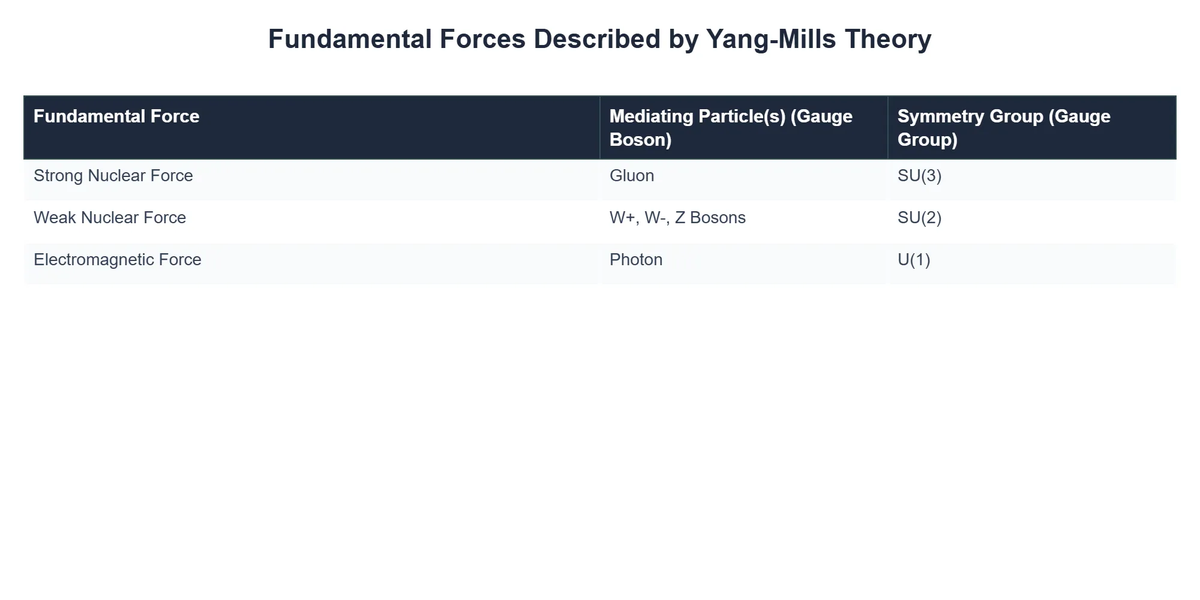
For example, in the case of the strong nuclear force, the theory involves a symmetry group called SU(3). This leads to the prediction of eight types of gluon particles, which mediate the strong force between quarks. Similarly, for the electroweak force, the symmetry group SU(2)xU(1) predicts the W+, W-, Z0, and photon particles. This intricate interplay between symmetry and fundamental forces is a hallmark of Yang-Mills theory. To learn more about the building blocks of matter, consider reading our article on Unveiling Quarks: Fundamental Particles.
- ✅ Local Transformations: Physical laws must be invariant under changes that vary from point to point.
- ➡️ Force Carriers: This invariance necessitates the existence of gauge bosons (e.g., photons, gluons, W and Z bosons).
- 💡 Mathematical Elegance: The theory derives fundamental forces from abstract symmetry principles.
Yang-Mills and the Standard Model of Particle Physics
The profound impact of Yang-Mills theory is most evident in its role as the mathematical backbone of the Standard Model of particle physics. The Standard Model successfully describes three of the four fundamental forces: the electromagnetic, weak, and strong nuclear forces, and classifies all known elementary particles.
Yang-Mills Theory: Strengths and Challenges
Pros
- ✔Provides the fundamental mathematical framework for strong, weak, and electromagnetic forces.
- ✔Forms the cornerstone of the Standard Model of Particle Physics.
- ✔Led to successful predictions of elementary particles and their interactions.
- ✔Exhibits mathematical elegance and consistency, enabling deep insights.
Cons
- ✖The color confinement and mass gap problems lack rigorous mathematical proof.
- ✖Calculations at strong coupling (low energies) are exceptionally complex and challenging.
- ✖Does not inherently incorporate gravity, preventing a full unification of all forces.
- ✖Requires external mechanisms (e.g., Higgs field) to explain particle masses.
Here’s how Yang-Mills theory applies to each:
- Quantum Electrodynamics (QED): This describes the electromagnetic force, mediated by photons. It’s an Abelian U(1) gauge theory, and while it predates the full Yang-Mills framework, it serves as the simplest example of a gauge theory.
- Quantum Chromodynamics (QCD): This is the theory of the strong nuclear force, which binds quarks together to form protons and neutrons, and holds atomic nuclei together. QCD is a non-Abelian SU(3) Yang-Mills theory, with gluons as its gauge bosons. The “color charge” of quarks is the symmetry that gluons mediate. For a deeper dive into the framework that underpins particle interactions, our resource on Understanding QFT Physics: Quantum Field Theory is highly recommended.
- Electroweak Theory: This unifies the electromagnetic and weak nuclear forces. It’s a non-Abelian SU(2)xU(1) Yang-Mills theory, involving W+, W-, Z0, and photon bosons. The spontaneous breaking of this symmetry, via the Higgs mechanism, gives mass to the W and Z bosons and other fundamental particles.
The predictive power of the Standard Model, built upon Yang-Mills principles, has been validated by countless experiments, including the discovery of the Higgs boson, which further cemented its status as our most successful theory of elementary particles. For more on the fundamental nature of reality, explore Quantum Laws of Physics: Unraveling Reality’s Rules.
According to Number Analytics, “Yang-Mills theory is a mathematical framework that helps us understand how particles interact through these fundamental forces.” You can learn more about its explanatory power by reading Yang-Mills Theory Explained.
Unanswered Questions & Future Directions
Despite its incredible success, Yang-Mills theory, as integrated into the Standard Model, does not provide a complete picture of the universe. There are significant mysteries that remain:
- ✅ Gravity: The Standard Model does not incorporate gravity, the fourth fundamental force. Unifying gravity with the other forces is a major goal of theoretical physics, often pursued through theories like String Theory or Quantum Gravity.
- ➡️ Dark Matter and Dark Energy: The Standard Model cannot explain the existence of dark matter and dark energy, which constitute the vast majority of the universe’s mass and energy.
- 💡 Masses of Neutrinos: The Standard Model initially predicted neutrinos to be massless, but experiments have shown they have a tiny, non-zero mass.
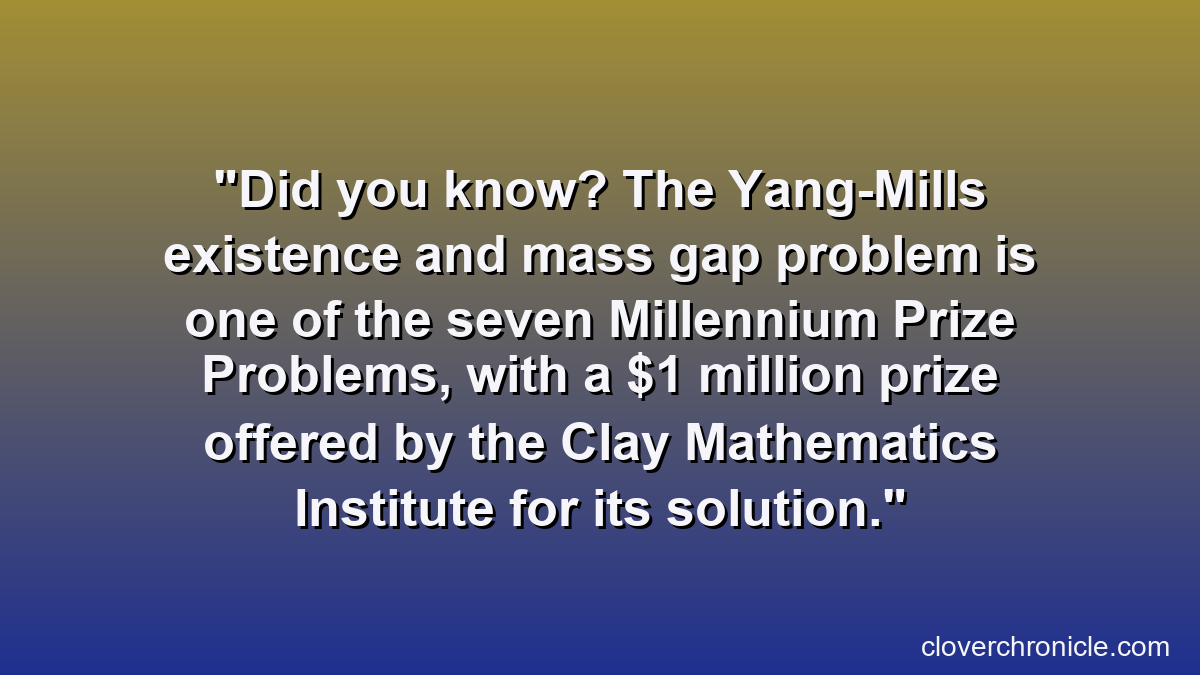
- ➡️ The Yang-Mills Existence and Mass Gap Problem: One of the Millennium Prize Problems in mathematics, this asks for a rigorous mathematical proof that Yang-Mills theory has a “mass gap” – meaning that quantum gluons are confined and form massive particles, rather than being massless like photons. Solving this would provide deep insights into the strong force. For deeper insights into theoretical physics, consider this Journey through Gauge Theories: From Foundations to New Frontiers.
Future research in particle physics, whether at large hadron colliders or through theoretical advancements, continues to build upon and seek extensions to the Yang-Mills framework. The pursuit of a “Grand Unified Theory” (GUT) or a “Theory of Everything” (TOE) often involves extending the symmetries described by Yang-Mills theory to encompass new particles and forces, aiming to explain all interactions from a single, overarching principle.
Recommended Video
The quest to understand the universe’s fundamental forces and particles is an ongoing journey. Yang-Mills theory provides an unparalleled lens through which we probe these mysteries, pushing the boundaries of human knowledge. For a broader exploration of the universe’s grandest questions, dive into Cosmic Queries: Probing the Mysteries of the Universe.
What is Yang-Mills theory?
Yang-Mills theory is a type of gauge theory fundamental to quantum field theory, describing the behavior of elementary particles and their interactions via fundamental forces.
How does Yang-Mills theory relate to the Standard Model?
It forms the mathematical backbone of the Standard Model, explaining the strong, weak, and electromagnetic forces and the particles that mediate them (gauge bosons).
What are some key predictions of Yang-Mills theory?
It predicts the existence of force-carrying particles like gluons (for the strong force) and W/Z bosons (for the weak force), and explains their interactions.
What is the ‘mass gap’ problem in Yang-Mills theory?
The mass gap problem is an unsolved mathematical problem that seeks to prove that elementary particles, according to Yang-Mills theory, have a non-zero mass even in quantum theories. It’s one of the Millennium Prize Problems.