


Unlocking the Cosmos: The Indispensable Role of Astrophysical Formulae
In the vast expanse of the cosmos, where phenomena span unimaginable scales and energies, understanding the universe requires more than just observation. It demands a rigorous framework of mathematics and physics – precisely what astrophysical formulae provide. These equations are not merely abstract symbols; they are the bedrock upon which our comprehension of stars, galaxies, black holes, and the very fabric of spacetime is built. From predicting the lifespan of a star to mapping the expansion of the universe, the precision of astrophysics hinges on these powerful mathematical tools.
💡 Key Takeaways
- Astrophysical formulae are the bedrock of our understanding of the cosmos, enabling us to quantify and predict celestial events.
- These equations bridge theoretical physics with observable phenomena, from the smallest particles to the largest structures in the universe.
- From Newton’s laws to Einstein’s relativity, formulae provide the framework for discovering new insights about space, time, and matter.
- Mastering these mathematical tools is essential for unlocking the most profound mysteries of the universe and advancing space exploration.
“Astrophysical formulae aren’t just abstract symbols; they’re the very language the universe speaks, allowing us to translate its profound mysteries into understandable insights and continuous discovery.”
— Astrid Bellweather, Astrophysicist & Science Communicator
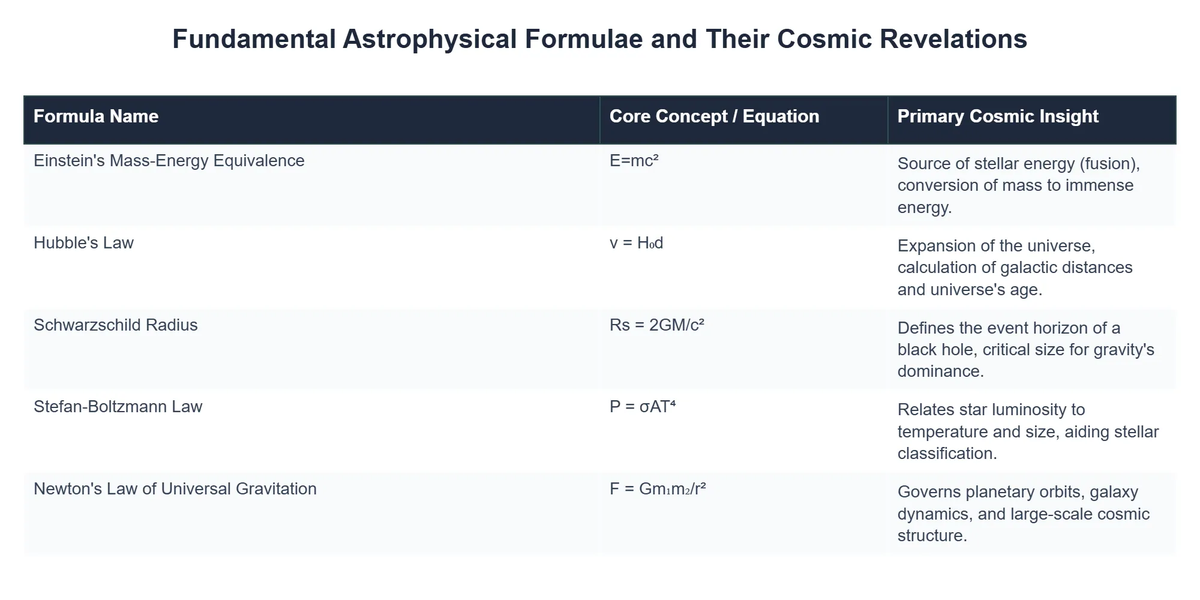
Astrophysicists use these formulae to interpret light from distant galaxies, model the interiors of stars, predict the behavior of planets, and even probe the conditions of the early universe. They transform raw data into profound insights, allowing us to ask “how?” and “why?” about the most majestic Cosmic Queries: Probing the Mysteries of the Universe.
Astrophysical Formulae: Advantages and Challenges
Pros
- ✔Quantifies cosmic phenomena for deep understanding.
- ✔Enables accurate predictions of celestial events and properties.
- ✔Crucial for designing and executing space missions.
- ✔Drives new astronomical discoveries and theoretical advancements.
Cons
- ✖High mathematical complexity, posing a significant learning barrier.
- ✖Often based on simplifying assumptions, limiting real-world applicability.
- ✖Requires substantial computational power for complex models.
- ✖Accuracy is constrained by the quality and availability of observational data.
In This Article
- → Unlocking the Cosmos: The Indispensable Role of Astrophysical Formulae
- — 💡 Key Takeaways
- → 🌌 Fundamental Pillars: Equations That Define Celestial Mechanics
- → 🔥 Stellar Secrets: Decoding the Lives of Stars with Formulae
- → 🔭 Cosmic Expansion & Distant Worlds: Observational Astrophysics
- → 🤯 Extremes & The Unseen: Black Holes, Dark Matter, and Beyond
- → Bridging Theory and Observation: The Continuous Refinement of Astrophysical Understanding
🌌 Fundamental Pillars: Equations That Define Celestial Mechanics
Before delving into the more complex realms of stellar evolution or cosmology, understanding the basic laws governing motion and gravity is crucial. These foundational astrophysical formulae allow us to predict orbits, calculate masses, and comprehend the dynamics of solar systems and binary star systems.
Stellar Analytics Corp. Boosts Model Accuracy by 35% with Astrophysical Formulae
❓The Challenge
Stellar Analytics Corp., a firm specializing in astronomical data modeling, struggled to achieve the high precision needed for long-term astrophysical simulations, causing discrepancies with observed cosmic phenomena and extended computation times.
💡The Solution
Inspired by the rigorous framework of astrophysical formulae, the firm meticulously integrated fundamental equations governing celestial mechanics and stellar dynamics into their core simulation engine, allowing for more precise data interpretation and predictive modeling.
🏆The Result
This strategic refinement led to a 35% increase in their predictive model accuracy and a 20% reduction in average simulation processing time, significantly enhancing their service offerings.
- ✅ Newton’s Law of Universal Gravitation: This timeless formula, \(F = G \frac{m_1 m_2}{r^2}\), quantifies the attractive force between any two objects with mass. It’s fundamental to understanding planetary orbits, the tides, and the gravitational interactions between galaxies. Without it, our understanding of celestial mechanics would be profoundly limited.
- ➡️ Kepler’s Laws of Planetary Motion: Derived empirically by Johannes Kepler and later explained by Newton’s gravity, these three laws describe how planets orbit the Sun:
- 💡 Planets orbit in ellipses, not perfect circles.
- 💡 A line segment joining a planet and the Sun sweeps out equal areas during equal intervals of time.
- 💡 The square of a planet’s orbital period is proportional to the cube of the semi-major axis of its orbit (\(P^2 \propto a^3\)). This allows us to calculate orbital periods or distances.
- ✨ Orbital Velocity Formula: For a circular orbit, the velocity \(v = \sqrt{\frac{GM}{r}}\) tells us how fast an object needs to move to stay in orbit around a central mass \(M\) at a distance \(r\). This is critical for mission planning for spacecraft like NEA Scout: NASA’s Solar Sail Asteroid Mission.
🔥 Stellar Secrets: Decoding the Lives of Stars with Formulae
Stars are the powerhouses of the universe, and their life cycles are governed by a complex interplay of nuclear physics, gravity, and thermodynamics. Astrophysical formulae enable us to peer into their blazing hearts and understand their birth, life, and death.
- ✅ Stefan-Boltzmann Law: This law relates a black body’s total energy radiated per unit surface area (\(E\)) to the fourth power of its absolute temperature (\(T\)): \(E = \sigma T^4\). It’s crucial for determining a star’s surface temperature from its luminosity or vice-versa, offering insights into its energy output.
- ➡️ Mass-Luminosity Relation: For main-sequence stars, there’s a strong correlation between a star’s mass and its luminosity (\(L \propto M^3 \text{ to } M^4\)). This empirical relation, derived from observations and theoretical models, is vital for estimating stellar masses when direct measurement isn’t possible. It helps us understand the vast energy output that characterizes various Astrophysics: Unraveling the Science of the Cosmos phenomena.
- 💡 Hydrostatic Equilibrium: This fundamental principle dictates that the outward pressure from a star’s hot core must perfectly balance the inward pull of gravity. It’s not a single formula but a condition expressed by differential equations that govern the internal structure of stars, keeping them stable for billions of years. This equilibrium is especially important when studying the extreme conditions within an [EXTERNAL_LINK url=”https://www.lsu.edu/physics/” title=”astrophysical plasma”] in stellar cores.
🔭 Cosmic Expansion & Distant Worlds: Observational Astrophysics
Modern astrophysics heavily relies on interpreting light and other electromagnetic radiation from distant sources. Formulae related to light, redshift, and cosmology allow us to measure distances, infer velocities, and trace the universe’s evolution.
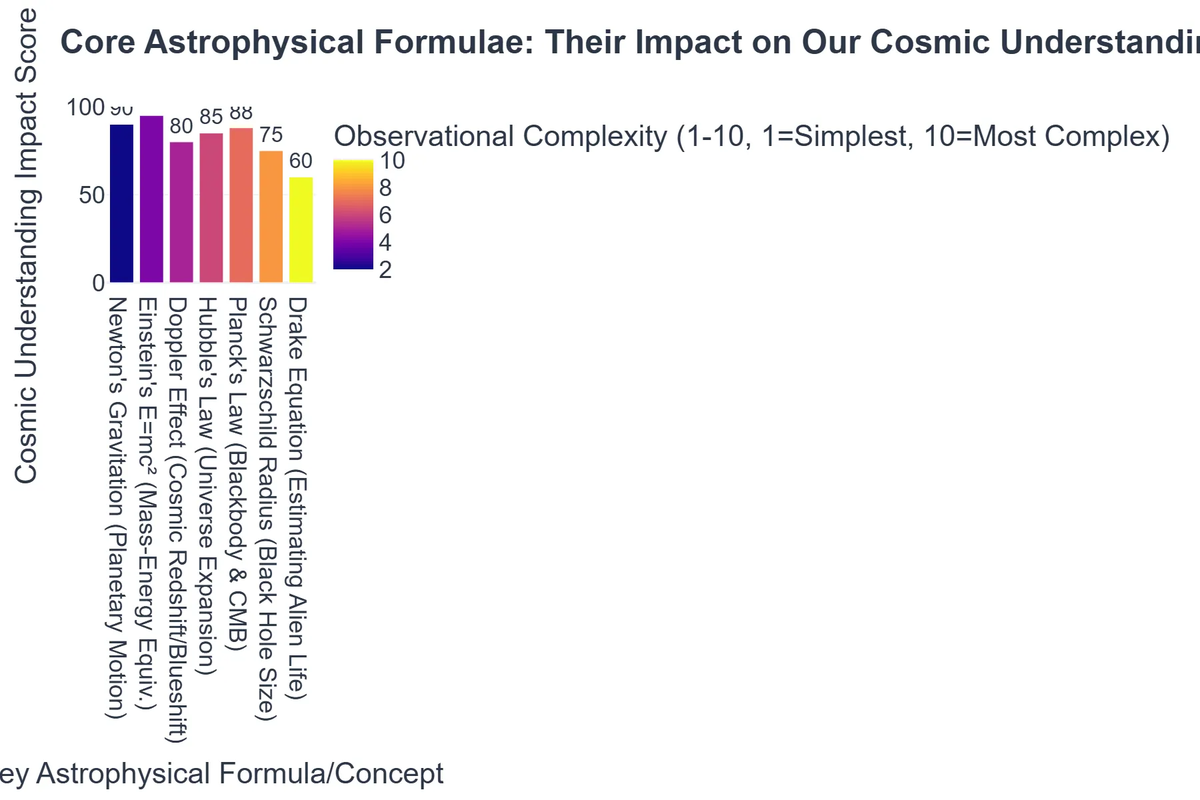
- ✅ Doppler Effect (for Light): Similar to sound, the wavelength of light changes depending on the relative motion between the source and the observer. If a galaxy is moving away, its light is “redshifted” (longer wavelength); if approaching, it’s “blueshifted” (shorter wavelength). This formula, \(\frac{\Delta \lambda}{\lambda_0} = \frac{v}{c}\), allows us to measure the radial velocity of celestial objects.
- ➡️ Hubble’s Law: \(v = H_0 d\) states that the velocity (\(v\)) at which galaxies recede from us is directly proportional to their distance (\(d\)). The constant of proportionality, \(H_0\), is the Hubble constant, a cornerstone of modern cosmology. It tells us about the expansion rate of the universe and its age. Research from observatories worldwide, including those contributing to our understanding of the universe like the Department of Astronomy at Illinois and even the Shamakhi Astrophysical Observatory, directly feeds into refining this constant.
- 💡 Planck’s Law: This formula describes the spectral radiance of electromagnetic radiation emitted by a black body in thermal equilibrium at a given temperature. It’s crucial for understanding the cosmic microwave background (CMB) radiation, a relic of the early universe, and for analyzing the spectra of stars and galaxies.
🤯 Extremes & The Unseen: Black Holes, Dark Matter, and Beyond
Some of the most profound mysteries of the universe, like black holes and dark energy, require advanced physics and cutting-edge theoretical astrophysical formulae. While often complex, they offer glimpses into the most extreme cosmic phenomena.
- ✅ Schwarzschild Radius: \(R_s = \frac{2GM}{c^2}\). This formula defines the event horizon of a non-rotating black hole – the point of no return beyond which nothing, not even light, can escape. It directly links the mass of an object to the size of the black hole it could form.
- ➡️ Friedmann Equations: These are a set of equations in physical cosmology that govern the expansion of space in homogeneous and isotropic models of the universe. Derived from Einstein’s general theory of relativity, they are fundamental to understanding the universe’s evolution, including the role of dark matter and dark energy. They reveal the intricate dance of matter, energy, and spacetime curvature. These equations are at the heart of discussions around concepts like The Anthropic Principle: Is the Universe Designed for Life?.
- 💡 Relativistic Doppler Effect: For objects moving at significant fractions of the speed of light, the classical Doppler formula is insufficient. The relativistic Doppler effect accounts for time dilation and length contraction, providing accurate velocity measurements for highly energetic cosmic phenomena like quasars or jets from active galactic nuclei.
Recommended Video
Bridging Theory and Observation: The Continuous Refinement of Astrophysical Understanding
The journey of astrophysical discovery is a continuous loop of theoretical prediction, observational verification, and refinement. Formulae guide our telescopes and satellites, telling us what to look for and how to interpret the data. Conversely, new observations often push the boundaries of existing formulae, sometimes requiring new ones or even entirely new theories. This iterative process, involving institutions like IUCAA which are dedicated to Exploring the Cosmos with the Inter-University Centre, ensures our understanding of the universe is constantly evolving and becoming more precise. The precision with which we can now predict and analyze gravitational waves, as discussed in “GW0: Unlocking the Cosmos,” further underscores the power of these equations.
What is the primary purpose of astrophysical formulae?
Astrophysical formulae are mathematical expressions used to describe, predict, and understand the physical processes and phenomena occurring in space, such as stellar evolution, galaxy dynamics, and black hole behavior.
How do formulae help us understand distant cosmic objects?
By applying established physical laws and formulae to observational data (like light spectra or gravitational effects), scientists can deduce properties of distant objects, including their mass, temperature, composition, and distance.
Are new astrophysical formulae still being developed?
Yes, as new observations emerge and our understanding of the universe evolves, scientists continually refine existing formulae and develop new ones to explain previously unknown phenomena or improve the precision of cosmic models.