Humanity’s enduring fascination with Mars is matched only by the monumental engineering challenge of reaching it. For decades, the National Aeronautics and Space Administration (NASA) has been at the forefront of this ambitious endeavor, relying on some of the most powerful and sophisticated launch vehicles ever conceived. These incredible machines, often referred to as a NASA Mars Rocket, are not merely transportation; they are the very foundation upon which our dreams of exploring the Red Planet are built.
💡 Key Takeaways
- NASA’s Mars rockets are vital for launching probes, rovers, and future human missions.
- Current rockets like Atlas V and SLS provide the necessary thrust for interplanetary trajectories.
- Future advancements focus on more powerful, reusable, and efficient propulsion systems for Mars.
- Each Mars mission relies on specialized rocket stages tailored for launch, transit, and entry.
“Mars rockets aren’t just about raw power; they are intricate ballet performances of physics, enabling our dreams to touch another world. They’re the real-life starships we’ve always imagined.”
— Astrid Bellweather, Astrophysicist & Science Fiction Consultant
From delivering robotic rovers to paving the way for future human expeditions, understanding the technology behind these rockets is crucial to appreciating the immense scale of Mars exploration. This comprehensive guide will delve into the past, present, and future of NASA’s efforts to power missions to Mars, exploring the engineering marvels that make interplanetary travel possible.
In This Article
- — 💡 Key Takeaways
- → The Indispensable Role of Rockets in Mars Exploration
- — Why Powerful Rockets Are Essential
- — Overcoming the Challenges of Interplanetary Travel
- → Evolution of NASA’s Mars Rocket Technology
- — Early Martian Pioneers and Their Launch Vehicles
- — The Modern Era: Atlas V, Delta IV Heavy, and Beyond
- — The SLS: Humanity’s Deep Space Workhorse
- → Understanding NASA Rocket Speed and Propulsion Systems
- — Chemical Propulsion: The Workhorse
- — Advanced Propulsion Concepts for Future Missions
- — How Fast Do We Go? Calculating the Interplanetary Journey
- → Key Components of a Mars-Bound Rocket System
- — Launch Vehicle Stages
- — Payload Fairings and Spacecraft Integration
- → The Journey to Mars: Mission Profiles and Trajectories
- — Launch Windows and Orbital Mechanics
- — Cruise Phase and Deep Space Maneuvers
- — Martian Entry, Descent, and Landing (EDL)
- → Future of NASA Mars Rockets: Enabling Human Exploration
- — The Artemis Program and Gateway as Stepping Stones
- — Developing Next-Generation Propulsion for Crewed Missions
- — The Vision for Sustainable Martian Presence
- → Conclusion: Blazing Trails to the Red Planet
The Indispensable Role of Rockets in Mars Exploration
Reaching Mars isn’t just about distance; it’s about escaping Earth’s immense gravitational pull and traversing the vast emptiness of space with precision. Rockets provide the necessary thrust to achieve these feats.
Why Powerful Rockets Are Essential
- ✅ Escape Velocity: To leave Earth’s orbit and embark on an interplanetary trajectory, a spacecraft must achieve escape velocity – approximately 11.2 kilometers per second (about 25,000 mph). This requires an immense amount of energy provided by multi-stage rockets.
- ➡️ Heavy Payloads: Mars missions often involve sending large, complex scientific instruments, rovers, and future human habitats. Powerful rockets are needed to lift these substantial payloads into space.
- 💡 Precision Trajectory: Even a slight error in launch velocity or direction can cause a spacecraft to miss Mars entirely. Rockets provide the control and power for extremely precise orbital insertions and trans-Mars injections.
Overcoming the Challenges of Interplanetary Travel
Beyond the initial launch, the journey to Mars presents unique hurdles that rocket systems must address:
- 🚀 Long Duration: The cruise phase to Mars can last anywhere from six to nine months. The propulsion system used for initial injection must be reliable and efficient.
- 🌌 Deep Space Environment: Rockets and spacecraft must withstand the harsh vacuum of space, extreme temperature fluctuations, and radiation.
- 🛰️ Correction Maneuvers: Small burns from onboard propulsion systems are needed throughout the journey to fine-tune the trajectory and ensure the spacecraft arrives at Mars as intended.
Evolution of NASA’s Mars Rocket Technology
NASA’s journey to Mars has been a story of continuous innovation in launch vehicle technology, adapting to the increasing demands of more ambitious missions.
Early Martian Pioneers and Their Launch Vehicles
Early Mars missions, such as the Mariner probes and the Viking landers, paved the way for future exploration. These missions relied on rockets like the Atlas-Centaur and the Titan III-E/Centaur. These launch vehicles, while powerful for their time, laid the groundwork for future advancements, proving the feasibility of interplanetary travel.
The Modern Era: Atlas V, Delta IV Heavy, and Beyond
In recent decades, robotic Mars missions have primarily used the workhorse rockets developed by the United Launch Alliance (ULA), a joint venture involving Boeing and Lockheed Martin:
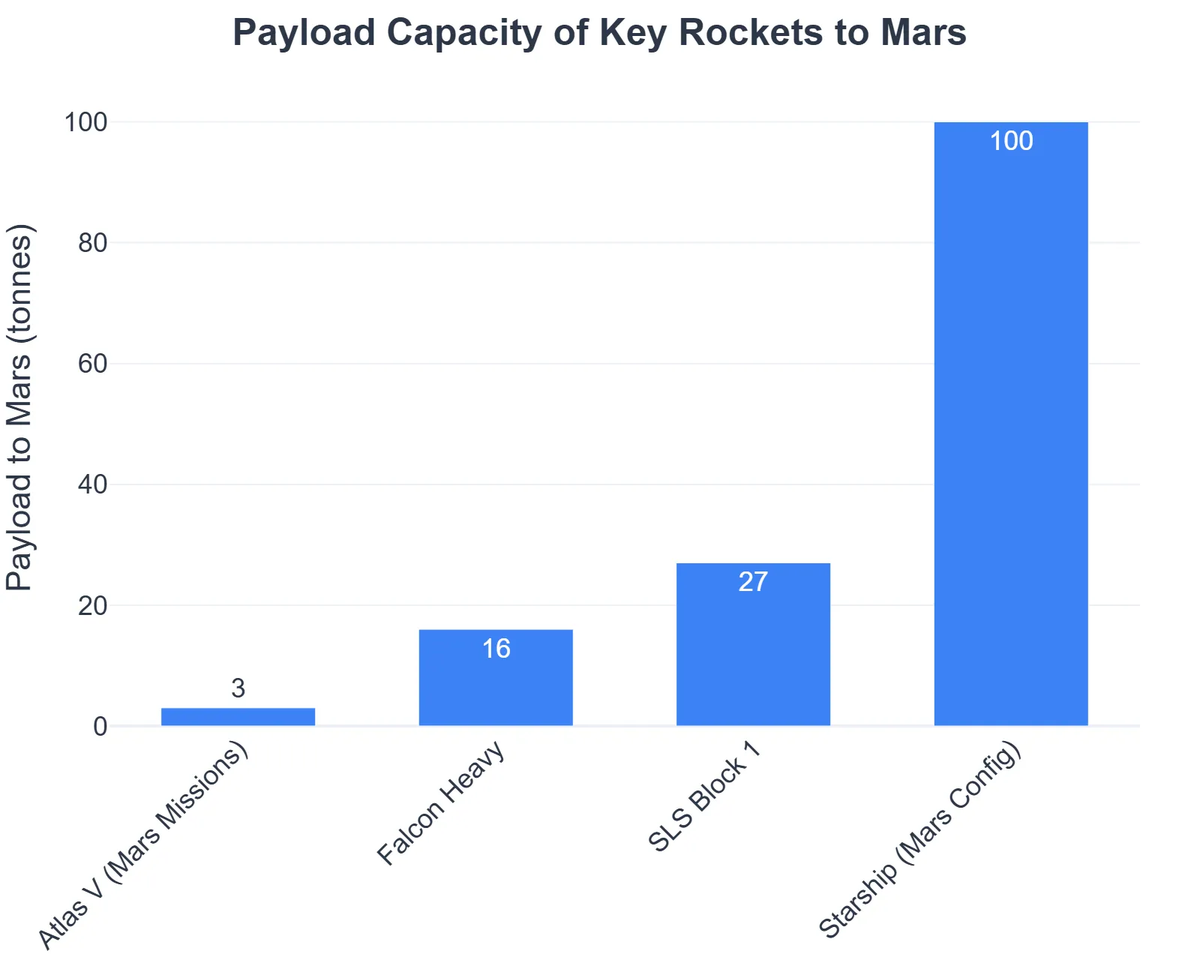
- ✅ Atlas V: This highly reliable rocket has launched several iconic Mars missions, including the Mars Reconnaissance Orbiter (MRO), the Curiosity rover, and the Perseverance rover (Mars 2020 mission) with its accompanying Ingenuity helicopter. Its modular design allows for varying levels of thrust depending on the payload.
- ➡️ Delta IV Heavy: While less frequently used for Mars missions than the Atlas V, the Delta IV Heavy is one of the most powerful operational rockets, capable of lifting very heavy payloads.
For more on the range of missions, explore NASA Mars Missions: Humanity’s Journey to the Red Planet.
The SLS: Humanity’s Deep Space Workhorse
Looking to the future, NASA’s Space Launch System (SLS) is designed to be the backbone of human deep space exploration, including crewed missions to Mars. This mega-rocket is the most powerful rocket ever built by NASA, designed to lift unprecedented payloads to lunar orbit and beyond.
- 🚀 Unmatched Power: SLS Block 1, which launched the Artemis I mission, generates 8.8 million pounds of thrust. Future iterations (Block 1B and Block 2) will be even more powerful.
- 🌌 Crew and Cargo: SLS is capable of carrying the Orion spacecraft with astronauts, along with large amounts of cargo and scientific equipment needed for long-duration missions to Mars.
- 🌍 Foundational for Artemis: SLS is central to the Artemis program, which aims to return humans to the Moon, serving as a critical stepping stone for Mars exploration. For more insights into these broader initiatives, consider reading NASA Missions: From Apollo to Mars and Beyond.
Understanding NASA Rocket Speed and Propulsion Systems
When discussing NASA Rocket Speed, it’s less about a constant velocity and more about achieving specific escape and orbital insertion velocities, along with the efficiency of the propulsion systems.
Chemical Propulsion: The Workhorse
The vast majority of launch vehicles, including the Atlas V, Delta IV Heavy, and SLS, rely on chemical propulsion. This involves the controlled combustion of propellants (fuel and oxidizer) to generate thrust.
- 🔥 High Thrust: Chemical rockets provide the immense power needed for liftoff and trans-Mars injection maneuvers.
- ⛽ Propellant Types: Common propellants include liquid hydrogen/liquid oxygen (LH2/LOX) and kerosene/liquid oxygen (RP-1/LOX). Solid rocket boosters (SRBs) also provide significant initial thrust for vehicles like the SLS.
Advanced Propulsion Concepts for Future Missions
While chemical propulsion is effective for launching, NASA is actively researching and developing more efficient propulsion systems for faster, more sustainable human missions to Mars:
NASA Mars Rockets: Advantages and Challenges
Pros
- ✔Enables crucial scientific discovery and future human exploration of Mars.
- ✔Drives significant technological innovation in propulsion, materials, and systems.
- ✔Capable of delivering large, complex payloads essential for advanced missions.
- ✔Fosters international collaboration and enhances national prestige in space exploration.
Cons
- ✖Incur extremely high development, manufacturing, and operational costs.
- ✖Possess inherent high risks of catastrophic failure due to extreme technical complexity.
- ✖Require very long development timelines, making them susceptible to political and funding shifts.
- ✖Contribute to atmospheric emissions and space debris, posing environmental concerns.
- ⚡ Electric Propulsion: Systems like solar electric propulsion (SEP) offer extremely high fuel efficiency, though with lower thrust. They are ideal for long-duration cargo missions or for maneuvering in space once initial velocity is achieved.
- ☢️ Nuclear Thermal Propulsion (NTP): NTP engines could significantly reduce travel times to Mars. Instead of burning propellants, a nuclear reactor heats a propellant (like hydrogen) to extreme temperatures, expelling it through a nozzle for thrust. This technology is viewed as a game-changer for human Mars missions. For more details on these advancements, see 6 Technologies NASA is Advancing to Send Humans to Mars.
- 💡 Solar Sail/Ion Propulsion: These less traditional methods, while not “rocket” propulsion in the conventional sense, are being explored for very long-duration, low-thrust missions. For example, ion thrusters are used on missions like Psyche.
How Fast Do We Go? Calculating the Interplanetary Journey
The “speed” of a Mars mission is not a simple number, but a combination of factors:
- Escape Velocity: Roughly 25,000 mph (40,230 km/h) to leave Earth’s gravity.
- Trans-Mars Injection (TMI): After reaching Earth orbit, rockets perform a powerful burn to accelerate the spacecraft onto a trajectory that will intercept Mars. This burn imparts a specific velocity change (delta-v) that places the spacecraft on a Hohmann transfer orbit – the most fuel-efficient path.
- Average Cruise Speed: Once on its trajectory, the spacecraft is mostly coasting. Its speed relative to the Sun and Mars varies throughout the journey due to gravitational influences. The time it takes to reach Mars (6-9 months) gives an average speed in the tens of thousands of miles per hour, but it’s not constant.
The critical factor is achieving the correct initial velocity and trajectory, not maintaining a constant high speed, which would require prohibitive amounts of fuel.
Key Components of a Mars-Bound Rocket System
A launch vehicle is a complex stack of integrated systems, each playing a vital role in sending missions to the Red Planet.
Launch Vehicle Stages
- ⚙️ First Stage: Contains the most powerful engines and propellants, providing the initial thrust to lift off and ascend through the densest part of Earth’s atmosphere. It separates and falls away once its fuel is depleted.
- ⬆️ Upper Stages: These stages ignite after the first stage separates, carrying the spacecraft to orbital velocity and then performing the crucial Trans-Mars Injection burn. The Centaur upper stage, for example, is well-known for its role in Mars missions.
Payload Fairings and Spacecraft Integration
- 🛡️ Payload Fairing: This aerodynamic nose cone protects the sensitive spacecraft (like a rover or orbiter) from atmospheric forces during ascent. It separates once the rocket is in space.
- 🔗 Spacecraft Adapter: The interface that connects the spacecraft securely to the rocket’s upper stage.
Understanding these components is key to grasping the full scope of Mars Missions: A Complete Guide to Past, Present, and Future Journeys.
The Journey to Mars: Mission Profiles and Trajectories
Launching a rocket to Mars is just the beginning of a meticulously planned interplanetary ballet.
Launch Windows and Orbital Mechanics
Due to the relative positions of Earth and Mars as they orbit the Sun, launch opportunities (or “windows”) only occur approximately every 26 months. Missing a window means waiting over two years for the next one.

- 📅 Synchronized Orbits: Missions are timed to coincide with when Earth and Mars are optimally aligned for a fuel-efficient Hohmann transfer orbit.
- 📐 Precision Targeting: The launch vehicle must place the spacecraft on a trajectory that accounts for the movement of both planets during the transit time.
Cruise Phase and Deep Space Maneuvers
After the Trans-Mars Injection, the spacecraft coasts for months. During this cruise phase:
- 🛰️ Telemetry and Navigation: Ground teams constantly monitor the spacecraft’s health and refine its trajectory with tiny, precise engine burns.
- 🔄 Mid-Course Corrections: These maneuvers ensure the spacecraft arrives at the precise location and angle needed for Martian atmospheric entry.
Martian Entry, Descent, and Landing (EDL)
While not strictly part of the “rocket” phase, the success of the mission hinges on a safe arrival. Rockets deliver the spacecraft, but the spacecraft itself then employs a complex sequence of aerobraking, parachutes, and retro-rockets (or sky cranes, as with Curiosity and Perseverance) for a soft landing on Mars.
Future of NASA Mars Rockets: Enabling Human Exploration
The ultimate goal of Mars exploration is to send humans to the Red Planet. This ambitious objective demands even more powerful and innovative rocket technologies.
The Artemis Program and Gateway as Stepping Stones
NASA’s Artemis program aims to establish a sustainable human presence on the Moon. This lunar return is not an end in itself but a critical proving ground for technologies and operational procedures required for Mars. The Lunar Gateway, a space station orbiting the Moon, will serve as a staging point for deep space missions. Learn more about the future in NASA Mars Mission 2026: The Next Giant Leap.
Developing Next-Generation Propulsion for Crewed Missions
For human missions to Mars, reducing transit time is paramount for astronaut health and mission safety. This drives the development of advanced propulsion systems:
- 🚀 Nuclear Thermal Propulsion: As mentioned, NTP offers a significant advantage in speed and efficiency, potentially cutting transit times by several months.
- 💡 In-Situ Resource Utilization (ISRU): While not a propulsion method, ISRU plays a role by allowing future missions to produce rocket fuel directly on Mars, reducing the amount of fuel that needs to be launched from Earth, thereby easing the burden on rockets. This is crucial for return journeys. For more on how NASA is powering up human reach, check out Powering Up NASA’s Human Reach for the Red Planet.
The Vision for Sustainable Martian Presence
Beyond initial human landings, the vision includes establishing permanent outposts. This will require massive cargo lifts, potentially via re-usable heavy-lift rockets, to transport habitats, life support systems, and scientific equipment. The development of such capabilities rests squarely on the shoulders of next-generation rocket technology.
Recommended Video
Conclusion: Blazing Trails to the Red Planet
From the pioneering Atlas rockets to the mighty Space Launch System, NASA’s journey to Mars is intrinsically linked to the evolution of its rocket technology. These incredible machines are more than just engines and fuel tanks; they are the physical manifestation of humanity’s insatiable curiosity and our drive to explore beyond Earth. The ongoing advancements in propulsion and launch capabilities are not just about reaching Mars, but about unlocking the potential for sustainable human presence among the stars.
As we continue to probe the mysteries of the universe, the power and precision of the NASA Mars Rocket will remain indispensable, propelling our robotic emissaries and, soon, our astronauts towards the tantalizing red horizon. For a broader perspective on space exploration, delve into our pillar content: Cosmic Queries: Probing the Mysteries of the Universe.
Frequently Asked Questions
How do rockets get payloads all the way to Mars?
They use multiple stages to achieve escape velocity from Earth, then fire engines again for Trans-Mars Injection (TMI) burn, setting the spacecraft on a precise trajectory towards the Red Planet.
What innovations are expected in future Mars rockets?
Future innovations include nuclear thermal propulsion, in-space refueling, and advanced reusable launch systems to make Mars travel more efficient and affordable.
What’s the biggest challenge in launching missions to Mars?
Beyond sheer power, the biggest challenges involve precise navigation over vast distances, ensuring spacecraft integrity through launch and transit, and managing complex mission profiles with narrow launch windows.