
Cognitive Bias & Heuristics: Understanding Mental Shortcuts in Decision-Making
In the intricate landscape of the human mind, our decisions are rarely purely logical. Instead, they are often shaped by powerful, invisible forces: cognitive bias and heuristics. These mental shortcuts, while incredibly efficient, can sometimes lead us astray, coloring our perceptions and influencing the choices we make. Understanding these fundamental aspects of our cognition is crucial for anyone looking to make more informed decisions, navigate complex situations, and truly unlock the secrets of our body and mind.
💡 Key Takeaways
- Cognitive biases are systematic errors in thinking that affect decisions.
- Heuristics are mental shortcuts that simplify complex problems, but can lead to biases.
- Recognizing common biases like confirmation bias or availability heuristic is crucial.
- Understanding these mechanisms empowers individuals to make more deliberate and rational choices.
“Our brains are incredible efficiency machines, but these efficiencies, manifest as biases and heuristics, can sometimes steer us away from optimal rationality. Awareness is the first step towards navigating these inherent cognitive tendencies.”
— Eleanor Vance, Neuroscience Communicator & Cognitive Psychologist
This comprehensive guide delves deep into the world of mental shortcuts, explaining what they are, how they work, and why recognizing them is vital for personal and professional growth. For a broader perspective on how our minds operate, explore our pillar page on The Human Enigma: Unlocking the Secrets of Our Body and Mind.
In This Article
- → Cognitive Bias & Heuristics: Understanding Mental Shortcuts in Decision-Making
- — 💡 Key Takeaways
- → What Are Cognitive Biases?
- — Characteristics of Cognitive Biases:
- → What Are Heuristics?
- — How Heuristics Work:
- → The Interplay: How Biases and Heuristics Influence Decision-Making
- — Impact on Daily Life:
- → Common Examples of Cognitive Biases & Heuristics in Action
- — Popular Cognitive Biases:
- — Key Heuristics:
- → Why Do We Rely on Mental Shortcuts?
- — Reasons for Their Existence:
- → Mitigating the Impact: Strategies for Better Decision-Making
- — Practical Strategies:
- → Conclusion
What Are Cognitive Biases?

A cognitive bias is a systematic pattern of deviation from norm or rationality in judgment. It’s essentially a “bug” in our brain’s operating system, leading us to perceive information and make decisions in a predictably irrational way. These biases are often unconscious, deeply ingrained, and impact everything from our personal opinions to major investment decisions.
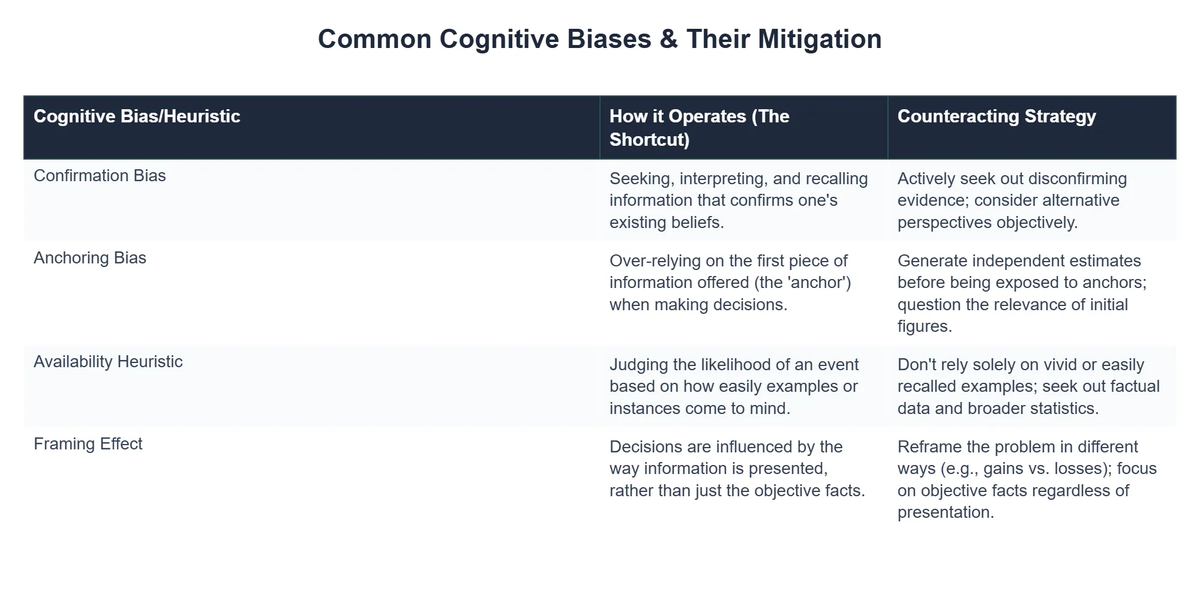
Characteristics of Cognitive Biases:
- ✅ Systematic Errors: They are not random mistakes but predictable deviations from logical thinking.
- ➡️ Unconscious Influence: We are often unaware of their presence and impact on our thoughts.
- 💡 Information Processing Distortions: They can affect how we recall memories, process information, and evaluate risks.
For a detailed exploration of different types, see our article on Types of Cognitive Bias: Understanding Distortions in Thinking.
What Are Heuristics?
Heuristics are mental shortcuts or “rules of thumb” that our brains use to simplify complex problems and make quick decisions. Unlike biases, heuristics are not inherently “bad”; they are essential tools for navigating an overwhelming world by reducing cognitive load. However, the shortcuts they provide can sometimes lead to systematic errors – which is where cognitive biases often emerge.
How Heuristics Work:
- 🧠 Efficiency: They allow for rapid judgments, saving time and mental energy.
- ⚡ Problem-Solving: They provide quick, though not always optimal, solutions.
- 🌐 Adaptive: They are developed from experience and help us cope with uncertainty.
According to The Decision Lab, “Heuristics are mental shortcuts that allow people to solve problems and make judgments quickly and efficiently.” They are the tools, and biases are the potential outcomes of those tools being misapplied or overused. Learn more about their function at The Decision Lab’s Heuristics page.
Cognitive Biases & Heuristics: The Dual Nature of Mental Shortcuts
Pros
- ✔Enable quick decision-making, especially under time pressure.
- ✔Reduce cognitive load by simplifying complex information.
- ✔Often lead to practical and effective judgments in familiar situations.
- ✔Essential for rapid responses in dynamic or critical environments.
Cons
- ✖Lead to systematic errors and flawed judgments (biases).
- ✖Can distort reality and hinder objective evaluation of information.
- ✖May reinforce stereotypes, prejudice, or irrational beliefs.
- ✖Increase vulnerability to manipulation and poor choices in novel situations.
The Interplay: How Biases and Heuristics Influence Decision-Making
The relationship between cognitive biases and heuristics is symbiotic. Heuristics are the mechanisms—the mental shortcuts we employ—and cognitive biases are often the observable outcomes or systematic errors that result from relying on those shortcuts in certain situations. For example, the availability heuristic (a shortcut that favors easily recalled information) can lead to the availability bias (overestimating the likelihood of events that are easily remembered, like plane crashes).
Impact on Daily Life:
- 🏡 Personal Choices: From what brand of coffee to buy to who to vote for.
- 📈 Financial Decisions: Investing, saving, and spending habits are heavily influenced.
- 🤝 Social Interactions: How we perceive others and build relationships.
- 🏥 Professional Settings: Particularly in fields like clinical trials, where understanding heuristics and biases is crucial for decision-making. You can find more on this at Applied Clinical Trials Online.
Common Examples of Cognitive Biases & Heuristics in Action
Our daily lives are rife with examples of these mental shortcuts guiding our decisions. Recognizing them is the first step toward mitigating their potential downsides.
Popular Cognitive Biases:
- Confirmation Bias: The tendency to seek out, interpret, favor, and recall information that confirms one’s existing beliefs.
- ➡️ Example: Only reading news sources that align with your political views.
- Anchoring Bias: The tendency to rely too heavily on the first piece of information offered (the “anchor”) when making decisions.
- ➡️ Example: Negotiating a price, where the initial offer heavily influences the final agreement.
- Framing Effect: How information is presented (framed) influences the choices people make.
- ➡️ Example: A product advertised as “90% fat-free” sounds more appealing than “contains 10% fat,” even though they are identical.
Key Heuristics:
- Availability Heuristic: Judging the probability of events by how easily examples come to mind.
- 💡 Example: Fearing plane crashes more than car accidents because plane crashes are more widely reported and thus more “available” in memory.
- Representativeness Heuristic: Judging the likelihood of things in terms of how well they seem to represent, or match, particular prototypes; may lead us to ignore other relevant information.
- 💡 Example: Assuming someone dressed in a suit is a lawyer, even if the general population has far more artists than lawyers. Dive deeper into this on our page about Representative Bias: Understanding Cognitive Shortcuts.
- Affect Heuristic: Relying on emotions to make decisions, rather than detailed analysis.
- 💡 Example: Making investment choices based on gut feelings about a company rather than financial data.
For more on how these shortcuts impact us, explore our article on Cognitive Bias: Understanding Our Brain’s Mental Shortcuts.
Why Do We Rely on Mental Shortcuts?
The reliance on cognitive bias and heuristics isn’t a flaw; it’s an evolutionary adaptation. Our brains evolved to operate efficiently in a complex world, where making quick judgments was often more crucial for survival than making perfectly logical ones. This cognitive efficiency comes at a cost, but it’s a necessary trade-off.
Reasons for Their Existence:
- ⏱️ Cognitive Load Reduction: The sheer volume of information we encounter daily would paralyze us if we processed every detail.
- 💨 Speed of Decision-Making: In many situations, a quick, imperfect decision is better than no decision or a delayed perfect one.
- 🔋 Energy Conservation: Deep, analytical thinking is resource-intensive. Shortcuts conserve mental energy.
- 🌎 Uncertainty Management: When faced with incomplete information, heuristics provide a way to make a plausible guess.
Mitigating the Impact: Strategies for Better Decision-Making
While we can’t eliminate cognitive biases entirely, we can certainly learn to recognize them and mitigate their negative effects. The goal isn’t to become perfectly rational, but to become more aware and make more deliberate choices when it truly matters.
Practical Strategies:
- ✅ Awareness: Simply knowing about common biases and heuristics is the first and most critical step.
- ➡️ Slow Down: For important decisions, consciously pause and engage in System 2 (analytical) thinking rather than System 1 (intuitive) thinking.
- 🔄 Seek Diverse Perspectives: Actively solicit opinions from people with different viewpoints to challenge your own biases.
- 📝 Use Frameworks: Employ decision-making tools like pros and cons lists, cost-benefit analysis, or pre-mortem exercises.
- ❓ Question Assumptions: Always ask yourself, “Why do I believe this?” and “What evidence supports (or contradicts) this belief?”
- 🧠 Practice Self-Reflection: Regularly review past decisions, identifying where biases might have influenced the outcome.
Developing a robust understanding of these biases empowers you. For further strategies to sharpen your cognitive abilities, refer to our article on Cognitive Biases: Unmasking Your Mind.
Recommended Video
Conclusion
The world of cognitive bias and heuristics is a fascinating testament to the complexity and efficiency of the human mind. While these mental shortcuts serve an essential purpose in enabling us to navigate our fast-paced lives, their influence can subtly steer us away from optimal decisions. By cultivating awareness, embracing critical thinking, and actively employing strategies to counteract their effects, we can move closer to mastering our own decision-making processes. This journey of understanding our inherent mental mechanisms is a core component of truly unlocking The Human Enigma: Unlocking the Secrets of Our Body and Mind, leading to more thoughtful, effective, and rational choices in all aspects of life.
Frequently Asked Questions
How do cognitive biases affect daily life?
They influence everything from financial decisions and interpersonal relationships to how we process news and form opinions, often leading to irrational choices or distorted perceptions.
Can I overcome my cognitive biases?
While completely eliminating biases is challenging, awareness, critical thinking, and specific strategies like seeking diverse perspectives or “debiasing” techniques can significantly mitigate their impact.
What are some common examples of cognitive biases?
Common examples include confirmation bias (seeking information that confirms beliefs), anchoring bias (over-relying on the first piece of information), and availability heuristic (judging likelihood based on ease of recall).