


Groundwater Geology: The Hidden World Beneath Our Feet
Beneath the bustling cities, verdant forests, and vast oceans lies an intricate, dynamic, and often overlooked world: the realm of groundwater. Far from being static, this hidden resource plays a pivotal role in sustaining life, shaping landscapes, and influencing the very pulse of our planet. Understanding groundwater geology is not just an academic pursuit; it’s essential for managing our most vital resource.
💡 Key Takeaways
- Groundwater is a critical, often unseen, component of the global water cycle.
- Aquifers are underground layers of permeable rock or sediment that hold significant amounts of water.
- Understanding groundwater geology is essential for sustainable water resource management and environmental protection.
- Human activities significantly impact groundwater quality and availability, necessitating careful stewardship.
“Groundwater is Earth’s hidden circulatory system, a silent guardian of ecosystems and a critical buffer against climate extremes. Its geophysical signatures reveal the secrets of our planet’s past and future water resilience.”
— Marcus Sterling, Geophysical Explorer & Climate Dynamics Analyst
This comprehensive guide delves deep into the science of groundwater, unraveling its secrets, exploring its movement, and highlighting its immense importance. From the subtle dance of the water table to the vast underground reservoirs, prepare to journey into the Earth’s unseen hydrological engine, a core component of Earth’s Unseen Forces: The Hidden Dynamics of Our Planet.
In This Article
- → Groundwater Geology: The Hidden World Beneath Our Feet
- — 💡 Key Takeaways
- → 💧 What is Groundwater Geology: Unveiling the Subsurface Science
- → 🔄 The Hydrologic Cycle: Groundwater’s Crucial Role
- — 🌧️ From Precipitation to Infiltration
- — Underground Flow and Discharge
- → 🪨 Key Geological Concepts: Aquifers, Aquitards, and the Water Table
- — Aquifers: Nature’s Underground Reservoirs
- — Aquitards & Aquicludes: Restricting Water Flow
- — 🌊 The Water Table: The Dynamic Boundary
- → 🔬 Groundwater Movement and Quality
- — Darcy’s Law: Quantifying Flow
- — Chemical Fingerprints: Groundwater Quality
- → 🌐 Importance of Groundwater: Lifeblood of Our Planet
- — Sources of Drinking Water
- — Agriculture and Industry
- — Ecological Support
- → ⚠️ Challenges and Sustainable Management
- — Over-extraction and Depletion
- — Contamination
- — Towards Sustainable Groundwater Management
- → 📚 Studying Groundwater Geology: Tools and Resources
- — Fundamental Resources
- — Practical Application
- → Conclusion: The Imperative of Understanding Groundwater
💧 What is Groundwater Geology: Unveiling the Subsurface Science

Groundwater geology, also known as hydrogeology, is the scientific study of the distribution and movement of water below the Earth’s surface. It’s a fascinating interdisciplinary field that combines principles of geology, hydrology, chemistry, and environmental science to understand how water interacts with rocks and soils.
This discipline seeks to answer critical questions such as:
- ✅ Where is groundwater located?
- ✅ How does it move through different geological formations?
- ✅ What is its quality, and how does it change over time?
- ✅ How can we sustainably manage this essential resource for human and ecological needs?
The study of groundwater is fundamental to everything from agricultural practices and urban water supply to predicting seismic activity and assessing environmental contamination. It truly is the “hidden world beneath our feet” that governs so much of our visible world.
🔄 The Hydrologic Cycle: Groundwater’s Crucial Role
Groundwater is not isolated; it’s an integral part of the global hydrologic (water) cycle. This continuous movement of water on, above, and below the surface of the Earth is powered by solar energy and gravity.
🌧️ From Precipitation to Infiltration
The journey of groundwater begins with precipitation (rain, snow, sleet, hail). When precipitation reaches the ground, it can:
- ➡️ Run off into rivers, lakes, and oceans (surface runoff).
- ➡️ Evaporate back into the atmosphere.
- ➡️ Be absorbed by plants (transpiration).
- ➡️ Infiltrate the ground, moving downward through soil and rock layers.
It’s this infiltration that recharges groundwater systems. The rate and amount of infiltration depend on factors like soil type, vegetation cover, land use, and the intensity and duration of precipitation events.
Underground Flow and Discharge
Once water infiltrates, it moves through pores, cracks, and fractures in the subsurface. This subsurface flow eventually discharges naturally at springs, seeps, rivers, lakes, wetlands, and oceans. This continuous cycle highlights groundwater’s dynamic nature, not as a static pool, but as a slowly moving component of the Earth’s water system.
🪨 Key Geological Concepts: Aquifers, Aquitards, and the Water Table
Understanding groundwater flow requires familiarity with specific geological terms that define the different underground layers.
Aquifers: Nature’s Underground Reservoirs
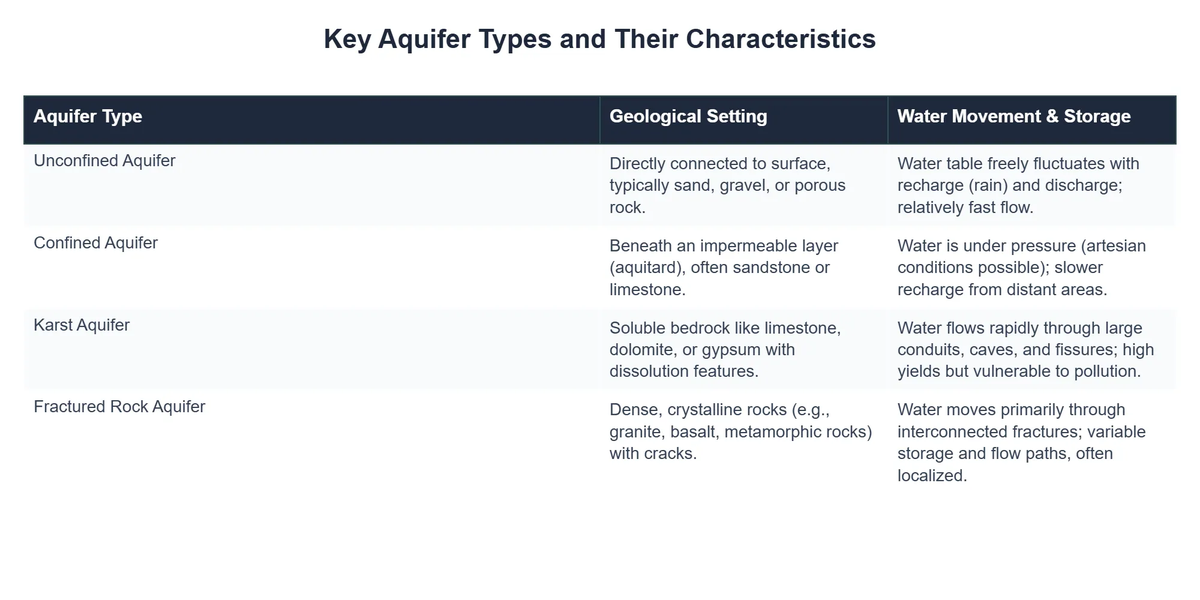
An aquifer is a saturated geological formation that can yield significant quantities of water to wells and springs. They are essentially permeable layers of rock, sand, or gravel that store and transmit groundwater.
Aquifers are characterized by their ability to store and transmit water. This ability is largely dependent on their:
- 💡 Porosity: The percentage of void space in a rock or sediment, allowing it to hold water. Some rocks, like sandstone or highly fractured granite, can have significant porosity. Even seemingly solid rocks can have tiny void spaces, much like how Vugs in Geology: Uncovering Hidden Rock Chambers create open spaces within rock formations.
- 💡 Permeability: The ability of a porous material to allow fluids to pass through it. A highly permeable material allows water to move through it easily.
There are two main types of aquifers:
- Unconfined Aquifers: These are aquifers where the water table is the upper boundary. They are directly recharged by surface water and precipitation. Wells drilled into unconfined aquifers do not require pressure to bring water to the surface; water levels in the well reflect the water table.
- Confined Aquifers: These aquifers are overlain by a less permeable layer (an aquitard or aquiclude) that restricts vertical water movement. Water in confined aquifers is often under pressure, and if a well penetrates such an aquifer, the water level in the well can rise above the top of the aquifer itself (artesian wells).
Aquitards & Aquicludes: Restricting Water Flow
- Aquitard: A geological formation that significantly retards, but does not entirely prevent, the flow of water. Examples include silts, clays, and shales. They can slowly transmit water over long periods.
- Aquiclude: A geological formation that is essentially impermeable to water. It can store water but does not transmit it effectively. Dense, unfractured rock like granite or thick layers of unfractured clay can act as aquicludes, forming confining layers above or below aquifers.
🌊 The Water Table: The Dynamic Boundary
The water table is the upper surface of the zone of saturation, where all pores and spaces are completely filled with water. Above the water table is the unsaturated zone (or vadose zone), where pores contain both air and water. The water table is not static; it fluctuates based on:
- 🌧️ Recharge: Precipitation, infiltration from rivers/lakes.
- ☀️ Discharge: Pumping from wells, evaporation, flow into surface water bodies.
- 🗓️ Seasonal Variations: Typically higher during wet seasons, lower during dry seasons.
🔬 Groundwater Movement and Quality
Groundwater doesn’t just sit still; it moves, albeit often very slowly, through the porous matrix of the subsurface.
Darcy’s Law: Quantifying Flow
The movement of groundwater is primarily driven by gravity and pressure differences, often described by Darcy’s Law. This fundamental principle of hydrogeology states that the discharge rate through a porous medium is proportional to the cross-sectional area and the hydraulic gradient, and inversely proportional to the fluid viscosity. In simpler terms, water flows from areas of higher hydraulic head (pressure) to areas of lower hydraulic head.
Chemical Fingerprints: Groundwater Quality
As groundwater moves through different rock and soil types, it dissolves minerals and picks up various chemical constituents. This interaction gives each groundwater source a unique chemical signature.
Common dissolved solids include calcium, magnesium, sodium, potassium, bicarbonate, sulfate, and chloride. The presence and concentration of these constituents determine the “hardness” or “softness” of water and its suitability for various uses.
Monitoring groundwater quality is paramount, as it can be affected by both natural processes and human activities. For detailed assessment, agencies like the California Department of Water Resources emphasize the importance of understanding this hidden resource.
🌐 Importance of Groundwater: Lifeblood of Our Planet
Groundwater is arguably one of the most critical natural resources on Earth. Its significance spans ecological, economic, and social dimensions.
Sources of Drinking Water
Globally, groundwater provides nearly half of all drinking water and supports vital ecosystems. For many rural communities, it is the sole source of potable water. Its natural filtration through geological layers often makes it cleaner than surface water, though it’s still susceptible to contamination.
Agriculture and Industry
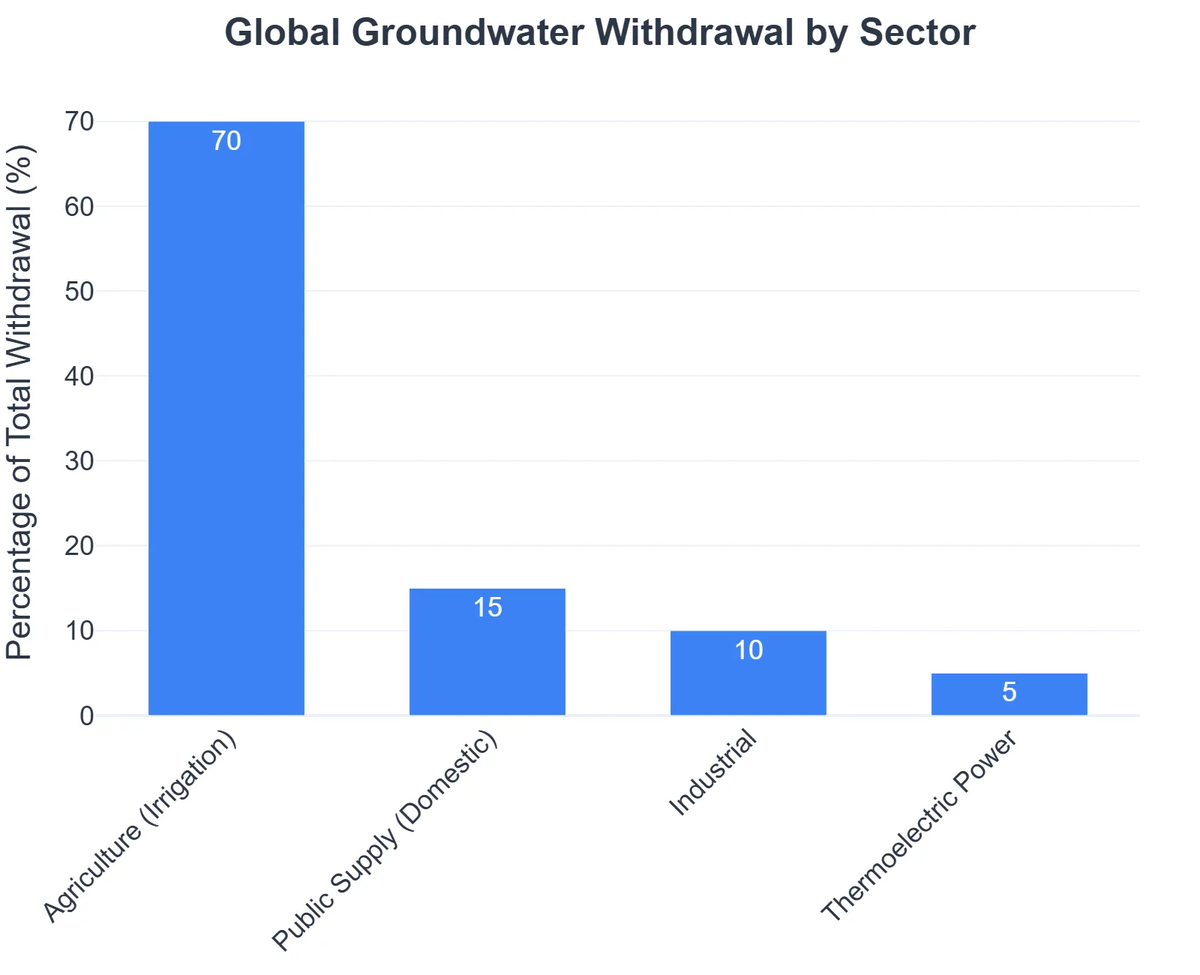
A significant portion of groundwater is used for irrigation, fueling agricultural productivity worldwide. Industries also rely heavily on groundwater for various processes, from cooling to manufacturing.
Ecological Support
Groundwater sustains baseflow in rivers and streams, particularly during dry periods, and maintains water levels in lakes and wetlands. Many unique ecosystems, such as fens and specific types of forests, are directly dependent on groundwater discharge.
As highlighted by Oxford University’s discussions on the water beneath our feet, our reliance on groundwater is profound and ever-increasing.
⚠️ Challenges and Sustainable Management
Despite its critical importance, groundwater resources face numerous threats, primarily from human activities.
Over-extraction and Depletion
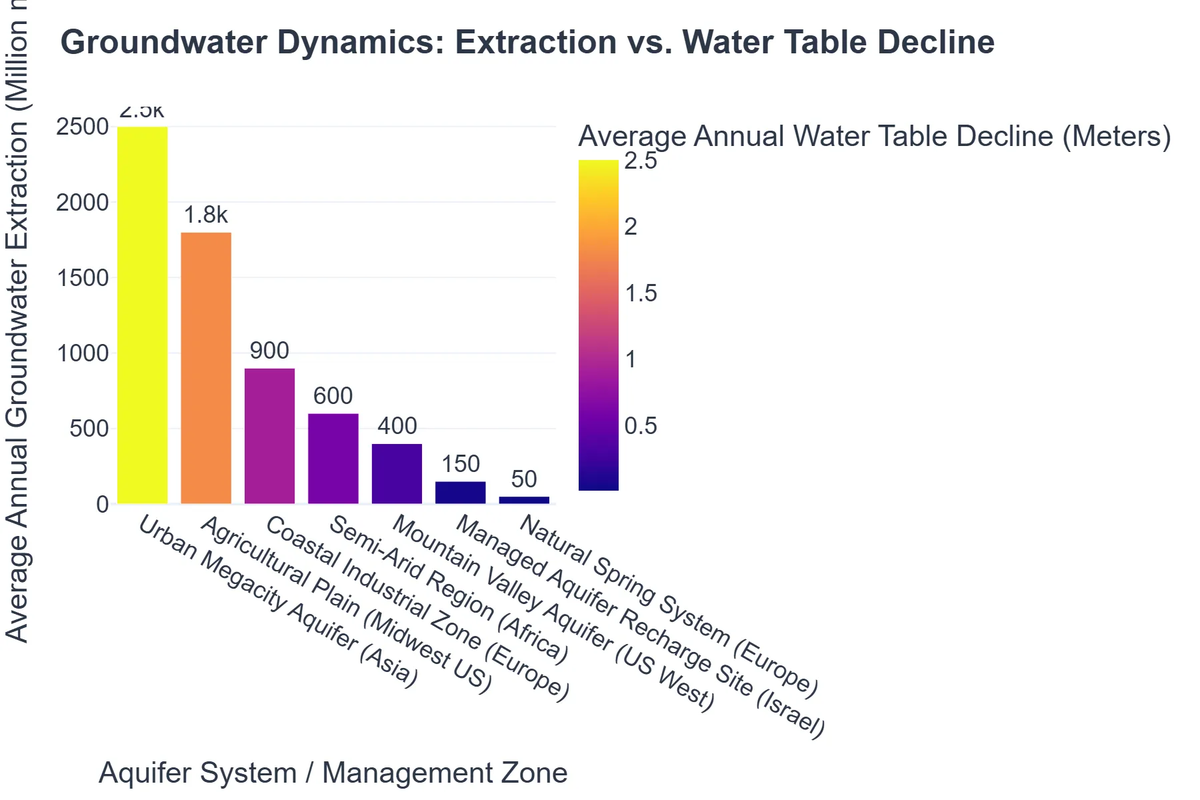
When groundwater is pumped faster than it can be recharged, it leads to declining water tables. This can cause:
- 📉 Land subsidence: The ground literally sinks as the supporting water is removed.
- 🧂 Saltwater intrusion: In coastal areas, over-pumping can draw saltwater into freshwater aquifers, rendering them unusable.
- 💧 Reduced baseflow: Rivers and streams dependent on groundwater for baseflow may dry up.
- 🌳 Ecological impacts: Wetlands and groundwater-dependent ecosystems can suffer.
Contamination
Groundwater, though naturally filtered, is vulnerable to contamination from various sources:
- 🚜 Agricultural runoff: Pesticides, herbicides, fertilizers.
- 🏭 Industrial waste: Chemicals, heavy metals.
- 🗑️ Landfills: Leachate from waste.
- 🛢️ Leaking storage tanks: Petroleum products.
- 🚽 Septic systems: Pathogens, nutrients.
Once an aquifer is contaminated, remediation can be incredibly difficult, time-consuming, and expensive due to the slow movement of groundwater.
Towards Sustainable Groundwater Management
Sustainable management practices are crucial for protecting this vital resource. Key strategies include:
- ✅ Regulation and Policy: Implementing laws and policies to control groundwater abstraction and protect its quality.
- ✅ Artificial Recharge: Deliberately enhancing infiltration to replenish aquifers, often using stormwater or treated wastewater.
- ✅ Water Conservation: Promoting efficient water use in agriculture, industry, and domestic settings.
- ✅ Monitoring and Data Collection: Regularly assessing groundwater levels and quality to inform management decisions.
📚 Studying Groundwater Geology: Tools and Resources
Becoming an expert in groundwater geology requires a blend of theoretical knowledge and practical application.
Fundamental Resources
For anyone serious about delving into this field, acquiring robust Hydrogeology textbooks is a foundational step. These texts provide the theoretical framework, mathematical models, and case studies essential for understanding complex groundwater systems.
Practical Application
Practical hydrogeological work involves field investigations, well drilling, geophysical surveys, and laboratory analysis. For environmental professionals and concerned citizens alike, water quality testing kits are invaluable tools for initial assessments of groundwater purity, helping identify potential issues before they become major problems. For deeper geological context, exploring Earth’s Epochs: An Introduction to Geologic Time can provide a comprehensive understanding of the long-term geological processes that create and shape aquifer systems.
Modern hydrogeology also leverages advanced technologies, including GIS (Geographic Information Systems) for mapping, remote sensing, and sophisticated computer models for predicting groundwater flow and contaminant transport.
Recommended Video
Frequently Asked Questions
What is groundwater geology?
Groundwater geology is the scientific study of the distribution and movement of water below the Earth’s surface, focusing on geological formations that hold and transmit water.
What is an aquifer?
An aquifer is an underground layer of water-bearing permeable rock, rock fractures, or unconsolidated materials (such as gravel, sand, or silt) from which groundwater can be extracted.
Why is groundwater important?
Groundwater is a vital resource, serving as a primary source of drinking water for billions, supporting ecosystems, maintaining river flow, and being crucial for agriculture and industrial processes worldwide.
How does climate change affect groundwater?
Climate change can alter precipitation patterns, impacting groundwater recharge rates, and lead to increased water demand or reduced availability in many regions, thereby affecting water security.