
The universe is a realm of profound mysteries, and few scientific endeavors captivate the public imagination quite like the exploration of its fundamental building blocks. At the heart of this quest lies the Large Hadron Collider (LHC) at CERN, an engineering marvel designed to probe the deepest secrets of matter and energy. Yet, alongside its groundbreaking discoveries, the LHC has also been the subject of persistent, often alarming, speculation – primarily the fear that it could create a runaway black hole that devours Earth.
💡 Key Takeaways
- The LHC cannot create dangerous, macroscopic black holes.
- Any theoretical micro black holes would be harmless and evaporate almost instantly.
- Cosmic rays generate far more energetic particle collisions in Earth’s atmosphere daily without issue.
- The LHC is crucial for understanding fundamental physics, not for apocalyptic scenarios.
“The universe itself is the ultimate particle accelerator, constantly producing energies far beyond anything the LHC achieves. The notion that a minuscule, short-lived ‘black hole’ created in a lab could pose a threat is a captivating sci-fi trope, but fundamentally misunderstands the scale and nature of these phenomena.”
— Astrid Bellweather, Astrophysicist & Science Fiction Consultant
In this comprehensive guide, part of our commitment to Cosmic Queries: Probing the Mysteries of the Universe, we aim to separate scientific fact from sensationalized fiction. We’ll delve into the real science behind the LHC, address the misconceptions surrounding lhc black hole creation, and reassure you about the stringent safety measures in place. Join us as we demystify the incredible world of particle physics and provide clarity on one of the most misunderstood aspects of modern science.
In This Article
- — 💡 Key Takeaways
- → What is the Large Hadron Collider (LHC) and What Does It Do?
- — ⚙️ How the LHC Works
- → The “Black Hole” Controversy: Origins of the Fear
- — 📚 Misconceptions and Media Hysteria
- — ⚛️ The Theoretical Basis: Extra Dimensions and Mini Black Holes
- → The Science Behind “Mini Black Holes” at the LHC
- — 💨 Hawking Radiation and Evaporation
- — Comparison with Cosmic Rays
- — 🔒 Rigorous Safety Assessments and CERN Safety
- → What the LHC Has Actually Discovered (No Black Holes… Yet!)
- — 🔬 Key Discoveries and Contributions:
- → Conclusion: A Triumph of Science, Not a Threat
What is the Large Hadron Collider (LHC) and What Does It Do?
The Large Hadron Collider (LHC) is the world’s largest and most powerful particle accelerator, located at CERN near Geneva, Switzerland. It’s a colossal scientific instrument designed to answer fundamental questions about the universe.
⚙️ How the LHC Works
Imagine a 27-kilometer (17-mile) ring of superconducting magnets accelerating two beams of protons to nearly the speed of light in opposite directions. At four points around the ring, these beams are made to collide, recreating conditions similar to those that existed just moments after the Big Bang. These collisions produce a shower of new particles, which physicists then analyze to understand the fundamental forces and particles that govern our universe.
- ✅ Extreme Energies: The LHC achieves energies previously unimaginable in a laboratory setting, allowing scientists to glimpse exotic phenomena.
- ✅ Particle Detection: Massive detectors surrounding the collision points record the paths, energies, and identities of the newly created particles.
- ✅ Unveiling Nature’s Secrets: By studying these collisions, physicists aim to understand the Standard Model of particle physics, dark matter, extra dimensions, and the nature of mass itself.
The “Black Hole” Controversy: Origins of the Fear

The notion that the LHC could produce a dangerous black hole gained traction long before the collider even began operations. This fear, while understandable given the destructive power commonly associated with astrophysical black holes, stems from a misunderstanding of both theoretical physics and the scale of LHC experiments.
📚 Misconceptions and Media Hysteria
Early on, concerns were raised in media and by a few individuals about the potential for the LHC to create objects that could hypothetically endanger Earth. These concerns often conflated the theoretical possibility of creating microscopic, short-lived “mini black holes” with the massive, gravitationally dominant black holes found in space, such as those at the centers of galaxies.
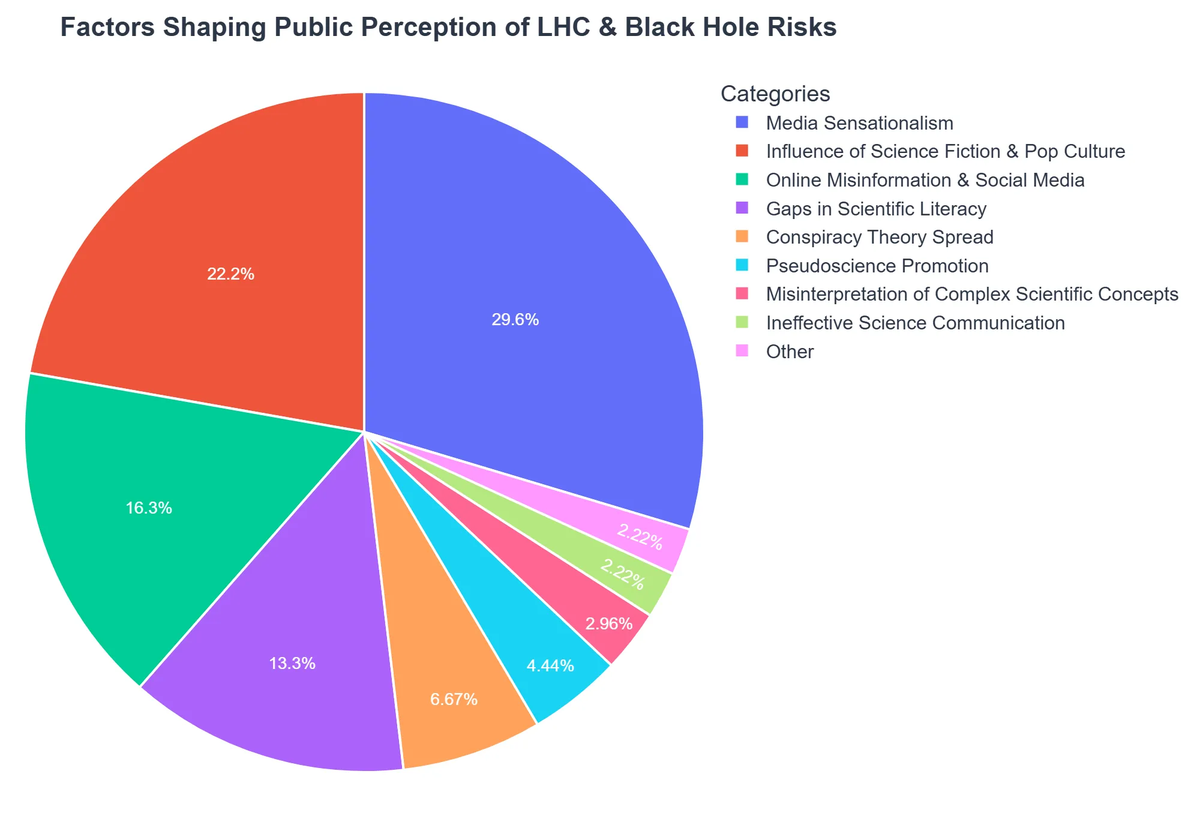
The anxieties were often fueled by a dramatic portrayal of science, sometimes even reaching into discussions of “apocalyptic” scenarios. For a historical perspective on these concerns, one might look at academic discussions surrounding the perceived risks of particle accelerators, such as those examined in “ALICE and the Apocalypse: Particle Accelerators as Death Machines in Speculative Fiction” (see: publish.lib.umd.edu).
⚛️ The Theoretical Basis: Extra Dimensions and Mini Black Holes
The theoretical possibility of creating mini black holes at the LHC arises from certain speculative theories in particle physics, particularly those involving extra spatial dimensions. In these theories, gravity might be much stronger at very small scales than we perceive it to be in our everyday three dimensions. If these extra dimensions exist and are large enough, the energy levels achievable at the LHC could theoretically be sufficient to compress matter into a black hole at a microscopic level, known as a quantum or mini black hole.
- ➡️ Theoretical, Not Proven: It’s crucial to understand that the existence of large extra dimensions is a theoretical concept, not yet proven by experimental evidence.
- ➡️ Planck Scale Physics: These theories operate at the Planck scale, an energy realm far beyond our current experimental reach, even with the LHC.
The Science Behind “Mini Black Holes” at the LHC
Even if these theoretical conditions were met and the LHC could produce mini black holes, the science dictates that they would be fundamentally different from the stellar or supermassive black holes we observe in the cosmos.
💨 Hawking Radiation and Evaporation
A key concept here is Hawking radiation. Predicted by Stephen Hawking, this theory states that black holes, especially very small ones, are not entirely black. They emit radiation and, over time, lose mass and eventually evaporate. The smaller the black hole, the faster it evaporates.
- 💡 Instant Disappearance: A mini black hole produced at the LHC would be unimaginably small – far smaller than an atom. Based on current understanding, it would evaporate almost instantaneously via Hawking radiation, long before it could interact with any other matter.
- 💡 Not a Threat: It would not “suck in” surrounding matter and grow, but rather disappear in a burst of energy, posing no threat to the LHC, Earth, or anything else.
Comparison with Cosmic Rays
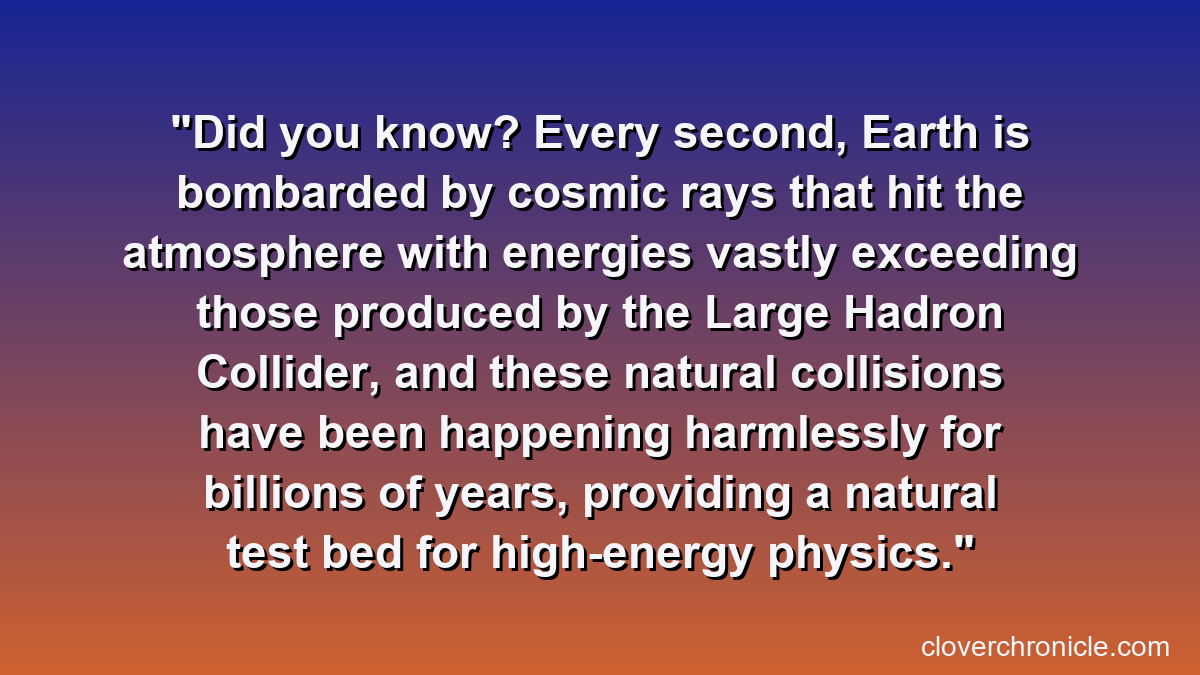
Perhaps the most compelling argument for LHC safety comes from nature itself. Our atmosphere is constantly bombarded by cosmic rays – high-energy particles from space that collide with Earth’s atmosphere at energies far greater than those produced by the LHC.
- ⚡ Natural Collisions: These natural collisions have been happening for billions of years, creating particles at energies sometimes hundreds of millions of times higher than what the LHC achieves.
- 🌍 Earth is Safe: If mini black holes formed from these cosmic ray collisions were stable and dangerous, Earth and other celestial bodies would have been destroyed long ago. The fact that they haven’t is powerful empirical evidence that such black holes either don’t form or are harmless if they do.
🔒 Rigorous Safety Assessments and CERN Safety
Before the LHC was switched on, exhaustive safety reviews were conducted by independent experts. These reviews considered all theoretical scenarios, including the most pessimistic ones involving black hole creation. The conclusion was unequivocal: the LHC poses no conceivable threat. CERN has an impeccable safety record, and all experiments undergo rigorous scrutiny.
For more on how CERN addresses these concerns, read our dedicated article: Could CERN Create a Black Hole? Addressing Cosmic Concerns.
What the LHC Has Actually Discovered (No Black Holes… Yet!)
Despite the theoretical possibility and public fascination, the LHC has not created any stable black holes. Instead, it has made groundbreaking discoveries that have revolutionized our understanding of particle physics.
While the theoretical possibility of Creating a Black Hole: Science and Speculation in a lab remains a subject of scientific curiosity, the LHC’s practical achievements are far more concrete.
🔬 Key Discoveries and Contributions:
- ✅ The Higgs Boson: In 2012, the LHC famously confirmed the existence of the Higgs boson, the particle associated with the Higgs field, which gives other fundamental particles their mass. This was a monumental achievement that completed the Standard Model of particle physics.
- ✅ Quark-Gluon Plasma: Experiments at the LHC have successfully recreated and studied quark-gluon plasma, a state of matter that existed just micro-seconds after the Big Bang. This provides insights into the early universe.
- ✅ Searches for New Physics: The LHC is continuously searching for evidence of physics beyond the Standard Model, including dark matter candidates, supersymmetry, and signs of extra dimensions. While these searches continue, no direct evidence for dangerous black hole formation has emerged.
To understand the observable, cosmic phenomena, consider reading about Actual Black Holes: Evidence from Space, which are vastly different from the theoretical mini-black holes discussed here.
Recommended Video
Conclusion: A Triumph of Science, Not a Threat
The Large Hadron Collider stands as a testament to human ingenuity and our insatiable drive to understand the universe. The fears surrounding lhc black hole creation, while understandable in their origin, are not supported by scientific understanding or empirical evidence. The theoretical mini black holes, if they ever form, would be harmless and evaporate almost instantly.
The true story of the LHC is one of unprecedented discovery in particle physics, pushing the boundaries of human knowledge and providing profound insights into the fundamental nature of reality. With stringent CERN safety protocols and the constant monitoring of our natural universe, we can confidently look to the LHC not as a source of cosmic peril, but as a beacon of scientific progress.
It continues to be a crucial tool in answering the most profound cosmic queries, helping us to piece together the grand puzzle of existence without posing a threat to our planet.
Frequently Asked Questions
Can the LHC really create black holes?
The LHC might, in theory, create ‘micro black holes’ if certain extra dimensions exist, but these would be incredibly tiny and unstable, evaporating almost instantly due to Hawking radiation. They pose no threat.
Are these micro black holes dangerous?
No. If created, they would be far smaller and dissipate much faster than any conventional black hole, having no gravitational impact on their surroundings whatsoever.
How do scientists know the LHC is safe?
Scientists have extensively studied the safety implications. They point to natural phenomena like cosmic rays, which bombard Earth with far higher energies than the LHC, producing similar theoretical micro black holes harmlessly for billions of years.
What is the real purpose of the LHC?
The LHC’s primary purpose is to explore fundamental questions about the universe, such as the origin of mass, the nature of dark matter, and the existence of new particles or forces, by recreating conditions shortly after the Big Bang.