


Humanity’ has long gazed at the night sky, captivated by the allure of the Red Planet. Mars, our closest planetary neighbor, represents not just a scientific frontier but a profound dream of expanding our presence beyond Earth. But what does it truly take to plan a mars trip? Beyond the audacious vision, there are immense costs, complex realities, and groundbreaking technologies shaping the future of space travel. This comprehensive guide delves into everything you need to know about journeying to Mars, from the astronomical expenses to the intrepid pioneers making it possible.
💡 Key Takeaways
- A crewed Mars mission involves multi-billion dollar investments, primarily for advanced propulsion and life support systems.
- The journey to Mars presents significant health risks, including radiation exposure and and the effects of microgravity, requiring innovative countermeasures.
- Future Mars missions will likely rely on international collaboration and reusable rocket technology to reduce costs and increase feasibility.
- While ambitious, human travel to Mars is increasingly seen as achievable within the next few decades, driven by both government agencies and private enterprises.
“While the physics of getting to Mars are understood, the human and economic challenges remain immense. Bridging the gap between scientific ambition and practical reality is where the true innovation lies.”
— Astrid Bellweather, Astrophysicist & Science Fiction Consultant
In This Article
- — 💡 Key Takeaways
- → The Allure of the Red Planet: Why Mars?
- → The Astronomical Cost of a Mars Trip: Current Estimates & Future Projections
- — 💸 How Much Does a Mars Trip Cost?
- → The Realities of a Civilian Trip to Space (and Beyond): Beyond Earth’s Orbit
- — ⏰ Travel Time to Mars
- → Key Players in the Future of Space Travel Today
- — 🌌 Government Space Agencies: The Foundation
- — 🚀 Private Space Companies: Accelerating the Pace
- → Technological Hurdles and Innovations for Deep Space Travel
- → The Human Element: Health, Training, and Psychology
- — 🧘 Physical Challenges of Long-Duration Spaceflight
- — 🧠 Psychological Resilience
- → Timeline for the First Trip to Mars: Dreams vs. Reality
- → Conclusion: The Ultimate Cosmic Query
The Allure of the Red Planet: Why Mars?
Mars holds a unique position in our cosmic neighborhood. Its relative proximity, potential for past or present water, and somewhat similar geology to Earth make it a prime candidate for future human exploration and potential colonization. Scientists are driven by the quest for knowledge, the search for extraterrestrial life, and the imperative of becoming a multi-planetary species to ensure humanity’s long-term survival.
- ✅ Scientific Discovery: Unlocking secrets about planetary formation, the origins of life, and the universe itself.
- ➡️ Resource Potential: Accessing potential water ice, minerals, and other resources to support long-term missions and future settlements.
- 💡 Inspiration and Innovation: Pushing the boundaries of human ingenuity, fostering technological advancements that benefit life on Earth.
- 🚀 Species Survival: Establishing an off-world outpost as a safeguard against catastrophic events on Earth.
For a broader perspective on humanity’s drive to explore, consider reading our article on Humanity’s Cosmic Journey: Our Place in Outer Space.
The Astronomical Cost of a Mars Trip: Current Estimates & Future Projections
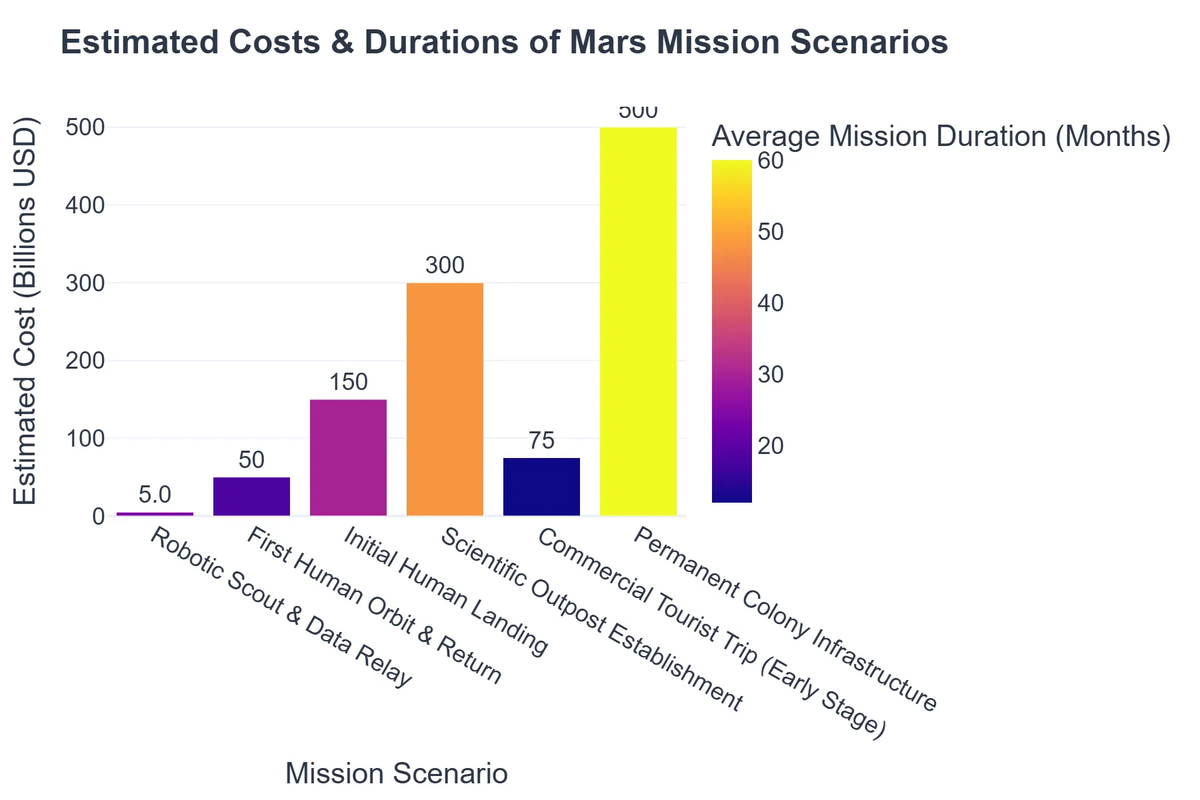
The phrase “cost of trip to space” takes on an entirely new meaning when contemplating a journey to Mars. Unlike suborbital tourism or even a visit to the ISS, a Mars mission involves entirely new levels of engineering, logistics, and long-duration life support. The price tag is staggering, ranging from hundreds of billions to even trillions of dollars for a full-scale human mission, encompassing research, development, launch vehicles, habitats, and return capabilities.
💸 How Much Does a Mars Trip Cost?
Estimating the exact space trip cost for a Mars mission is complex, as no human mission has yet been attempted. However, various space agencies and private companies have offered projections:
- Government-Led Missions (e.g., NASA): Historically, large-scale NASA missions (like Apollo) ran into hundreds of billions in modern dollars. A sustained human presence on Mars, as outlined in documents like NASA’s Journey to Mars – Pioneering Next Steps, would likely exceed initial estimates due to unforeseen challenges and decades of development.
- Private Ventures (e.g., SpaceX): Companies like SpaceX aim to drastically reduce the trip to space cost through reusability and mass production. Elon Musk has famously suggested a future individual ticket price to Mars could eventually drop to around $100,000 to $500,000 for a return journey, though this is for a fully established, routine transport system, not the initial pioneering missions. (Source: Elon Musk Reveals Future Price Plan for a Return Ticket to Mars)
These figures are largely for infrastructure development. The eventual cost for an individual citizen to take a civilian trip to space to Mars would only become feasible once the foundational technologies and logistics are well-established and routinely performed, perhaps decades from now.
The Realities of a Civilian Trip to Space (and Beyond): Beyond Earth’s Orbit
While the prospect of a civilian trip to space is growing for suborbital flights and orbital tourism, a journey to Mars presents an entirely different set of challenges. This isn’t a quick jaunt like Virgin Galactic‘s suborbital flights or a short stay on the ISS; it’s a multi-year expedition into deep space.
⏰ Travel Time to Mars
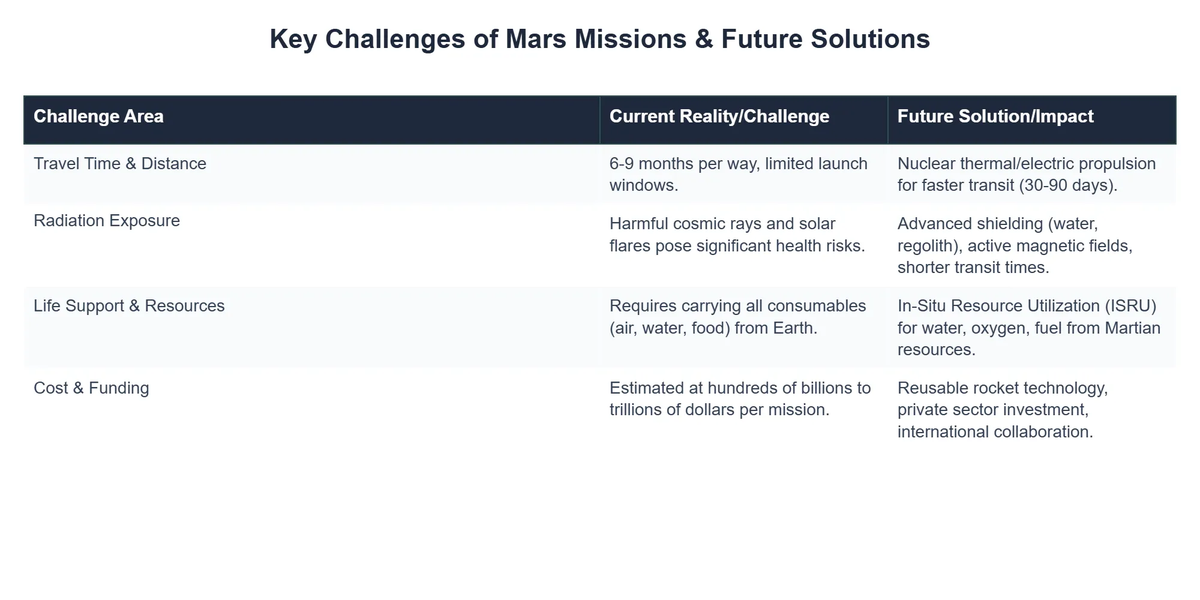
The journey itself is not trivial. Depending on orbital mechanics, the travel time from Earth to Mars typically ranges from 7 to 9 months for a one-way trip. This long duration has significant implications for:
- ⏳ Life Support: Systems must reliably sustain human life for extended periods, recycling air, water, and waste.
- ☢️ Radiation Exposure: Astronauts would be exposed to cosmic radiation and solar flares, necessitating robust shielding.
- 🍎 Food and Supplies: Every item must be carried, or advanced in-situ resource utilization (ISRU) must be developed on Mars.
- 💪 Physical and Mental Health: The isolation, confinement, and microgravity environment pose significant challenges.
Learn more about orbital mechanics and travel times in our article, Earth to Moon Travel Time: Exploring Space Travel Times, which provides context for longer journeys.
Key Players in the Future of Space Travel Today
The dream of a human mars trip is being actively pursued by a combination of government agencies and innovative private companies, marking a new era in the space race.

🌌 Government Space Agencies: The Foundation
NASA remains at the forefront of Mars exploration, with robotic missions like Perseverance and its Ingenuity helicopter paving the way. Their Artemis program, aiming for a lunar presence by the mid-2020s, is seen as a critical stepping stone for deep space missions, including Mars.
🚀 Private Space Companies: Accelerating the Pace
Private companies are injecting capital, innovation, and a sense of urgency into the pursuit of Mars.
- SpaceX Mars Program: Elon Musk’s SpaceX is perhaps the most ambitious player, with the stated long-term goal of making humanity a multi-planetary species. Their Starship spacecraft and Super Heavy booster system are designed to transport large numbers of people and cargo to Mars, with initial uncrewed test flights already underway. The vision for the SpaceX Mars Program involves building a self-sustaining city on the Red Planet.
- Blue Origin: Jeff Bezos’s Blue Origin, while currently focused on orbital and lunar ambitions with its New Glenn rocket and Blue Moon lander, also eyes deep space. Their long-term vision of “millions of people living and working in space” aligns with the eventual expansion to destinations like Mars.
- Virgin Galactic: While Virgin Galactic focuses on suborbital space tourism (e.g., the kind of flight that saw William Shatner space trip to the edge of space), their work is contributing to the commercialization of space and the development of reusable spacecraft technology, which could indirectly benefit future deep-space endeavors.
Technological Hurdles and Innovations for Deep Space Travel
Sending humans to Mars demands a leap in technological capabilities beyond what currently exists for routine space trip today scenarios.
- 💡 Advanced Propulsion: Chemical rockets, while powerful, are slow for deep-space journeys. Research into nuclear thermal propulsion, solar electric propulsion, or even more exotic concepts could dramatically cut transit times.
- 🏠 Self-Sustaining Habitats: On Mars, habitats must protect against radiation, extreme temperatures, and dust storms. In-situ resource utilization (ISRU) is key – using Martian resources (like water ice to create propellant or breathable air) to reduce reliance on Earth.
- ⚕️ Robust Life Support Systems: Closed-loop systems that recycle air, water, and waste with minimal resupply from Earth are crucial for long-duration missions.
- 🤖 Robotics and AI: Autonomous systems and advanced robotics will be vital for construction, maintenance, and dangerous tasks on Mars, reducing risk for human crews.
The challenges of establishing a permanent presence on Mars are immense, as discussed in our detailed piece on Colonizing Mars: Scientific and Ethical Challenges.
The Human Element: Health, Training, and Psychology
Beyond the hardware, the human body and mind face unprecedented stresses on a Mars mission. Astronaut training must go beyond preparing for a typical space trip today.
🧘 Physical Challenges of Long-Duration Spaceflight
- 🦴 Bone Density Loss: Microgravity significantly weakens bones.
- 💪 Muscle Atrophy: Muscles waste away without the constant pull of gravity.
- 👁️ Vision Impairment: Known as SANS (Spaceflight-Associated Neuro-ocular Syndrome), affecting astronauts’ eyesight.
- ☢️ Radiation Exposure: Long-term exposure increases cancer risk and can damage the central nervous system.
Rigorous exercise regimens, advanced nutritional planning, and potentially artificial gravity solutions are being explored to mitigate these effects.
🧠 Psychological Resilience
The isolation, confinement, and vast distances from Earth can take a toll on mental health. Crews will need:
- 🤝 Exceptional Team Dynamics: The ability to work cohesively and resolve conflicts in high-stress environments.
- 🧘 Psychological Support: Access to counseling and mental health resources, potentially using virtual reality or augmented reality tools.
- 🌳 Connection to Earth: Maintaining communication with loved ones, perhaps with significant time delays.
The entire endeavor requires not just engineering prowess but a deep understanding of human physiology and psychology in extreme environments. For a fascinating look into the lives of astronauts, explore ISS Virtual Tour: Life Aboard the International Space Station, which offers a glimpse into prolonged space habitation.
Timeline for the First Trip to Mars: Dreams vs. Reality
When can we expect the first trip to Mars? While predictions vary widely, a realistic assessment points to the late 2030s or early 2040s for the first human boots on Martian soil.
- Current Preparations: Agencies like NASA are focusing on lunar missions (Artemis program) as proving grounds for Mars technologies and procedures. This “Moon to Mars” strategy allows for testing life support, deep-space communication, and radiation shielding closer to home.
- SpaceX’s Ambition: SpaceX has often cited goals of sending uncrewed Starship cargo missions to Mars in the mid-2020s, followed by crewed missions by the late 2020s or early 2030s, though these timelines are highly ambitious and subject to change based on development and testing.
- International Collaboration: A human mission to Mars is such a monumental undertaking that it will likely require unprecedented international cooperation, pooling resources and expertise from multiple nations.
The journey to Mars is not just about technology; it’s about a fundamental shift in human perspective and capability. The ongoing progress of missions like those covered in Mars Missions 2024: The Space Race Reloaded are crucial steps on this path.
Recommended Video
Conclusion: The Ultimate Cosmic Query
A human mission to Mars stands as one of humanity’s most ambitious undertakings. It represents the pinnacle of scientific endeavor, engineering innovation, and human daring. While the “cost of trip to space” to Mars is astronomical, and the realities of deep-space travel are formidable, the collective efforts of government agencies like NASA and private pioneers such as the SpaceX Mars Program, Blue Origin, and Virgin Galactic are steadily transforming this cosmic dream into a tangible future. The first trip to Mars isn’t a question of “if,” but “when,” promising to redefine our understanding of humanity’s place in the universe. As we continue to explore and probe these profound questions, we invite you to join us on Cosmic Queries: Probing the Mysteries of the Universe for more insights into our incredible cosmos.
Frequently Asked Questions
How much would a trip to Mars cost?
Estimates for a crewed Mars mission range from tens of billions to over a hundred billion dollars, encompassing development, launch, and mission operations.
How long would a trip to Mars take?
A one-way journey to Mars typically takes 6-9 months, depending on orbital alignments, with a total mission duration often lasting 2-3 years due to return window constraints.
What are the biggest challenges for human Mars travel?
Key challenges include mitigating radiation exposure, developing long-duration life support systems, addressing psychological effects of isolation, and achieving high propulsion efficiency.
When is humanity expected to go to Mars?
While timelines vary, major space agencies and private companies aim for crewed Mars missions to occur in the late 2030s to early 2040s.