Dive deep into the cosmos, and few phenomena captivate the imagination quite like black holes. These enigmatic celestial objects represent the ultimate triumph of gravity, warping the very fabric of space and time to an unimaginable degree. While often portrayed as cosmic vacuum cleaners, understanding the black hole gravity requires a precise grasp of fundamental physics and a journey beyond our everyday experiences.
💡 Key Takeaways
- Black holes form from the gravitational collapse of massive stars.
- Their gravity is so immense that nothing, not even light, can escape past the event horizon.
- Black holes significantly warp spacetime, influencing the orbits of nearby stars and the formation of galaxies.
- The study of black holes provides critical insights into the fundamental laws of physics and the nature of the universe.
“Black holes aren’t just cosmic vacuum cleaners; they are extreme laboratories where gravity reveals its most profound secrets, stretching our imaginations and our understanding of reality itself.”
— Astrid Bellweather, Astrophysicist & Science Fiction Consultant
In this comprehensive guide, we’ll unravel the mysteries of the gravitational force exerted by black holes, explore the bizarre physics that governs them, and shed light on how they interact with the universe around them. Prepare to challenge your perceptions of reality as we delve into the heart of cosmic darkness.
In This Article
- — 💡 Key Takeaways
- → What Exactly is a Black Hole?
- — 🌌 Not a “Hole” in Space
- — 🌟 The Core Components
- → The Science Behind Black Hole Gravity: General Relativity
- — 🌀 Spacetime Curvature
- — 💡 The Extreme Nature of Gravity
- → The Event Horizon: Gravity’s Point of No Return
- — 🎯 Defining the Event Horizon
- — 📏 Schwarzschild Radius Explained
- → Singularity: The Heart of the Black Hole
- — ⚫ Infinite Density, Zero Volume
- — ❓ Beyond Our Current Understanding
- → How Does Black Hole Gravity Affect Its Surroundings?
- — 🌪️ Accretion Disks and Jets
- — 🍝 Tidal Forces: The Spaghettification Effect
- — 🔍 Gravitational Lensing
- → Black Hole Gravity vs. Other Celestial Objects
- — 📏 Distance Matters Most
- — 💡 Why Black Holes Don’t “Suck Up” Everything
- → Conclusion: Probing the Mysteries of the Universe
What Exactly is a Black Hole?
Before we dissect the nature of their gravity, it’s crucial to understand what a black hole fundamentally is. Far from being “holes” in the traditional sense, they are incredibly dense concentrations of matter, collapsed under their own immense gravitational pull.
🌌 Not a “Hole” in Space
- ✅ Extreme Density: A black hole is not an empty void, but rather a region of spacetime where matter has been compressed into an extraordinarily small volume. Imagine squeezing something with the mass of several Suns into a sphere smaller than a city.
- ➡️ Gravitational Dominance: This extreme density creates a gravitational field so powerful that nothing—not even light—can escape its grasp once it crosses a certain boundary.
🌟 The Core Components
A black hole is typically described by two primary components that are critical to understanding its gravitational influence:
- 💡 The Singularity: At the very center of a non-rotating black hole lies the singularity, a point of infinite density and zero volume. Here, the laws of physics as we understand them break down.
- 💡 The Event Horizon: This is the boundary around the singularity where the escape velocity exceeds the speed of light. Once anything crosses this threshold, it is irrevocably pulled towards the singularity.
The Science Behind Black Hole Gravity: General Relativity
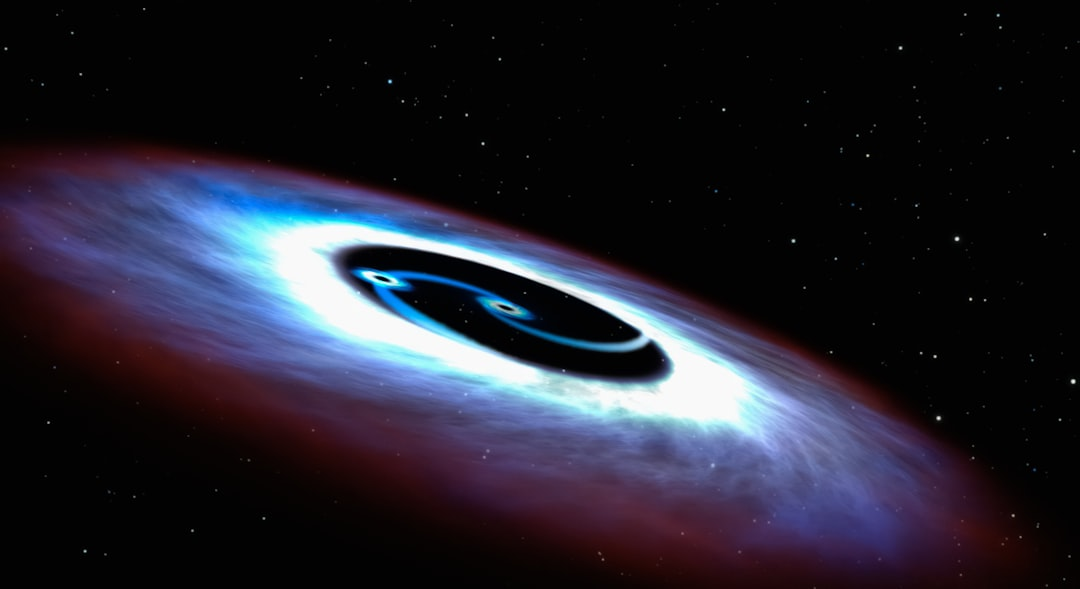
The concept of black holes is rooted deeply in Albert Einstein’s theory of General Relativity, which revolutionized our understanding of gravity itself. Unlike Newton’s classical view of gravity as a force, Einstein described it as a curvature of spacetime caused by mass and energy.
Understanding Black Hole Gravity: Benefits and Challenges
Pros
- ✔Advances fundamental physics and tests theories like General Relativity.
- ✔Provides crucial insights into galaxy formation and cosmic evolution.
- ✔Drives innovation in observational astrophysics and data analysis.
- ✔Inspires scientific curiosity and public engagement with astronomy.
Cons
- ✖Extreme observational difficulty due to their nature and vast distances.
- ✖Requires highly complex theoretical and mathematical frameworks.
- ✖Limited opportunities for direct experimental verification.
- ✖Demands significant resource investment in research and technology.
🌀 Spacetime Curvature
- ✅ Gravitational Wells: Massive objects like planets and stars create “dips” or “wells” in the fabric of spacetime, similar to how a bowling ball deforms a stretched rubber sheet. The more massive an object, the deeper the well.
- ➡️ Extreme Warping: Black holes represent the most extreme form of this curvature. Their immense mass compacted into such a tiny space creates an infinitely deep well, literally tearing a hole in the conventional understanding of spacetime. To explore this further, read our article on Black Hole Spacetime: Navigating Gravity’s Ultimate Warp.
💡 The Extreme Nature of Gravity
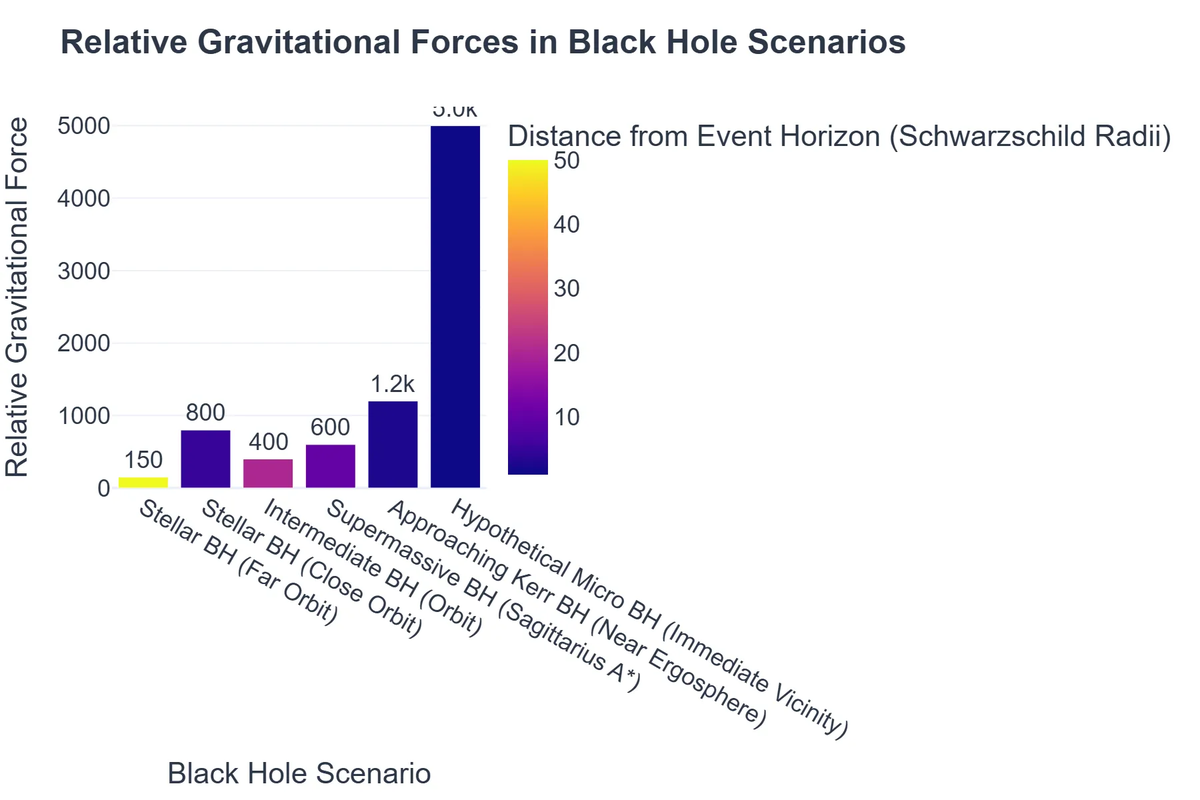
For celestial objects like Earth or the Sun, gravity diminishes with distance in a predictable way. However, near a black hole, this effect becomes dramatically amplified due to the extreme curvature:
- 📈 Exponential Increase: As you approach the singularity, the gravitational pull doesn’t just increase linearly; it escalates at an astonishing rate.
- ⚖️ Relative Strength: It’s not that a black hole has “infinite” gravity everywhere; rather, its gravitational influence at a given distance is proportional to its mass, just like any other object. The difference is how compact that mass is, leading to an incredibly strong pull up close.
The Event Horizon: Gravity’s Point of No Return
The event horizon is perhaps the most famous and unsettling feature of a black hole, representing the critical boundary where its gravitational force becomes insurmountable.
🎯 Defining the Event Horizon
- ✅ Escape Velocity: The event horizon is the precise distance from the black hole’s singularity where the escape velocity—the speed needed to break free from its gravitational pull—exceeds the speed of light. Since nothing can travel faster than light, anything that crosses this boundary is trapped forever.
- ➡️ One-Way Boundary: It’s a “point of no return,” but not a physical surface. There’s no wall or barrier; it’s a conceptual boundary defined by the gravitational field’s strength.
📏 Schwarzschild Radius Explained
For a non-rotating, uncharged black hole (known as a Schwarzschild black hole), the size of its event horizon is defined by its Schwarzschild Radius. This radius is directly proportional to the mass of the black hole.
- 💡 Mass Matters: A more massive black hole will have a larger event horizon. For example, if our Sun were to become a black hole, its Schwarzschild radius would be about 3 kilometers.
- 💡 Theoretical vs. Observed: While we cannot observe the event horizon directly, its effects on surrounding matter and light allow us to infer its presence. Learn more about its calculation and significance in our article on the Schwarzschild Black Hole and Radius: Understanding Spacetime.
Singularity: The Heart of the Black Hole
At the very core of a black hole, nestled within the event horizon, lies the singularity – a concept that pushes the boundaries of our current understanding of physics.
⚫ Infinite Density, Zero Volume
- ✅ Gravitational Collapse: According to general relativity, all the mass of the black hole collapses to an infinitely small, infinitely dense point at its center. This is the singularity.
- ➡️ Breakdown of Physics: At this point, spacetime curvature becomes infinite, and the known laws of physics cease to apply. It’s a region where our current mathematical models and theories fail.
❓ Beyond Our Current Understanding
While theoretical models predict the existence of singularities, they also highlight the limitations of current physics. Quantum gravity theories are being developed to reconcile general relativity with quantum mechanics, hoping to provide a more complete picture of what happens at a black hole’s core.
How Does Black Hole Gravity Affect Its Surroundings?
The immense gravitational force of a black hole doesn’t just impact objects that cross its event horizon; it profoundly influences the cosmic environment around it in several fascinating ways.
🌪️ Accretion Disks and Jets
- ✅ Feeding Frenzy: As gas, dust, and even stars approach a black hole, the gravitational force pulls them in. This matter doesn’t fall directly in; instead, it forms a rapidly spinning disk around the black hole called an accretion disk.
- ➡️ Extreme Heat and Light: The intense friction and compression within the accretion disk heat the material to millions of degrees, causing it to emit powerful X-rays and gamma rays, making black holes indirectly observable.
- 🚀 Relativistic Jets: Some black holes also produce powerful jets of plasma that are ejected outward at nearly the speed of light, perpendicular to the accretion disk. The exact mechanism for their formation is still an active area of research.
🍝 Tidal Forces: The Spaghettification Effect
- ✅ Differential Gravity: Due to the extreme gradient of a black hole’s gravitational field, the pull on the part of an object closer to the black hole is significantly stronger than on the part farther away.
- ➡️ Stretching and Tearing: This differential force creates powerful tidal forces, stretching objects vertically and compressing them horizontally—a process famously dubbed “spaghettification.”
🔍 Gravitational Lensing
Just as a glass lens can bend light, the powerful gravity of a black hole can bend the path of light rays that pass near it. This phenomenon is known as gravitational lensing.
- 💡 Distorted Images: When light from distant galaxies passes by a black hole, its path is warped, creating distorted, magnified, or even multiple images of the background object.
- 📸 Observational Tool: Gravitational lensing provides a powerful tool for astronomers to detect and study black holes, even if they are not directly visible. This is how we get those incredible images, as discussed in What Does a Black Hole Look Like? Event Horizon Telescope Images.
Black Hole Gravity vs. Other Celestial Objects
A common misconception is that black holes are like cosmic vacuum cleaners, indiscriminately sucking up everything in their path. This is not accurate. The gravitational force of a black hole, while intense up close, still obeys the same fundamental laws of gravity as any other massive object.
📏 Distance Matters Most
- ✅ Orbital Mechanics: If you replaced our Sun with a black hole of the exact same mass, Earth’s orbit would remain unchanged. The black hole’s gravitational pull at Earth’s distance would be identical to the Sun’s.
- ➡️ Proximity is Key: An object only falls into a black hole if it gets close enough to be captured by its event horizon. This is why black holes can exist peacefully at the centers of galaxies, with stars orbiting them for billions of years.
💡 Why Black Holes Don’t “Suck Up” Everything
The fear of black holes indiscriminately devouring everything is largely unfounded. Their gravitational influence, at a significant distance, is no different than that of any other object of the same mass. As explained by sources like NASA Science, a black hole’s pull is only extreme very close to it.
- ✅ Stable Orbits: Many stars and gas clouds maintain stable orbits around supermassive black holes in galactic centers, demonstrating that only objects within a certain proximity are at risk of being pulled in.
- ➡️ No “Extra” Gravity: A black hole doesn’t possess some mysterious “extra” gravity; it’s simply the result of an immense amount of mass packed into an incredibly small space, making its gravitational field extremely strong at close range.
Recommended Video
Conclusion: Probing the Mysteries of the Universe
Understanding black hole gravity is not just an academic exercise; it’s a journey into the most extreme environments in the universe, pushing the boundaries of our physical understanding. From the spacetime-warping effects predicted by General Relativity to the bizarre physics of the event horizon and singularity, black holes continue to challenge and inspire scientists.
These cosmic behemoths are not merely destructive forces but active participants in galactic evolution, influencing star formation, galaxy growth, and the dynamics of the universe on grand scales. As we continue to refine our observational tools and theoretical models, the mysteries of black hole gravity will undoubtedly lead us to deeper insights into the very nature of space, time, and the universe itself. Explore more cosmic wonders by visiting our main page: Cosmic Queries: Probing the Mysteries of the Universe.
Frequently Asked Questions
What is a black hole?
A black hole is a region of spacetime where gravity is so strong that nothing—no particles or even electromagnetic radiation such as light—can escape from it. It typically forms from the remnant of a massive star’s gravitational collapse.
How does black hole gravity affect time?
According to Einstein’s theory of general relativity, the intense gravity near a black hole causes significant time dilation, meaning time passes more slowly for an observer closer to the black hole compared to an observer far away.
Can black holes ‘suck in’ everything in the universe?
No, black holes only exert a strong gravitational pull over objects that come very close to them, typically within their event horizon. Their gravitational influence weakens with distance, similar to any other massive object. Our solar system is not at risk of being swallowed by a black hole.
What is the event horizon?
The event horizon is the boundary around a black hole beyond which nothing can escape, not even light. It is often referred to as the ‘point of no return’ because the escape velocity within this boundary exceeds the speed of light.