

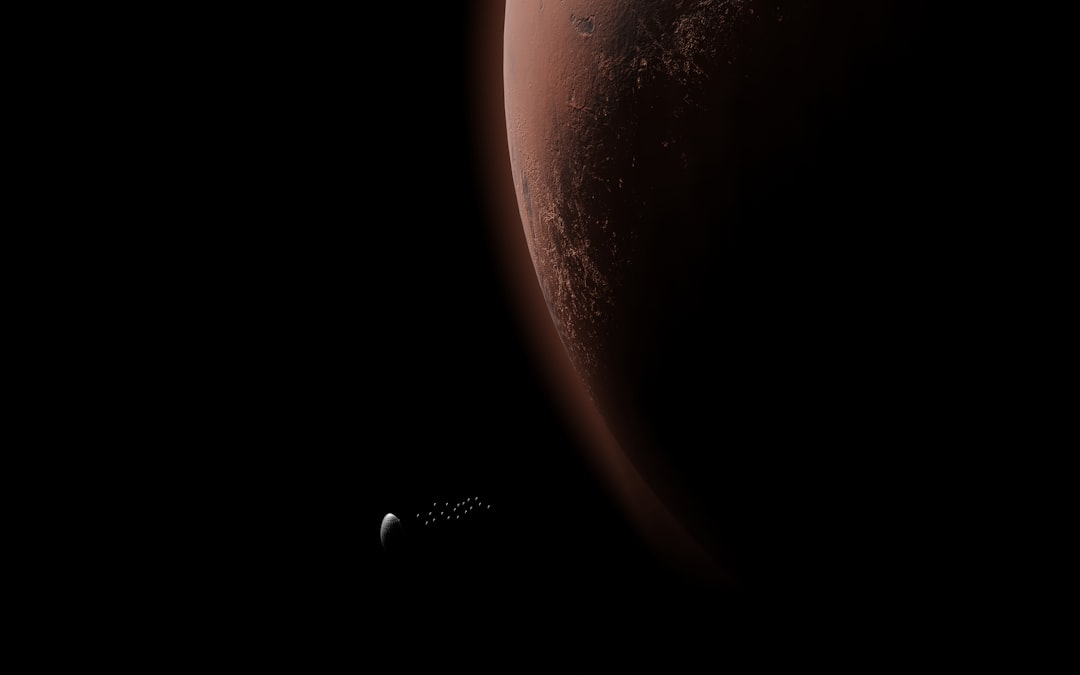
Spacecraft Flybys: Exploring Distant Worlds
The vastness of space holds countless mysteries, and for decades, humanity has sought to unravel them. Among the most effective and fascinating methods of initial reconnaissance is the flyby spacecraft – a sophisticated probe designed to make a close, high-speed pass by a celestial body, gathering as much data as possible in a fleeting encounter. These missions are instrumental in our quest to understand distant worlds, from the gas giants of our outer solar system to the frigid outposts of the Kuiper Belt.
💡 Key Takeaways
- Spacecraft flybys are cost-effective methods for initial reconnaissance of distant celestial bodies.
- They provide crucial, high-resolution data on planetary atmospheres, magnetic fields, and surface features.
- Missions like Voyager and New Horizons exemplify the profound scientific insights gained from flyby encounters.
- Flybys often serve as precursors for more complex orbital or lander missions, charting future exploration pathways.
“Flybys are cosmic snapshots, brief but profound glimpses that don’t just inform our science, they ignite our imagination, pushing the boundaries of what we conceive is possible for humanity’s reach among the stars.”
— Astrid Bellweather, Astrophysicist & Science Fiction Consultant
In this comprehensive guide, we’ll delve into the mechanics, triumphs, and future of planetary flybys, demonstrating why they remain a cornerstone of modern space exploration techniques.
In This Article
- → Spacecraft Flybys: Exploring Distant Worlds
- — 💡 Key Takeaways
- → What is a Spacecraft Flyby? 🚀
- — The Basics of Close Encounters
- — Gravity Assist Maneuvers: A Cosmic Slingshot
- → Why Flybys Are Crucial Space Exploration Techniques 🔭
- — Cost-Effectiveness and Reach
- — Initial Reconnaissance and Survey
- — Studying Transient Phenomena
- → Iconic Flyby Missions and Their Discoveries ⭐
- — The Grand Tour: Voyager 1 & 2
- — Pioneering Pluto: New Horizons
- — Cassini-Huygens and Galileo Flybys
- → The Science Behind a Successful Flyby 🔬
- — Precision Navigation and Timing
- — Payloads for Data Collection
- — Challenges: Speed, Radiation, and Data Transmission
- → Limitations and Future of Flyby Missions 🚧
- — Brief Observation Window
- — Planetary Protection Considerations
- — Next-Generation Flyby Concepts
- → Conclusion: Unveiling the Universe, One Flyby at a Time
What is a Spacecraft Flyby? 🚀
At its core, a spacecraft flyby is a method of space exploration where a probe passes close to a celestial body without entering orbit or landing. This allows for rapid reconnaissance and the collection of valuable scientific data about planets, moons, asteroids, or comets that would otherwise be inaccessible or too costly to visit with orbiters or landers.
The Basics of Close Encounters
- ✅ Swift Observation: Unlike orbiters, which spend extended periods studying a body, flyby missions capture a snapshot, observing the target from various angles during a short window.
- ➡️ Data Collection: Even in a brief encounter, advanced instruments can measure magnetic fields, analyze atmospheric compositions, capture high-resolution imagery, and much more.
- 💡 Initial Surveys: Flybys often serve as initial scouts, providing critical information that helps scientists decide if more dedicated missions (like orbiters or landers) are warranted in the future.
Gravity Assist Maneuvers: A Cosmic Slingshot
One of the most critical aspects of many flyby missions is the use of a “gravity assist” or “gravitational slingshot.” This technique involves a spacecraft swinging close to a planet to harness its gravitational pull, altering the probe’s speed and/or trajectory without expending significant amounts of precious onboard fuel.
- ✅ Fuel Efficiency: Gravity assists reduce the amount of propellant needed for a mission, making it possible to reach distant targets faster and with smaller launch vehicles.
- ➡️ Trajectory Optimization: By strategically using planetary gravity, mission planners can bend a spacecraft’s path, redirecting it to new targets across the solar system.
- 💡 Multi-Target Missions: This technique enabled missions like Voyager to visit multiple planets, using each encounter to slingshot towards the next.
Why Flybys Are Crucial Space Exploration Techniques 🔭
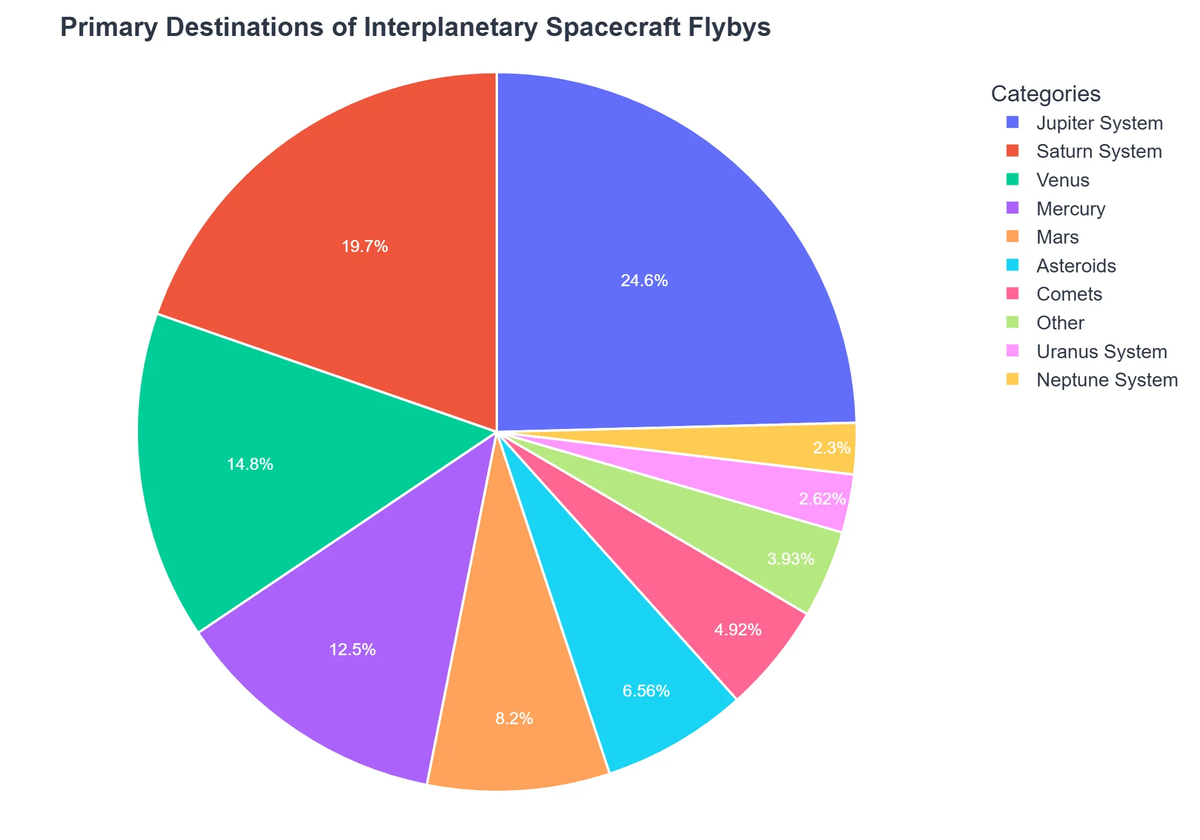
Flybys offer unique advantages that make them indispensable to our understanding of the cosmos, complementing other space exploration techniques.
Cost-Effectiveness and Reach
Launching a mission to deep space is an incredibly expensive undertaking. Flybys, by their very nature, often present a more cost-effective approach to exploring the outer solar system and beyond. They typically require less fuel and can be designed to visit multiple targets, maximizing scientific return per mission.
- ✅ Resource Optimization: Fewer fuel requirements mean lighter spacecraft and less powerful (and expensive) rockets needed for launch.
- ➡️ Distant Targets: They allow us to explore the most remote corners of our solar system, often where an orbiter would be too complex or impossible to sustain.
Initial Reconnaissance and Survey
Before committing to a long-duration orbital mission or a complex landing, a flyby can provide invaluable reconnaissance. It helps assess potential hazards, identify areas of interest, and refine scientific objectives for future, more focused missions. For instance, early Mars flybys paved the way for orbiters and rovers.
Studying Transient Phenomena
Flybys are also ideal for studying objects that are not permanently fixed, such as comets or asteroids on their paths through the solar system. A spacecraft can be precisely timed to intercept and observe these fleeting targets up close, providing data that could not be gathered from Earth-based telescopes.
Iconic Flyby Missions and Their Discoveries ⭐
Throughout history, several spacecraft have redefined our understanding of the universe through spectacular planetary flybys.
The Grand Tour: Voyager 1 & 2
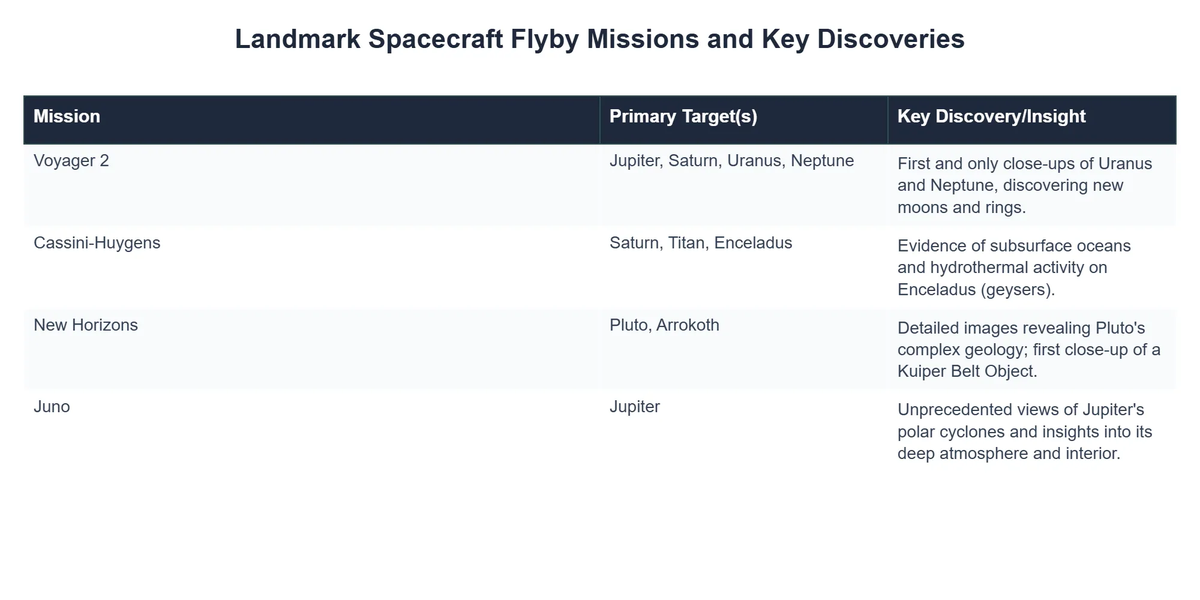
Launched in 1977, the Voyager probes famously undertook a “Grand Tour” of the outer solar system, leveraging a rare planetary alignment. Voyager 1 performed flybys of Jupiter and Saturn, while Voyager 2 visited Jupiter, Saturn, Uranus, and Neptune, becoming the only spacecraft to ever visit the latter two ice giants.
- ✅ Jupiter: Discovered active volcanoes on Io and detailed the Great Red Spot.
- ➡️ Saturn: Revealed intricate details of its ring system and moons.
- 💡 Uranus & Neptune: Provided our first close-up images and data, revealing their unique atmospheric compositions, magnetic fields, and strange moons.
Today, both Voyagers continue their journey into interstellar space, serving as humanity’s farthest ambassadors. Learn more about their incredible journey on the official JPL website.
Pioneering Pluto: New Horizons
The New Horizons mission, launched in 2006, revolutionized our understanding of Pluto and the Kuiper Belt. In July 2015, it performed a breathtaking flyby of Pluto and its moons, revealing a surprisingly geologically active world. Then, on New Year’s Day 2019, it conducted the most distant flyby in history, passing by the Kuiper Belt object Arrokoth (formerly Ultima Thule).
- ✅ Pluto: Unveiled a heart-shaped nitrogen glacier, vast mountain ranges of water ice, and a complex atmosphere.
- ➡️ Arrokoth: Showed it to be a pristine “contact binary” – two lobes that gently merged – providing clues to the early formation of planets.
The mission’s principal investigator, Alan Stern, has described these encounters as truly transformative. You can read an interview about the mission’s encounters with distant worlds on Space.com.
Cassini-Huygens and Galileo Flybys
While primarily orbiters, missions like Cassini (to Saturn) and Galileo (to Jupiter) also performed crucial flybys before achieving orbit. Galileo famously used multiple gravity assists from Venus and Earth to reach Jupiter, performing its own observations during these passes. Cassini conducted flybys of Jupiter on its way to Saturn, gathering data and testing instruments.
The Science Behind a Successful Flyby 🔬
Executing a successful flyby is an astonishing feat of engineering and precision.
Spacecraft Flybys: Benefits and Drawbacks of Distant Exploration
Pros
- ✔Cost-effective for initial reconnaissance of distant objects.
- ✔Enables exploration of multiple celestial bodies in one mission.
- ✔Allows reaching very distant targets faster than orbital missions.
- ✔Gathers valuable preliminary data without complex orbit insertion.
Cons
- ✖Provides only brief observation windows at the target.
- ✖Limited time for data collection and high-resolution imaging.
- ✖Cannot conduct long-term studies or detailed surface mapping.
- ✖No opportunity for in-situ measurements or sample collection.
Precision Navigation and Timing
Achieving a successful flyby requires incredible precision. Spacecraft must be aimed at a target hundreds of millions or even billions of kilometers away, arriving at a specific point in space and time with extreme accuracy. Even minor errors in trajectory can lead to a missed target or an unoptimized flyby.
- ✅ Deep Space Network: Communication and tracking rely on powerful antenna arrays like NASA’s Deep Space Network to send commands and receive data across vast distances.
- ➡️ Onboard Autonomy: Spacecraft often have a degree of autonomy to make real-time adjustments, crucial for targets where communication delays are minutes or hours long.
Payloads for Data Collection
Each flyby spacecraft carries a suite of scientific instruments tailored to its mission objectives. These typically include:
- ✅ Imagers: Cameras to capture visible light, infrared, and ultraviolet images.
- ➡️ Spectrometers: Instruments to analyze the composition of atmospheres, surfaces, and rings.
- 💡 Magnetometers: To measure magnetic fields and their interactions with the solar wind.
- ⚛️ Dust Detectors: To count and analyze particles in the space environment.
Challenges: Speed, Radiation, and Data Transmission
Despite their benefits, flybys come with unique challenges:
- ✅ High Speed: The very speed that allows for rapid exploration also limits observation time, making precise instrument pointing critical.
- ➡️ Radiation Environments: Passing close to gas giants exposes spacecraft to intense radiation belts, which can degrade electronics.
- 💡 Limited Data Downlink: The vast distances mean data transmission rates are often low, requiring careful prioritization of which data to send back.
For more on the complexities of operating spacecraft in various environments, you might find our article on Orbiter Spacecraft: Eyes and Ears in Planetary Exploration informative.
Limitations and Future of Flyby Missions 🚧
While incredibly powerful for initial reconnaissance, flybys do have inherent limitations.
How Aura Analytics Accelerated Market Insights with ‘Flyby’ Data Scans
❓The Challenge
Clients of Aura Analytics frequently required swift, cost-effective market viability assessments for new and niche digital product categories, a need traditional exhaustive research methods struggled to meet quickly or affordably.
💡The Solution
Inspired by the efficiency of spacecraft flybys, Aura Analytics developed a ‘Rapid Market Scan’ service. This approach involved high-speed, targeted data reconnaissance across diverse online platforms, quickly identifying key trends and competitor movements without the full commitment of a deep-dive study. They utilized automated data parsing as a ‘gravity assist’ to efficiently pivot and optimize data collection for multiple emerging niches simultaneously.
🏆The Result
This innovative ‘flyby’ methodology decreased their average market assessment turnaround time by 40% and led to a 25% increase in preliminary market viability study projects.
Brief Observation Window
The primary limitation is the short duration of the encounter. A flyby provides a snapshot, not a continuous, long-term study. This makes it difficult to observe dynamic processes, seasonal changes, or the long-term evolution of a planetary system, which are better suited for orbital missions.
Planetary Protection Considerations
With increasing exploration, ensuring that we don’t contaminate potentially habitable worlds with Earth microbes is paramount. Flyby missions, especially those targeting icy moons like Europa or Enceladus, must adhere to strict planetary protection protocols to minimize this risk. This is particularly important for missions venturing into regions where water might exist. The National Academies Press offers detailed assessments on this topic.
Next-Generation Flyby Concepts
Despite limitations, the concept of the flyby remains vital. Future missions might leverage flybys for:
- ✅ Interstellar Probes: Sending probes beyond our solar system, using solar gravity assists or other advanced propulsion.
- ➡️ Multi-Target Asteroid/Comet Tours: Rapidly surveying multiple small bodies in the inner or outer solar system.
- 💡 Enhanced Reconnaissance: Utilizing improved sensor technology and autonomous navigation to get even more out of fleeting encounters.
As we continue our search for life and understanding beyond Earth, flybys will undoubtedly play a role in exploring targets like Exoplanets: The Hunt for Habitable Worlds Beyond Our Solar System and even specific intriguing targets like GJ 1214 b: Exploring a Waterworld Exoplanet.
Recommended Video
Conclusion: Unveiling the Universe, One Flyby at a Time
From the pioneering journeys of Voyager to the groundbreaking discoveries of New Horizons, spacecraft flybys have consistently pushed the boundaries of human knowledge. These daring missions, characterized by precision engineering and scientific ingenuity, have transformed our understanding of the solar system, providing invaluable insights into distant planets, their moons, and other celestial bodies.
As technology advances, flybys will continue to be a crucial tool in our arsenal for space exploration, enabling us to scout new frontiers and deepen our comprehension of the universe’s grand design. They are a testament to our enduring curiosity, inspiring generations to ask the profound questions that drive all of Cosmic Queries: Probing the Mysteries of the Universe.
Frequently Asked Questions
What exactly is a spacecraft flyby?
A spacecraft flyby occurs when a probe passes close to a celestial body, gathering data and images without entering orbit or landing. It’s a quick, data-rich encounter.
Why are flybys crucial for planetary exploration?
Flybys are vital for initial reconnaissance, offering insights into distant, difficult-to-reach worlds. They are often less resource-intensive than orbital insertions and can use gravity assists to reach multiple targets.
Can you name some famous spacecraft flyby missions?
Iconic missions include the Voyager probes, which performed flybys of all the outer giant planets, and New Horizons, famous for its close passes by Pluto and Arrokoth.
What kind of data do spacecraft collect during a flyby?
During a flyby, spacecraft collect high-resolution images, analyze atmospheric compositions, measure magnetic fields, and gather data on surface temperatures and geological features, providing a wealth of information in a short period.