The cosmos is a stage for the most spectacular and violent events imaginable. Among these, few capture the imagination as profoundly as the moment a star, wandering too close to the gravitational abyss, is torn apart and consumed by a black hole. While such encounters are rare, astronomers occasionally witness these celestial feeding frenzies, offering unprecedented glimpses into the extreme physics of the universe.
💡 Key Takeaways
- SWIFT J1644+57 represents a unique, direct observation of a supermassive black hole consuming a star.
- This ‘stellar meal’ is known as a Tidal Disruption Event (TDE), where a star is stretched and torn by intense gravitational forces.
- The event released immense X-ray and gamma-ray flares, providing crucial data on black hole feeding mechanisms.
- Observations from this event help astronomers understand the extreme physics near black holes and galaxy evolution.
“SWIFT J1644+57 isn’t just a fascinating astronomical event; it’s a cosmic horror story played out on an unimaginable scale, showing us the raw, destructive power that underpins the elegance of the universe. It’s the ultimate special effect.”
— Astrid Bellweather, Astrophysicist & Science Fiction Consultant
One of the most remarkable observations of this cosmic drama unfolded with the detection of SWIFT J1644+57. This extraordinary event provided scientists with a front-row seat to a violent `tidal disruption event` (TDE), where a star met its ultimate demise at the clutches of a supermassive black hole. Far from a fleeting flash, SWIFT J1644+57 presented a prolonged, powerful X-ray beacon, making it a unique and invaluable case study in the mysteries of black hole accretion and relativistic jets.
In This Article
- — 💡 Key Takeaways
- → What is SWIFT J1644+57? Decoding the Cosmic Anomaly
- — 🔭 The Discovery and Initial Mystery
- — 🔬 The Signature of a Feeding Black Hole
- → The Violent Act: How a Black Hole Consumes a Star
- — 💥 Understanding Tidal Disruption Events (TDEs)
- — 🌀 Accretion Disks and Jets
- → The Uniqueness of SWIFT J1644+57’s Outburst
- — 💡 A Long-Lasting X-Ray Beacon
- — 🎯 Pointing Directly at Earth
- → Scientific Insights Gained from SWIFT J1644+57
- — 🔬 Testing Extreme Physics
- — 📊 Refining TDE Models
- → The Broader Context: Black Holes in the Universe
- — 🌌 Supermassive Black Holes and Galaxies
- — 🌠 Other Stellar Encounters
- → The Future of Studying Stellar Meals
- — 🚀 Next-Generation Telescopes and Surveys
- — ❓ Unanswered Questions
- → Conclusion
What is SWIFT J1644+57? Decoding the Cosmic Anomaly
In March 2011, NASA’s Swift satellite, a versatile observatory designed to detect gamma-ray bursts, picked up an unusual and persistent burst of X-rays from a distant galaxy. This signal, designated SWIFT J1644+57, didn’t fit the profile of a typical gamma-ray burst or supernova. Instead, it behaved like something far more exotic: a supermassive black hole devouring an unfortunate star.
🔭 The Discovery and Initial Mystery
- ✅ Unprecedented X-ray Luminosity: The observed X-ray emission from SWIFT J1644+57 was incredibly bright, hundreds of times more luminous than any typical X-ray source. Its brilliance indicated an extreme energy release.
- ✅ Prolonged Activity: Unlike a fleeting gamma-ray burst, the intense X-ray emission persisted for months, then years, though slowly decaying. This longevity was a key clue that something fundamentally different was occurring.
- ✅ Unusual Location: The source was traced to the center of a distant galaxy, about 3.9 billion light-years away, a strong indicator that a supermassive black hole was involved.
🔬 The Signature of a Feeding Black Hole
Astronomers quickly deduced that SWIFT J1644+57 was the signature of a rare cosmic event: a star wandering too close to a supermassive black hole and being ripped apart by its immense gravitational forces. This phenomenon is known as a `tidal disruption event` (TDE). What made SWIFT J1644+57 truly unique was not just the disruption itself, but the nature of the energy outflow.
The incredible brightness and persistence were best explained by the formation of a powerful, relativistic jet of particles emanating from the vicinity of the black hole, oriented almost directly towards Earth. This “on-axis” view provided an unparalleled opportunity to study the extreme physics at play when a black hole consumes a star.
The Violent Act: How a Black Hole Consumes a Star
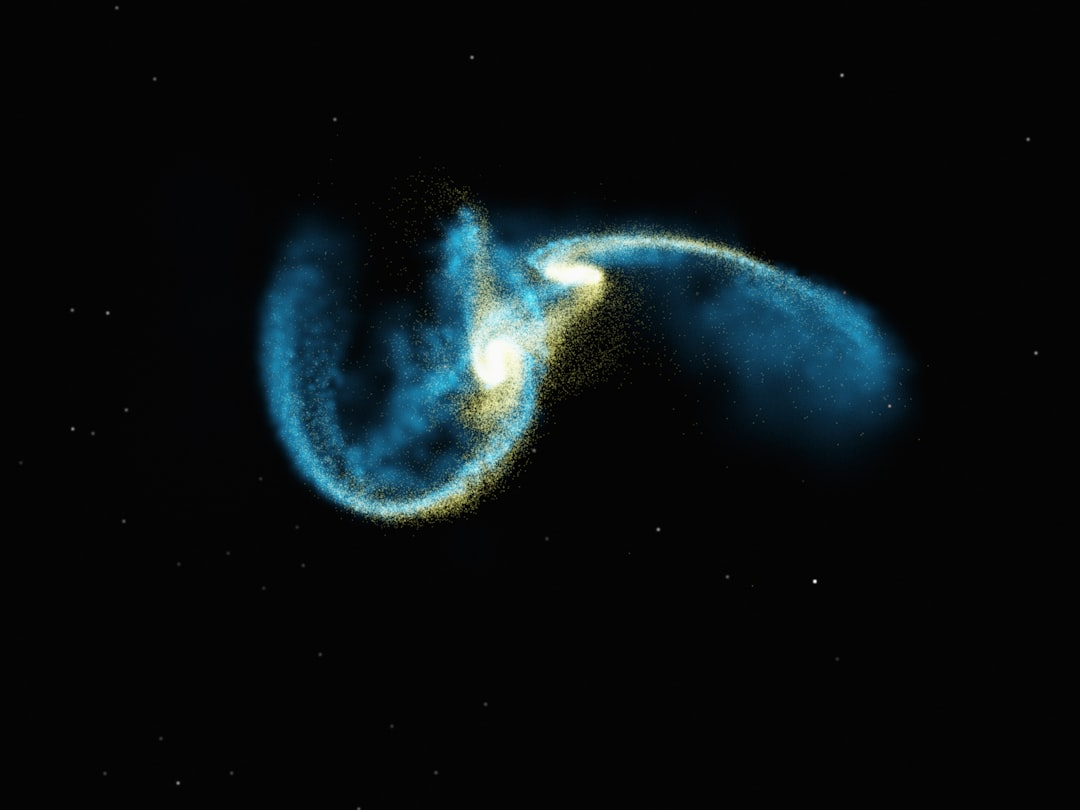
When a star ventures too close to a black hole, it crosses a gravitational threshold where the black hole’s tidal forces overwhelm the star’s own self-gravity. The result is a spectacular and violent transformation.
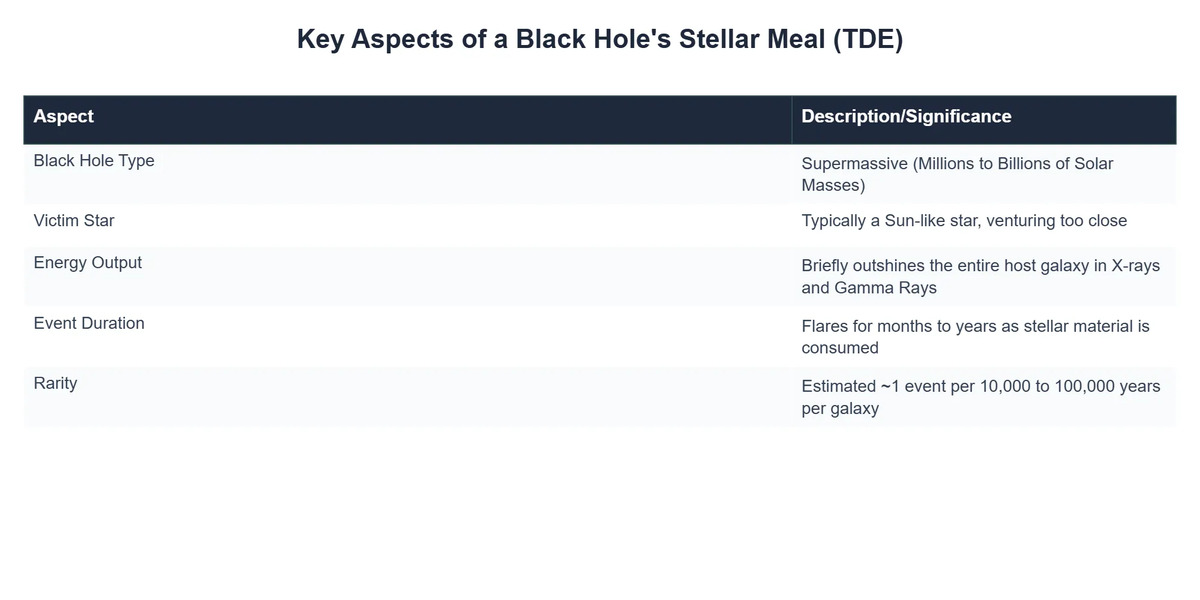
💥 Understanding Tidal Disruption Events (TDEs)
- ➡️ Gravitational Gradient: The black hole’s gravity pulls on the side of the star closer to it much more strongly than on the far side. This differential pull stretches the star into an elongated shape, a process colloquially known as “spaghettification.”
- ➡️ Stellar Demise: Once stretched beyond its breaking point, the star disintegrates into a stream of gas and dust. About half of this stellar material is ejected outwards, while the other half falls towards the black hole.
- ➡️ Accretion Disk Formation: The infalling material does not plunge directly into the black hole. Instead, it forms a rapidly rotating, superheated accretion disk around the black hole, spiraling inwards like water down a drain. This process generates immense heat and friction.
For a broader understanding of how black holes warp spacetime and the boundaries around them, explore Schwarzschild Black Hole and Radius: Understanding Spacetime.
🌀 Accretion Disks and Jets
The friction within the newly formed accretion disk heats the gas to millions of degrees, causing it to emit copious amounts of X-rays and visible light. In some cases, particularly with rapidly spinning black holes, a fraction of this infalling material can be launched outwards at nearly the speed of light, forming powerful, collimated jets. These are known as relativistic jets.
The energy released during this process can outshine the combined light of billions of stars for a brief period, providing a dramatic beacon for astronomers across billions of light-years.
The Uniqueness of SWIFT J1644+57’s Outburst
While theoretical models had long predicted `tidal disruption event`s, SWIFT J1644+57 offered something truly novel that transformed our understanding of these phenomena.
💡 A Long-Lasting X-Ray Beacon
Most observed TDEs result in bright, but relatively short-lived, flares of X-ray or UV emission as the star’s material is consumed. SWIFT J1644+57, however, maintained an astonishingly high level of X-ray brightness for months, and continued to be detectable for years, albeit with decreasing intensity. This extended luminosity suggested a more efficient and sustained feeding process or, more likely, a unique viewing geometry.
🎯 Pointing Directly at Earth
The consensus among astronomers is that the extraordinary nature of SWIFT J1644+57 stemmed from the fact that it produced a powerful relativistic jet, and that jet happened to be aimed almost directly at Earth. Imagine a cosmic flashlight pointed right at you. This “on-axis” orientation dramatically boosted the apparent brightness of the event, making it appear far more luminous than if the jet had been pointed elsewhere. Such jets are common in active galactic nuclei (AGNs), but observing one from a newly forming accretion disk during a TDE was unprecedented. This direct view provided a unique laboratory for studying the birth and evolution of these powerful cosmic accelerators.
Scientific Insights Gained from SWIFT J1644+57
The prolonged, bright emission from SWIFT J1644+57 turned it into a crucial cosmic laboratory, offering invaluable data to test and refine our understanding of extreme astrophysical processes.
🔬 Testing Extreme Physics
- ✅ Jet Formation Mechanisms: The observation provided direct evidence for the rapid formation of relativistic jets during a TDE. This helps scientists understand the conditions necessary for such jets to form and the role of black hole spin in their creation.
- ✅ Accretion Disk Dynamics: The detailed light curve allowed researchers to probe the dynamics of the newly formed accretion disk around a supermassive black hole, observing how the stellar debris settles into orbit and fuels the central engine.
- ✅ General Relativity in Action: The extreme gravitational environment near a black hole offers unique opportunities to test Einstein’s theory of general relativity under conditions impossible to replicate in Earth-bound laboratories.
📊 Refining TDE Models
Before SWIFT J1644+57, many TDE models focused on isotropic emission (radiation going out in all directions). This event highlighted the importance of relativistic beaming and the potential for TDEs to launch powerful jets. It forced a re-evaluation of how TDEs are categorized and how frequently we might be missing them if their jets are not pointed towards us. This discovery helped diversify the theoretical landscape of TDEs, leading to new ways of interpreting different types of observed flares.
For more on observable black holes, consider exploring the details of the M87 Black Hole: First Image of a Cosmic Giant, which provides a different kind of direct observational evidence.
The Broader Context: Black Holes in the Universe
SWIFT J1644+57 is just one compelling example of how black holes shape the cosmos. These enigmatic objects are fundamental to galactic evolution and the structure of the universe.
🌌 Supermassive Black Holes and Galaxies
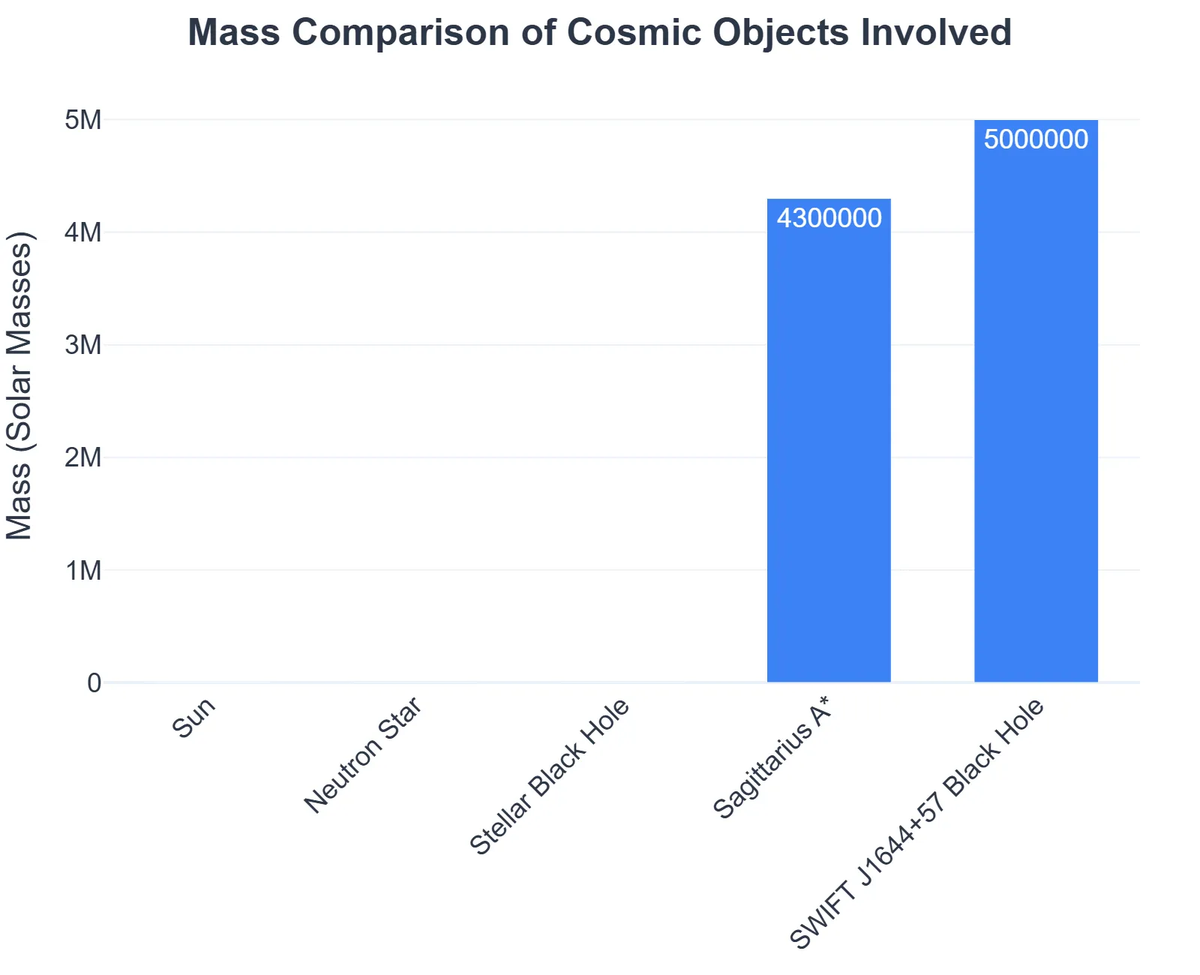
It is now widely accepted that nearly every large galaxy harbors a supermassive black hole at its core, with masses ranging from millions to billions of times that of our Sun. These behemoths are not merely passive residents; they play a crucial role in the formation and evolution of their host galaxies, influencing star formation rates and the distribution of gas and dust. Tidal disruption events like SWIFT J1644+57 offer rare opportunities to observe these dormant giants “waking up” and actively feeding, providing direct evidence of their presence and immense gravitational power.
To dive deeper into the overarching themes of cosmic exploration, delve into our pillar page: Cosmic Queries: Probing the Mysteries of the Universe.
SWIFT J1644+57: Unveiling a Black Hole’s Stellar Feast
Pros
- ✔Provides unprecedented direct observation of a star being consumed by a supermassive black hole.
- ✔Offers crucial empirical data to validate theoretical models of black hole accretion and jet formation.
- ✔Contributes significantly to understanding the growth and behavior of supermassive black holes in galactic centers.
- ✔Demonstrates the power of multi-wavelength astronomy in capturing transient high-energy cosmic events.
Cons
- ✖Such tidal disruption events (TDEs) are extremely rare, limiting opportunities for systematic study.
- ✖The transient and short-lived nature of the bright phases makes real-time, detailed observation challenging.
- ✖Occurs in distant galaxies, making high-resolution follow-up observations difficult even with powerful telescopes.
- ✖Requires highly sophisticated and sensitive instrumentation across various wavelengths for detection and analysis.
🌠 Other Stellar Encounters
While a star being entirely consumed is dramatic, black holes engage in many other types of interactions. These can range from subtle gravitational perturbations to the spectacular mergers of two black holes, creating gravitational waves that ripple through spacetime. Understanding these diverse interactions is key to piecing together the full picture of black hole astrophysics.
What happens when a black hole eats a star? The outcome can vary depending on the black hole’s mass and the star’s proximity, as detailed by Astronomy.com.
The Future of Studying Stellar Meals
The observation of SWIFT J1644+57 marked a turning point in black hole astrophysics. As our observational capabilities advance, we anticipate discovering many more such events, further enriching our understanding.
🚀 Next-Generation Telescopes and Surveys
- ✅ Enhanced X-ray Observatories: Future X-ray telescopes will have greater sensitivity and wider fields of view, increasing the likelihood of detecting more distant and fainter TDEs.
- ✅ Transient Surveys: Ground-based optical and radio telescopes, participating in large-scale transient surveys, are continuously scanning the sky for sudden flashes of light, promising to uncover a wealth of TDEs, some perhaps with jets pointed away from Earth.
- ✅ Multi-Wavelength Follow-up: The key to fully understanding these events lies in rapid, multi-wavelength follow-up observations, from radio waves to gamma rays, to capture the full spectrum of energy released.
NASA highlights how the “cry of a shredded star” like SWIFT J1644+57 ushers in a new era for testing relativity, as seen on NASA.gov.
❓ Unanswered Questions
Despite the breakthroughs enabled by SWIFT J1644+57, many questions about `tidal disruption event`s remain unanswered:
- 💡 What are the exact conditions that lead to the formation of relativistic jets in TDEs?
- 💡 How do the properties of the star (mass, composition) influence the TDE aftermath?
- 💡 Can we detect TDEs whose jets are not pointed at Earth, and what are their signatures?
- 💡 How frequently do such events occur across the universe, and how do they impact the evolution of black holes and galaxies?
Recommended Video
Conclusion
SWIFT J1644+57 stands as a landmark observation in modern astronomy, a testament to the dynamic and often violent nature of our universe. It offered an unparalleled view of a supermassive black hole consuming a star and launching a powerful jet directly into our line of sight.
This single event revolutionized our understanding of `tidal disruption event`s, providing crucial insights into the formation of relativistic jets, the dynamics of accretion disks, and the extreme physics at play around black holes. As technology advances, observations like SWIFT J1644+57 will continue to push the boundaries of our knowledge, illuminating the darkest corners of the cosmos and revealing the profound forces that shape the universe we inhabit.
Frequently Asked Questions
What is SWIFT J1644+57?
It’s the designation for a distant galaxy where a supermassive black hole was observed consuming a star, triggering powerful emissions.
What is a Tidal Disruption Event (TDE)?
A TDE occurs when a star gets too close to a black hole and is torn apart by the black hole’s immense gravitational forces, stretching it into a stream of gas.
How was this event observed?
It was initially detected by the Swift Gamma-Ray Burst Explorer satellite due to the bright X-ray and gamma-ray flares produced as the star was devoured.
What did we learn from SWIFT J1644+57?
It provided unprecedented insights into how black holes devour stars, the formation of relativistic jets, and the extreme physics of accretion disks around black holes.