

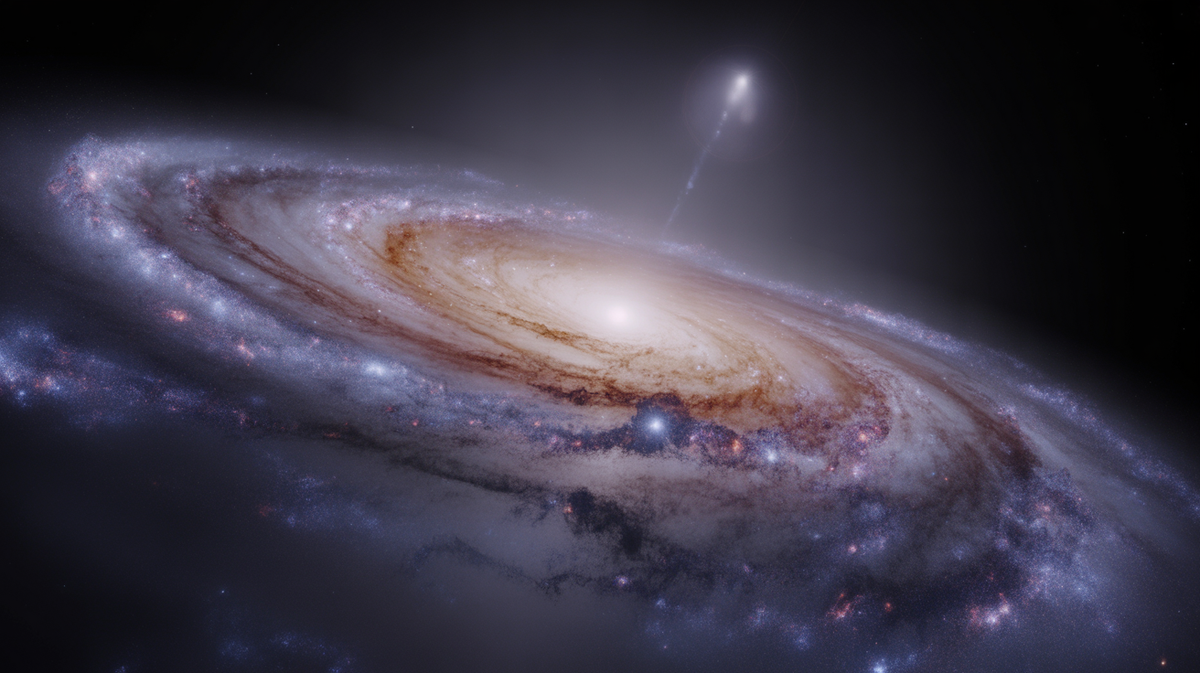
Unveiling Cosmic Nomads: The Enigma of Wandering Black Holes
In the vast, intricate tapestry of the cosmos, not all celestial bodies follow predictable paths. While supermassive black holes anchor galaxies and stellar black holes typically orbit companion stars, a peculiar class of gravitational titans defies these norms: the wandering black hole. These cosmic nomads traverse the galactic expanse, untethered and largely unseen, posing profound questions about their origins, behaviors, and the subtle yet significant impact they exert on the universe around them.
💡 Key Takeaways
- Wandering black holes are black holes ejected from their host galaxies or moving independently through intergalactic space.
- Their gravitational influence can disrupt stellar orbits, trigger star formation, or even lead to galactic collisions.
- Detecting these elusive objects is challenging, relying on indirect observational methods like gravitational lensing or X-ray emissions.
- Studying wandering black holes offers crucial insights into galaxy formation and the dynamics of massive objects in the universe.
“Wandering black holes are not just cosmic oddities; they are gravitational sculptors, silently shaping the very fabric of galaxies and offering profound clues about the universe’s most violent past.”
— Astrid Bellweather, Astrophysicist & Science Communicator
Understanding these rogue entities is crucial to piecing together the full narrative of galaxy evolution, stellar dynamics, and even the fate of stars and planets. This article delves into the fascinating world of free-floating black holes, exploring how they achieve their isolated existence, their potential influence on galactic structures, and the immense challenges involved in detecting these invisible giants.
In This Article
- → Unveiling Cosmic Nomads: The Enigma of Wandering Black Holes
- — 💡 Key Takeaways
- → What Are Wandering Black Holes?
- → How Do Black Holes Become Nomads?
- → The Galactic Impact of Wandering Black Holes
- → Observational Challenges and Future Prospects
- — 💡 How Do We Detect the Invisible?
- — 🚀 The Future of Rogue Black Hole Hunting
- — ❓ Frequently Asked Questions (FAQs) About Wandering Black Holes
What Are Wandering Black Holes?
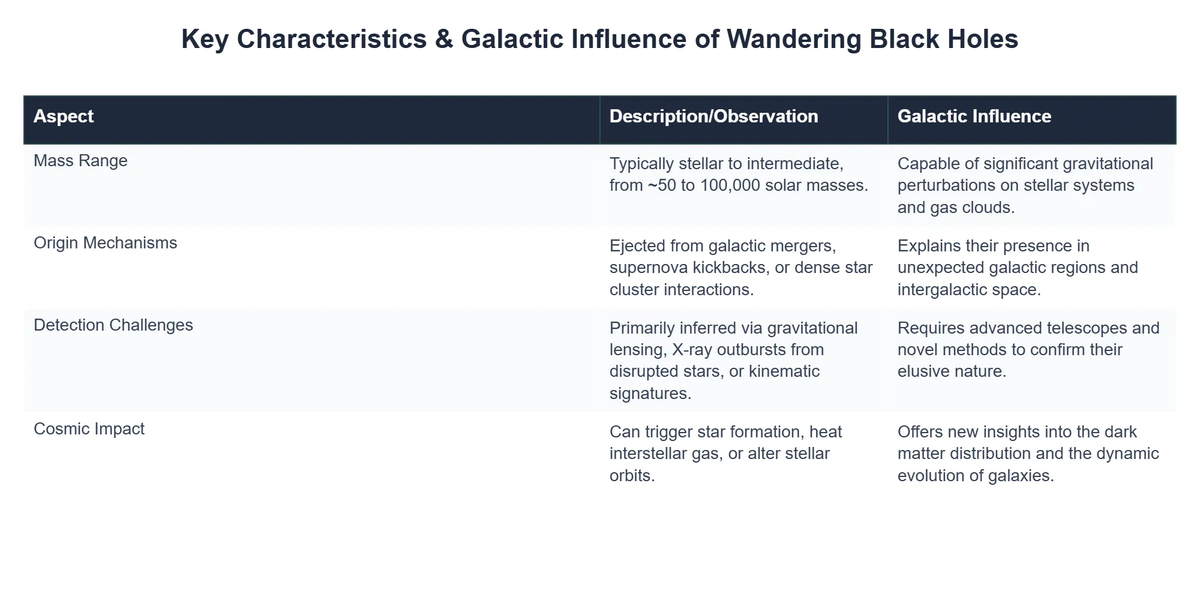
A wandering black hole, often referred to as a “rogue black hole” or “isolated black hole,” is a black hole that is not gravitationally bound to a specific star system or a galaxy’s central supermassive black hole. Unlike their more stationary counterparts, these cosmic entities drift through interstellar or intergalactic space, propelled by events that severed their original ties.
- ✅ Definition: A black hole existing independently, not part of a binary system or central galactic nucleus.
- ➡️ Size and Origin: Most theorized wandering black holes are stellar-mass black holes, formed from the collapse of massive stars. However, intermediate-mass black holes, or even ejected supermassive black holes from galaxy mergers, could also wander.
- 💡 Contrast: They differ from supermassive black holes (which sit at galactic centers) and stellar black holes (which typically remain in binary systems with their progenitor stars).
Their existence, long predicted by theory, has recently begun to gain observational support, primarily through gravitational microlensing events. For those keen to explore the broader context of these mysterious objects, our comprehensive guide on Cosmic Queries: Probing the Mysteries of the Universe offers a deeper dive into many cosmic phenomena.
How Do Black Holes Become Nomads?
The journey from a typical stellar remnant to a galactic wanderer is often violent and complex, driven by extreme gravitational interactions and explosive events. Several mechanisms are believed to kick black holes out of their stellar nurseries or galactic homes:
Unveiling Hidden Pathways: ‘AstroReach Marketing’ Maps Untracked Customer Journeys
❓The Challenge
AstroReach Marketing’s clients were observing inconsistent campaign performance, unable to pinpoint the subtle yet significant impact of untracked customer interactions—like ‘wandering black holes’—that occurred across diverse, unmonitored digital touchpoints.
💡The Solution
Inspired by the article’s focus on ‘detecting these invisible giants’ and understanding their ‘subtle yet significant impact,’ AstroReach Marketing implemented advanced multi-touch attribution and cross-device tracking tools, effectively ‘unveiling’ the previously ‘untethered’ customer journeys.
🏆The Result
This new visibility led to a 22% increase in marketing qualified leads (MQLs) and allowed for a 15% more efficient reallocation of ad spend by identifying previously undervalued conversion paths.
- 💥 Asymmetric Supernova Kicks: When a massive star collapses to form a black hole, the supernova explosion isn’t always perfectly symmetrical. If the explosion expels more material in one direction than another, the newly formed black hole receives a “kick” in the opposite direction, potentially ejecting it from its stellar cluster or even its host galaxy.
- 💫 Gravitational Slingshots in Multi-Body Systems: In dense stellar environments, such as globular clusters or galactic cores, a black hole can experience close encounters with other massive stars or compact objects. These interactions can act like a gravitational slingshot, imparting enough velocity to send the black hole hurtling into interstellar space.
- 🌀 Recoil from Binary Black Hole Mergers: When two black holes merge, the gravitational waves emitted during the final moments of their collision are not always uniform. This asymmetry can generate a “gravitational recoil” kick, potentially propelling the newly merged black hole away at immense speeds – sometimes thousands of kilometers per second. This phenomenon is also linked to concepts discussed in Einstein and Black Holes: Theory of Relativity’s Cosmic Legacy.
- 🌌 Ejection During Galaxy Mergers: While less common for stellar-mass black holes, supermassive black holes can also be ejected during the violent mergers of galaxies, especially if the new combined supermassive black hole receives a powerful recoil kick.
These ejection mechanisms contribute to a population of Rogue Black Holes: Wandering Giants of the Cosmos that roam the cosmos, silently influencing their surroundings.
The Galactic Impact of Wandering Black Holes
Though largely invisible, wandering black holes are not benign specters. Their sheer mass means they exert a significant gravitational influence, impacting the dynamics of the galaxy they traverse, even if encounters are rare.
- 🔭 Gravitational Perturbations: As a wandering black hole passes through star-forming regions or stellar clusters, its intense gravity can disturb the orbits of stars and gas clouds. This could potentially disrupt planetary systems, eject stars from their clusters, or even trigger new star formation by compressing gas.
- 🪐 Planetary Encounters: Perhaps one of the most intriguing possibilities is the interaction with planets. A wandering black hole could eject planets from their parent stars, creating new “rogue planets,” or, conversely, capture free-floating planets into orbit around itself, forming what are sometimes called “blanets.” Learn more about this fascinating scenario in Planets Around Black Holes: Unveiling Blanets and Rogue Planets.
- 💨 Accretion Signatures: While usually isolated and “hungry” for matter, if a wandering black hole happens to pass through a dense cloud of gas and dust, it can begin to accrete material. This accretion process could generate X-rays or other electromagnetic radiation, momentarily making the black hole detectable.
- ⭐ Influence on Galactic Evolution: While their direct encounters are rare, the cumulative gravitational effect of potentially millions of these objects could subtly contribute to the overall mass distribution and gravitational potential within a galaxy, influencing its long-term evolution.
The vastness of space makes a direct collision with Earth or our solar system an extremely remote possibility, though understanding the risks is part of cosmic safety; for more on that, see Could a Black Hole Threaten Earth? Understanding the Risk.

Observational Challenges and Future Prospects
Detecting a wandering black hole is one of the most formidable challenges in astrophysics. By their very nature, black holes do not emit light, making them invisible unless they are actively accreting matter or interacting gravitationally with luminous objects.
💡 How Do We Detect the Invisible?
- 🔭 Gravitational Microlensing: This is currently the most promising method. When a compact, massive object (like a black hole) passes in front of a more distant star, its gravity bends the starlight, causing the background star to appear temporarily brighter. The duration and shape of this brightening can reveal the mass of the lensing object. Recent observations by the Hubble Space Telescope have identified a potential candidate for a solitary stellar-mass black hole via this method. You can read more about such discoveries from sources like Live Science’s coverage of Hubble’s findings.
- ⚡ Accretion Signatures: If a wandering black hole encounters a sufficiently dense interstellar gas cloud, it could pull in material, forming an accretion disk that emits X-rays, radio waves, or other radiation. However, isolated black holes are unlikely to encounter such environments frequently enough to be consistently observed this way.
- 🌊 Gravitational Wave Detections: While individual wandering black holes don’t emit gravitational waves, their mergers with other black holes or neutron stars do. Observatories like LIGO and Virgo have detected numerous such events, though pinpointing the specific origin of each individual merging black hole as “wandering” before the merger is complex.
🚀 The Future of Rogue Black Hole Hunting
Upcoming astronomical missions are poised to revolutionize our ability to detect these elusive objects:
- 🌌 NASA’s Roman Space Telescope: Formerly known as WFIRST, the Roman Space Telescope is designed for wide-field infrared surveys, making it exceptionally well-suited to detect gravitational microlensing events. Its sensitivity and wide field of view could potentially discover thousands of wandering black holes and rogue planets. Learn more about its potential in NASA’s Exoplanet News.
- 📊 Gaia Mission: While not specifically designed for black holes, the European Space Agency’s Gaia mission, which precisely maps the positions and motions of billions of stars, could indirectly identify black holes by observing the peculiar gravitational wobbles they induce in nearby stars.
Understanding the population of wandering black holes is not just an academic exercise; it’s a vital step in comprehending the complete mass inventory of galaxies, the processes of stellar evolution, and the distribution of dark matter.
Recommended Video
❓ Frequently Asked Questions (FAQs) About Wandering Black Holes
What are wandering black holes?
Wandering black holes are black holes that are not gravitationally bound to a specific galaxy’s center but instead move through intergalactic or inter-cluster space.
How do wandering black holes form?
They can form when galaxies merge, ejecting supermassive black holes, or from the recoil of a binary black hole merger after gravitational wave emission.
What impact do they have on galaxies?
Their immense gravity can disrupt star clusters, alter galactic structures, trigger pockets of star formation, or even cause minor galactic mergers.
Are wandering black holes dangerous to Earth?
No, due to the vast distances in space and the extremely low probability of an encounter, wandering black holes pose no threat to Earth.