The vast expanse of our solar system holds countless secrets, and among its most ancient and enigmatic inhabitants are the Trojan asteroids orbiting Jupiter. These cosmic relics, trapped in gravitational sweet spots, are believed to be pristine remnants from the dawn of our solar system, holding clues to its formation and evolution. Enter the Lucy spacecraft mission, NASA’s groundbreaking endeavor to explore these distant, untouched worlds.
💡 Key Takeaways
- The Lucy mission is the first spacecraft to visit Jupiter’s Trojan asteroids, which share Jupiter’s orbit around the Sun.
- Trojan asteroids are believed to be pristine remnants from the early solar system, offering clues to planetary formation.
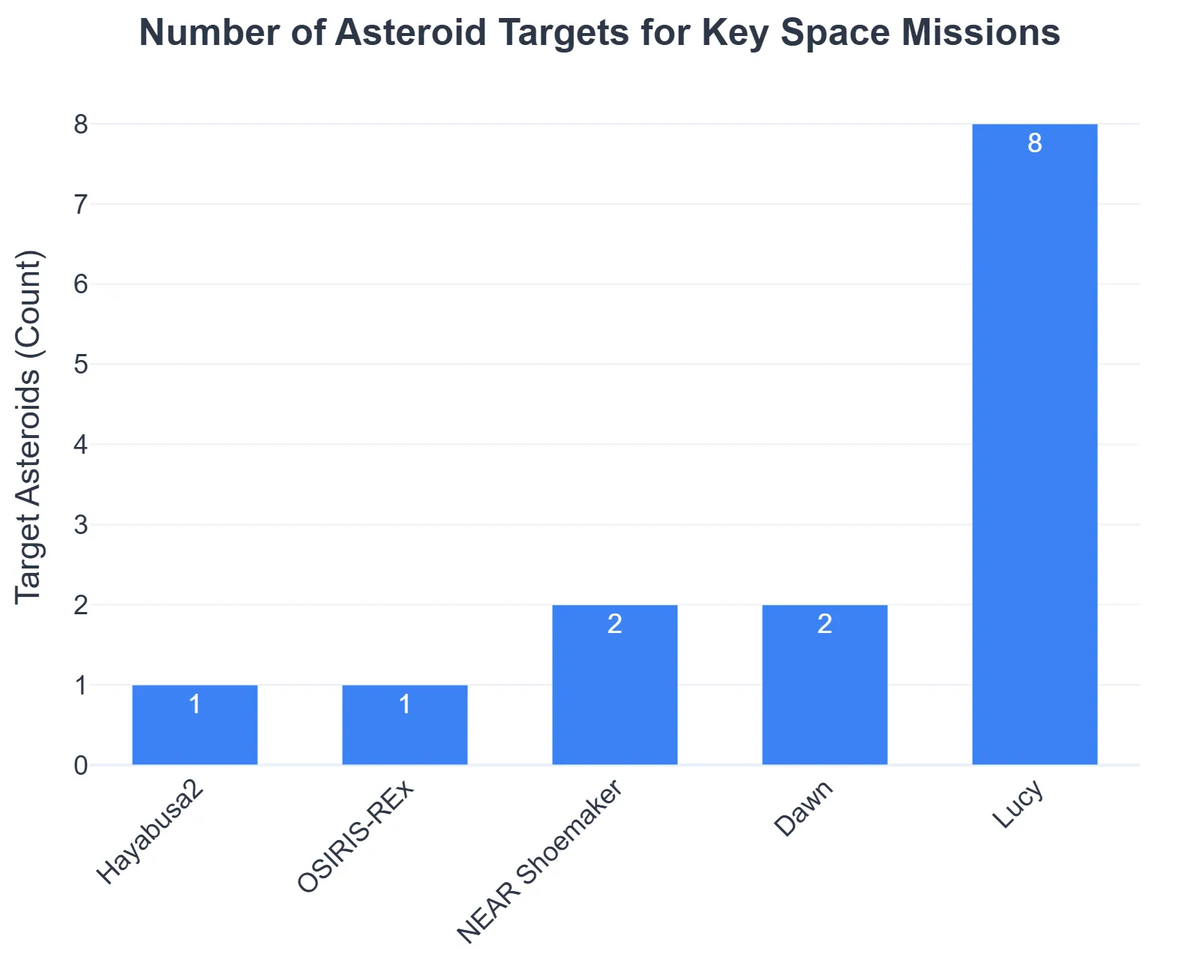
- Lucy will visit eight different asteroids over its 12-year primary mission, including one main-belt asteroid.
- The mission uses advanced instruments to study the geology, composition, and structure of these unique celestial bodies.
“The Lucy mission isn’t just about rocks; it’s about time travel. These Trojan asteroids are cosmic Rosetta Stones, potentially holding the fundamental story of our solar system’s chaotic birth. It’s the kind of epic narrative that makes science feel like the ultimate adventure.”
— Astrid Bellweather, Astrophysicist & Science Fiction Consultant
Launched in October 2021, the Lucy spacecraft is embarking on an unprecedented 12-year journey to visit an astounding nine different asteroids – including one main-belt asteroid and eight Jupiter Trojans. This ambitious mission promises to revolutionize our understanding of planetary formation and the early solar system’s architecture. It’s a testament to human ingenuity and our insatiable curiosity to probe the mysteries of the universe, a core theme we explore further in our main resource on Cosmic Queries: Probing the Mysteries of the Universe.
In This Article
- — 💡 Key Takeaways
- → What Are Jupiter’s Trojan Asteroids?
- — 🌌 The Lagrangian Points: Cosmic Parking Spots
- — Why Are Trojans Important? Unlocking Solar System History
- → The Lucy Spacecraft Mission: A Journey Through Time
- — 🎯 Mission Objectives
- — 🗓️ Key Dates and Trajectory
- → Anatomy of the Lucy Spacecraft
- — 🔬 Scientific Instruments Aboard Lucy
- — ☀️ Powering the Mission: Solar Arrays
- → The Scientific Significance of Lucy
- — 🕰️ Unlocking Solar System Formation
- — Comparing Diverse Asteroid Types
- → The Teams Behind the Mission
- → Conclusion: Lucy’s Enduring Legacy
What Are Jupiter’s Trojan Asteroids?
Jupiter’s Trojan asteroids are two large swarms of asteroids that share Jupiter’s orbit around the Sun. Unlike regular asteroids that primarily reside in the main asteroid belt between Mars and Jupiter, Trojans occupy gravitationally stable regions known as Lagrangian points.
🌌 The Lagrangian Points: Cosmic Parking Spots
- ✅ Definition: Lagrangian points (L4 and L5) are five specific positions in an orbital configuration where a small object, under the influence of two larger orbiting bodies (like Jupiter and the Sun), can maintain a stable position relative to them.
- ➡️ Trojan Locations: Jupiter’s Trojans are found in the L4 and L5 points. The L4 swarm (the “Greek camp”) leads Jupiter by 60 degrees in its orbit, while the L5 swarm (the “Trojan camp”) trails Jupiter by 60 degrees.
- 💡 Stability: These points are remarkably stable, allowing asteroids to accumulate and remain there for billions of years, largely undisturbed since the early solar system.
Why Are Trojans Important? Unlocking Solar System History
The significance of the Trojan asteroids lies in their unique composition and stable orbits. Scientists believe they are primordial material – the leftover building blocks from the outer solar system’s formation. Studying them up close provides a direct window into the conditions and materials that existed billions of years ago.
- 🔭 Planetesimal Remnants: Trojans are thought to be planetesimals, the small bodies that accreted to form planets. Their diverse compositions could reflect the different regions of the early solar nebula where they formed.
- 🔬 Comparative Planetology: By visiting multiple Trojans with varying compositions, Lucy can provide insights into how materials were distributed throughout the nascent solar system. This is akin to how missions like Galileo Spacecraft: Exploring Jupiter and its Icy Moons taught us about Jupiter’s system, but on a grander, solar-system-wide scale.
- 🧊 Icy Bodies: Many Trojans are thought to be rich in volatile materials, including water ice, which could have been delivered to the inner solar system by similar bodies.
The Lucy Spacecraft Mission: A Journey Through Time

The Lucy spacecraft mission is the first space mission to explore Jupiter’s Trojan asteroids. It represents a bold step in robotic space exploration, venturing into a previously unvisited population of celestial bodies. For more on how spacecraft navigate such vast distances, see our article on Spacecraft Flybys: Exploring Distant Worlds.
🎯 Mission Objectives
The primary goals of the Lucy mission are multifaceted and ambitious:
- ✅ Surface Composition: Determine the surface compositions of the Trojan asteroids, looking for silicates, organic materials, and water ice.
- ➡️ Geology and Morphology: Characterize the geology and surface morphology, including craters, fractures, and other features.
- 💡 Bulk Properties: Measure the bulk physical properties, such as density and mass, to infer their internal structures.
- 🔬 Cratering Records: Study the cratering records to understand the impact history of the outer solar system.
- 🌟 Diverse Sampling: Observe the widest possible diversity of Trojan asteroids to understand the full range of their characteristics.
🗓️ Key Dates and Trajectory
The Lucy mission’s trajectory is a masterpiece of orbital mechanics, leveraging Earth gravity assists to gain speed and change course. The mission timeline spans over a decade:
- 🚀 Launch: October 16, 2021, from Cape Canaveral Space Force Station.
- 🌍 Earth Gravity Assists: Lucy will perform three Earth gravity assists (in 2022, 2024, and 2030) to accelerate and adjust its trajectory.
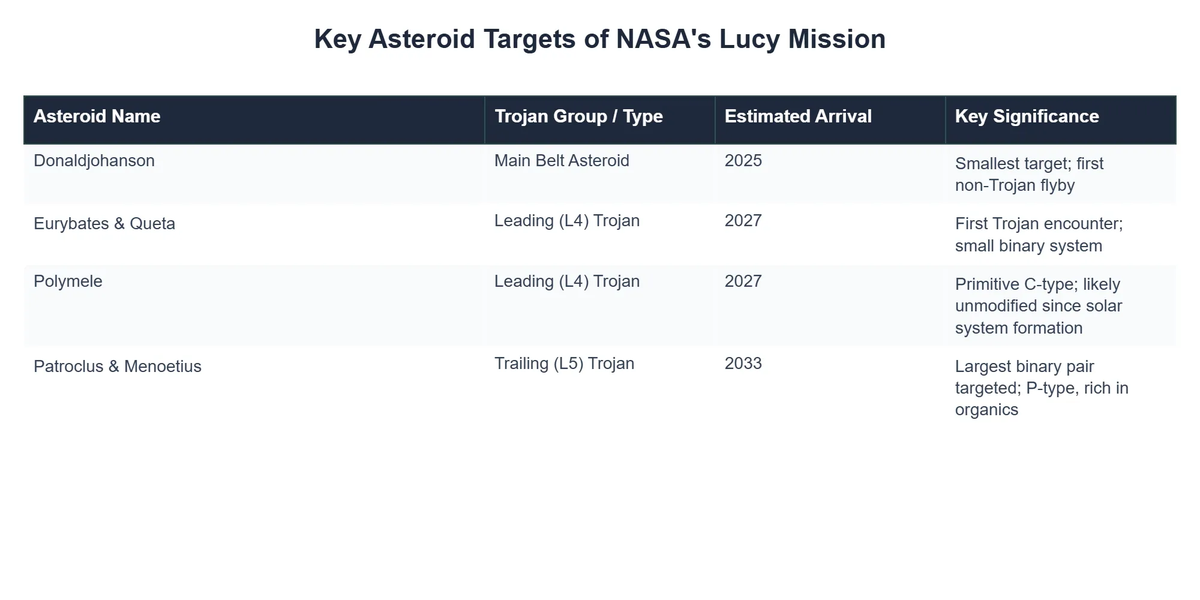
- 🌠 Main-Belt Asteroid Flyby: In 2025, Lucy will perform a flyby of Donaldjohanson, a main-belt asteroid, serving as an important test of its instruments and navigation systems before reaching the Trojans.
- 🌟 L4 Swarm Encounters: From 2027 to 2028, Lucy will encounter four Trojans in the L4 “Greek camp”: Eurybates (with its satellite Queta), Polymele, Leucus, and Orus.
- 🔄 Journey to L5: After visiting the L4 swarm, Lucy will execute another Earth gravity assist in 2030 to propel itself towards the L5 “Trojan camp.”
- 🌌 L5 Swarm Encounters: In 2033, Lucy will perform a close flyby of the binary asteroid Patroclus-Menoetius, its final scheduled target.
This multi-target flyby strategy is reminiscent of successful long-duration missions like New Horizons: NASA’s Pluto and Kuiper Belt Mission, which also utilized gravity assists to explore multiple distant objects.
Anatomy of the Lucy Spacecraft
The Lucy spacecraft is a marvel of engineering, designed to operate far from the Sun and execute precise flybys of multiple targets. It’s equipped with advanced instruments, large solar arrays, and robust communication systems.
🔬 Scientific Instruments Aboard Lucy
To achieve its ambitious scientific objectives, Lucy carries a suite of three primary scientific instruments, along with its high-gain antenna, which also serves as a critical science tool:
- L’LORRI (Lucy LOng Range Reconnaissance Imager): This high-resolution black-and-white camera is essential for capturing detailed images of the asteroid surfaces from a distance.
- L’Ralph: Comprising two sub-instruments:
- MVIC (Multispectral Visible Imaging Camera): Captures color images.
- LEISA (Linear Etalon Imaging Spectral Array): A near-infrared spectrometer for mapping surface composition and identifying different minerals and ices.
- L’TES (Lucy Thermal Emission Spectrometer): Measures the temperature of the asteroids, providing information about their surface properties and thermal inertia.
- Terminal Tracking Camera (TTCam): Used to track the asteroids during flybys, ensuring the main instruments are pointed correctly.
- Radio Science Experiment: Uses the spacecraft’s telecommunications system and high-gain antenna to precisely measure the mass of the asteroids by observing slight changes in Lucy’s trajectory due to their gravitational pull.
☀️ Powering the Mission: Solar Arrays
Given its deep-space journey far from the Sun, Lucy relies on two massive, circular solar arrays, each spanning approximately 24 feet (7.3 meters) in diameter when fully deployed. These arrays are critical for generating sufficient power to operate the spacecraft’s systems and scientific instruments throughout its long mission.
The power requirements for deep-space missions are substantial, and the design of these arrays is optimized for the lower light conditions at Jupiter’s orbit, where sunlight is only about 1/25th as strong as it is at Earth.
The Scientific Significance of Lucy
The Lucy spacecraft mission is poised to deliver unprecedented insights into the origins of our solar system, making it one of the most exciting missions of its generation.
🕰️ Unlocking Solar System Formation
The primary scientific driver for Lucy is its potential to reveal the history of planetary migration and the early solar system’s evolution. By studying these “fossils” of planet formation, scientists hope to:
- ✅ Validate Migration Models: Test theories about how giant planets like Jupiter and Saturn migrated early in the solar system’s history, scattering and capturing smaller bodies like the Trojans.
- ➡️ Understand Distribution: Gain insights into the distribution of primordial materials, understanding where different types of planetesimals formed and how they were mixed.
- 💡 Origin of Volatiles: Explore the possibility that Trojan asteroids, being ice-rich, could shed light on the delivery of water and organic molecules to Earth.
Comparing Diverse Asteroid Types
Lucy’s unique ability to visit multiple, compositionally diverse Trojan asteroids, along with a main-belt asteroid, is crucial. This diversity allows for direct comparative studies, which are far more powerful than studying a single object in isolation. Each flyby is a snapshot into a different part of the early solar system, offering a rich tapestry of data.

This multi-target approach helps to build a more complete picture, much like how missions such as OSIRIS-REx Mission: Asteroid Bennu Sample Return to Earth provide detailed insights into a single asteroid, but Lucy expands that to a population.
The Teams Behind the Mission
The success of the Lucy spacecraft mission is a testament to immense collaboration and expertise across various institutions.
- 🌟 NASA: As with many deep-space missions, the Lucy mission is led by NASA. NASA’s comprehensive oversight, funding, and launch services are fundamental to the mission’s execution.
- 🔬 Southwest Research Institute (SwRI): The mission is led by the Southwest Research Institute (SwRI) in Boulder, Colorado. SwRI is responsible for the overall scientific management, instrument development, and mission operations. This critical role ensures the scientific objectives are met and the spacecraft operates effectively.
- ⚙️ Lockheed Martin Space: Lockheed Martin Space built the Lucy spacecraft and is responsible for its operations.
- 🤝 Collaborating Institutions: Numerous other academic and research institutions across the United States contribute to the mission’s science team and instrument development, highlighting the collaborative nature of major space exploration projects.
Recommended Video
Conclusion: Lucy’s Enduring Legacy
The Lucy spacecraft mission represents a bold leap forward in our quest to understand the origins of our solar system. By journeying to the distant, untouched Jupiter Trojan asteroids, Lucy is providing us with an unparalleled opportunity to examine the very building blocks from which planets formed. These ancient time capsules hold the keys to unlocking the mysteries of our cosmic past, shedding light on planetary migration, the distribution of primordial materials, and perhaps even the early delivery of life’s ingredients to Earth.
As the Lucy spacecraft continues its epic voyage through the solar system, it promises to deliver a wealth of data that will redefine our textbooks and inspire future generations of astronomers and planetary scientists. Its journey is not just about visiting rocks in space; it’s about piecing together the grand narrative of our cosmic home. To learn more about the mission, visit The Planetary Society’s Lucy mission page.
Frequently Asked Questions
What are Jupiter’s Trojan asteroids?
Trojan asteroids are a large group of asteroids that share an orbit with a larger planet, located at its stable Lagrangian points (L4 and L5). Jupiter has two main swarms, leading and trailing the planet.
Why is the Lucy mission important?
Lucy is significant because it’s the first mission to directly explore these pristine remnants from the early solar system, which can provide invaluable insights into the conditions and processes of planet formation.
How long will the Lucy mission last?
The primary mission is planned for 12 years, during which it will perform flybys of eight different asteroids.
What instruments does Lucy carry?
Lucy carries a suite of advanced instruments, including a high-resolution imager (L’LORRI), a thermal emission spectrometer (L’TES), and a color visible imager and infrared spectrometer (L’Ralph), designed to study the asteroids’ composition and surface properties.