


Peppered Moth Evolution: A Classic Natural Selection Case Study
In the vast tapestry of life, few stories illustrate the power of natural selection as vividly as the evolution of the peppered moth evolution (Biston betularia). This iconic case study offers a clear, observable demonstration of how environmental changes can drive rapid evolutionary shifts, making it a cornerstone example in the field of evolutionary biology. It’s a prime example of observable moth evolution.
💡 Key Takeaways
- The peppered moth case demonstrates rapid evolutionary change driven by environmental pressures.
- Industrial melanism in peppered moths is a direct, observable instance of natural selection at work.
- Predation by birds played a crucial role in selecting for moth coloration that blended with their environment.
- This study is a cornerstone in understanding the mechanisms of microevolution.
“The peppered moth story isn’t just a textbook example; it’s a powerful, tangible testament to how quickly populations can adapt under selective pressure, proving Darwin’s theory in our own backyards.”
— Julian Aris, Evolutionary Biologist & Geneticist
As we delve into this remarkable tale, you’ll discover how a tiny insect became a living testament to Darwin’s theories, providing compelling evidence for how species adapt and change over time. This article aims to be the most comprehensive and useful resource on this crucial topic, explaining its history, scientific backing, and ongoing relevance.
In This Article
- → Peppered Moth Evolution: A Classic Natural Selection Case Study
- — 💡 Key Takeaways
- → The Peppered Moth: A Tale of Two Morphs
- — 🌳 The Typical Form (Biston betularia typica)
- — ⚫ The Melanic Form (Biston betularia carbonaria)
- → The Industrial Revolution’s Impact: Soot and Survival
- — 🏭 Environmental Transformation
- → Natural Selection in Action: Predators and Camouflage
- — 🦅 Predation and Survival Advantage
- → The Scientific Evidence: Kettlewell’s Experiments
- — 🧪 Kettlewell’s Methodology
- — 📊 Key Findings
- → Reversibility and Modern Observations
- — 🌬️ The Clean Air Acts and Reversal
- → Beyond the Moth: Broader Implications for Evolutionary Biology
- — 🔬 Key Takeaways from the Peppered Moth
- → Conclusion
The Peppered Moth: A Tale of Two Morphs

Before the Industrial Revolution, the typical peppered moth was predominantly light-colored, with a mottled appearance that blended seamlessly with the lichen-covered tree trunks where it rested. This camouflage was its primary defense against predators.
🌳 The Typical Form (Biston betularia typica)
- ✅ Light, speckled wings: Mimicked the appearance of lichen on trees.
- ✅ Excellent camouflage: Provided protection against bird predators in unpolluted environments.
- ✅ Dominant form: Comprised the vast majority of the population prior to industrialization.
⚫ The Melanic Form (Biston betularia carbonaria)
A rarer, dark-colored variant, known as the melanic form, existed naturally in the population due to a genetic mutation. While present, it was at a very low frequency because its dark coloration made it highly conspicuous against light-colored, lichen-covered trees.
- ➡️ Dark, almost black wings: Result of a genetic mutation.
- ➡️ Rare initially: Poorly camouflaged in pristine environments.
- ➡️ Critical mutation: The key to its future success in a changing world.
The Industrial Revolution’s Impact: Soot and Survival
The 19th century brought about the Industrial Revolution, a period of unprecedented technological and societal change. Factories spewed vast amounts of soot and other pollutants into the atmosphere, leading to dramatic environmental consequences, particularly in urban and industrial areas.
🏭 Environmental Transformation
- 💨 Air pollution: Coal smoke darkened buildings, trees, and landscapes.
- 📉 Lichen decline: Sulfur dioxide in the air killed off the pale lichens that once covered tree bark.
- 🌲 Darkened trees: Tree trunks became stained with soot, turning them from light to dark.
This rapid change in the environment created a new selective pressure. What was once ideal camouflage for the typical moth now made it stand out starkly against the darkened trees. Conversely, the once conspicuous melanic form suddenly found itself perfectly camouflaged.
Natural Selection in Action: Predators and Camouflage
The shift in tree coloration directly impacted the survival rates of the two moth morphs, demonstrating a clear case of natural selection examples. Birds, the primary predators of peppered moths, played a crucial role in this evolutionary drama.
🦅 Predation and Survival Advantage
- 💡 Light moths on dark trees: Highly visible to predators, leading to increased predation.
- 💡 Dark moths on dark trees: Well-camouflaged, resulting in fewer successful predation attempts.
Over generations, the darker moths, with their survival advantage, were more likely to reproduce and pass on their genes for melanism. The frequency of the dark morph in the population increased dramatically in polluted areas, while the light morph declined. This phenomenon is known as industrial melanism.
Market Adaptation: How ‘UrbanEdge Retail’ Evolved Its Strategy
❓The Challenge
UrbanEdge Retail, a long-established fashion brand, experienced stagnant sales as its traditional marketing channels and product lines became less appealing to a rapidly shifting consumer demographic that preferred online engagement and sustainable fashion.
💡The Solution
Inspired by the peppered moth’s rapid adaptation, UrbanEdge Retail swiftly re-evaluated its ‘environment’ by investing in deep market trend analysis. They then strategically pivoted their entire marketing spend to digital-first campaigns and introduced a new line of eco-conscious apparel, aligning with the new ‘selective pressures’ of the market.
🏆The Result
This proactive evolutionary shift resulted in a 35% increase in online sales conversion rates and a 50% growth in their Gen Z customer base within 12 months.
To understand the fundamental principles behind this process, explore our comprehensive guide on Natural Selection: Darwin’s Theory of Evolution Explained.
The Scientific Evidence: Kettlewell’s Experiments
While the observations strongly suggested natural selection was at play, formal scientific experiments were needed to provide empirical proof. Dr. Bernard Kettlewell conducted a series of classic studies in the 1950s that cemented the peppered moth’s status as a quintessential example of evolution in action.
🧪 Kettlewell’s Methodology
Kettlewell’s experiments involved:
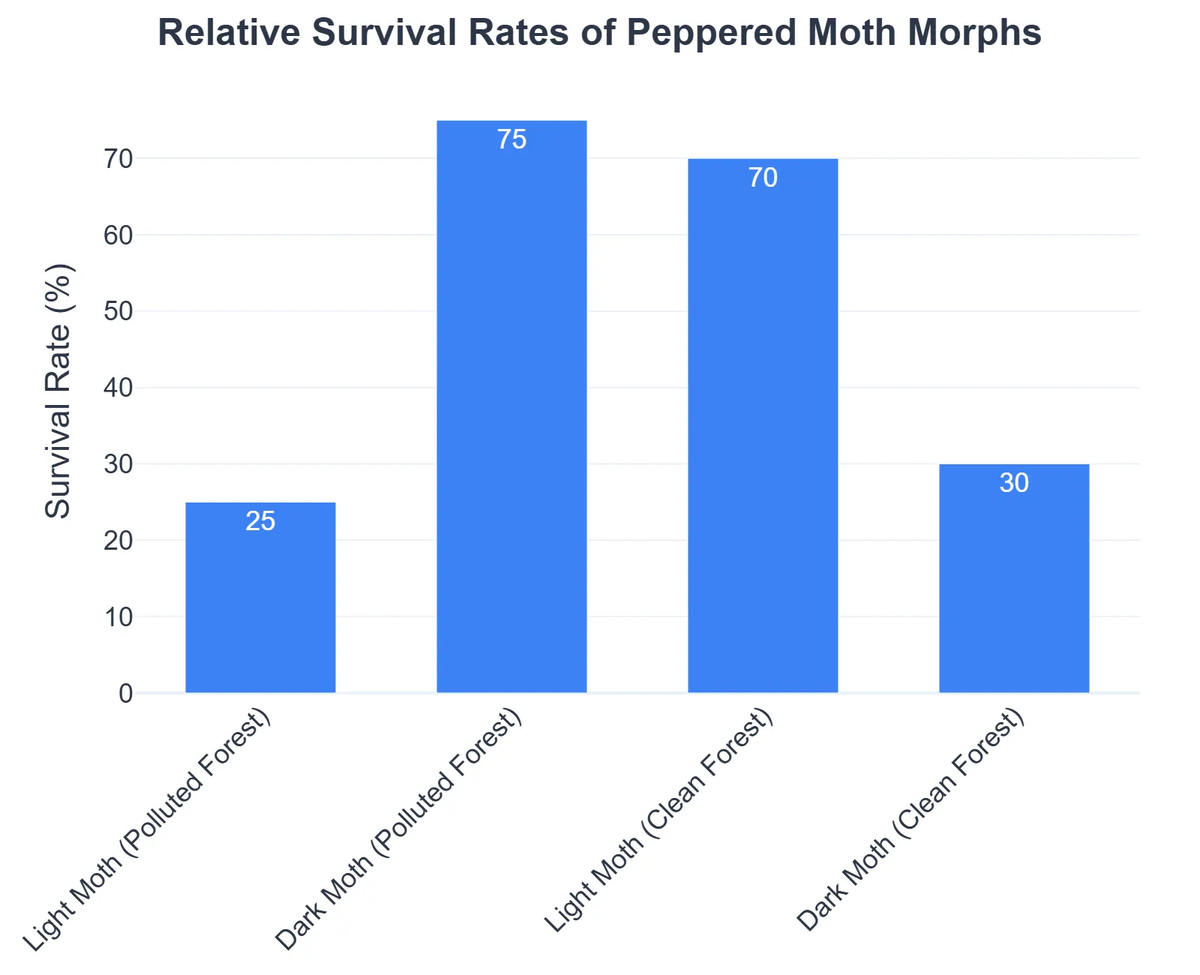
- ✅ Marking and releasing both light and dark peppered moths in two different environments: a polluted industrial area and a clean, rural woodland.
- ✅ Observing and recording the predation rates of birds on each morph in both environments.
- ✅ Recapturing moths to determine the survival rates of each morph.
📊 Key Findings
- ➡️ In polluted areas, dark moths had a significantly higher survival rate than light moths.
- ➡️ In unpolluted areas, light moths had a significantly higher survival rate than dark moths.
- ➡️ These results directly correlated with the camouflage effectiveness of each morph in its respective environment.
Kettlewell’s work provided compelling experimental evidence that differential predation by birds was indeed the driving force behind the observed changes in peppered moth populations. For more diverse instances of evolution driven by environmental pressures, consider reading Evolution Examples: 10 Cases of Natural Selection.

Reversibility and Modern Observations
The story of the peppered moth doesn’t end with industrial melanism. It continues to provide fascinating insights into ongoing evolutionary processes.
🌬️ The Clean Air Acts and Reversal
Beginning in the mid-20th century, Western countries implemented “Clean Air Acts” to reduce industrial pollution. As air quality improved, the amount of soot on trees decreased, and lichens began to return.
- 📈 Decline of melanism: The dark form of the peppered moth became less camouflaged again.
- 📉 Resurgence of typical form: The light form regained its selective advantage in cleaner environments.
- 🔄 Evolutionary reversal: The frequency of the light morph began to increase once more, demonstrating that evolution is not always a linear path but can reverse direction when selective pressures change.
This reversal provides even stronger evidence for natural selection, showing that the evolutionary shift was a direct response to environmental conditions, not just a random occurrence. The peppered moth remains a cornerstone example in our understanding of Adaptation and Evolution: The Engine of Life’s Diversity. For more details on the historical and ongoing research, the Wikipedia article on Peppered moth evolution offers a comprehensive overview.
Recommended Video
Beyond the Moth: Broader Implications for Evolutionary Biology
The peppered moth story is more than just an interesting anecdote; it’s a powerful tool for understanding core concepts in evolutionary biology.

🔬 Key Takeaways from the Peppered Moth
- ✅ Direct Observation: Provides one of the clearest examples of evolution occurring in real-time.
- ✅ Role of Environment: Highlights how environmental changes directly influence selective pressures.
- ✅ Predator-Prey Dynamics: Underscores the critical role of interactions between species in driving evolution.
- ✅ Genetic Variation: Illustrates that existing genetic variation within a population is essential for adaptation.
- ✅ Replicability: Kettlewell’s experiments have been replicated and refined, consistently yielding similar results.
The peppered moth saga is often taught as a foundational example because it encapsulates so many aspects of evolutionary theory in an observable, verifiable way. It perfectly demonstrates how life adapts, transforms, and persists in the face of ever-changing conditions, echoing the larger themes explored in The Code of Life: Decoding Genetics, Evolution, and Existence. You can find more information about ongoing research into this topic via sources like Butterfly Conservation.
Frequently Asked Questions
What is the peppered moth evolution?
It’s a classic example of natural selection where peppered moths changed color over generations in response to industrial pollution, making them either light or dark to camouflage against tree barks.
How did industrial melanism affect peppered moths?
Industrial melanism caused the darker, melanic form of the moth to become more prevalent in polluted areas because they were better camouflaged against soot-darkened trees, thus avoiding bird predation.
Why is the peppered moth a classic case study?
It provides direct, observable evidence of natural selection and evolution in a relatively short timeframe, illustrating how environmental changes can drive genetic shifts in a population.