


Decoding the Cosmic Canvas: Why YouTube is Your Black Hole Hub
In the vast, ever-expanding universe of information, understanding complex scientific concepts like black holes can feel like a daunting task. Textbooks are often dense, and scientific papers require specialized knowledge. This is where YouTube emerges as an unparalleled resource for cosmic education, offering a dynamic and accessible portal into the most enigmatic objects in the cosmos.
💡 Key Takeaways
- Learn where to find the most informative and engaging black hole content on YouTube.
- Understand complex black hole concepts explained by leading science communicators.
- Discover visual representations of spacetime, event horizons, and singularity.
- Enhance your cosmic knowledge with curated video recommendations.
“Navigating the vast universe of online science content can be daunting. This guide curates the finest black hole explanations on YouTube, making the cosmos accessible to everyone.”
— Astrid Bellweather, Astrophysicist & Science Communicator
YouTube hosts an incredible array of channels dedicated to astronomy and theoretical physics, breaking down intricate theories into digestible, visually stunning segments. Whether you’re a curious beginner or an aspiring astrophysicist, you can find high-quality black hole videos that simplify the complex, visualize the unseen, and spark your cosmic curiosity. From animated explainers to expert interviews and documentary excerpts, the platform has revolutionized how we engage with scientific discovery.
In This Article
- → Decoding the Cosmic Canvas: Why YouTube is Your Black Hole Hub
- — 💡 Key Takeaways
- — 🚀 Accessibility and Visual Learning
- — 💡 Staying Current with Discoveries
- → Criteria for Selecting Top Black Hole YouTube Channels
- — ✔️ Scientific Accuracy and Credibility
- — 🎨 Visual Quality and Production Value
- — 🎯 Accessibility and Clarity of Explanation
- — 🤝 Engagement and Community
- → The Titans of Cosmic Education: Top Astronomy YouTube Channels
- — 🌌 Kurzgesagt – In a Nutshell
- — 🔬 PBS Spacetime
- — 🔭 NASA (Official Channel)
- — 🧠 SciShow Space
- — 💡 Veritasium
- — 🎙️ StarTalk with Neil deGrasse Tyson
- → Deep Dives: Essential Black Hole Video Series & Documentaries
- — ➡️ The Fabric of the Cosmos (PBS Nova/Brian Greene)
- — ➡️ How the Universe Works (Discovery Channel)
- — ➡️ Event Horizon Telescope (EHT) Unveils Black Hole Image
- → Visualizing the Unseen: Explaining Black Hole Concepts Through Animation
- — ✨ The Power of Simulation
- — 🖥️ From Data to Dazzling Imagery
- → Beyond the Basics: Advanced Topics and Debates on Black Holes
- — 🌀 Hawking Radiation and the Information Paradox
- — 〰️ Wormholes and Exotic Matter
- — ⚛️ Micro Black Holes and Primordial Black Holes
- — 🌌 Black Holes and Extra Dimensions
- → How to Maximize Your Black Hole Learning Experience on YouTube
- — 📚 Curate Your Own Playlists
- — 💬 Engage with the Community
- — 📝 Take Notes and Summarize
- — 🔍 Explore Related Content
- — 🔗 Cross-Reference and Verify
- → Navigating Misconceptions: What to Watch Out For
- — 🛑 Sensationalism Over Science
- — 🤔 Common Black Hole Myths to Spot
- — 🚨 Identifying Unreliable Sources
- → Your Ultimate Black Hole Video Playlist (Curated Selection)
- → The Future of Black Hole Content on YouTube
🚀 Accessibility and Visual Learning
- ✅ Visual Comprehension: Black holes are abstract. YouTube channels excel at using state-of-the-art animations and simulations to illustrate concepts like spacetime curvature, accretion disks, and event horizons, making them far easier to grasp than static images or text.
- ✅ Expert Insights: Many channels feature interviews with leading scientists, astronomers, and physicists, offering direct access to the latest research and theories straight from the experts.
- ✅ Diverse Learning Styles: Whether you prefer quick animated shorts, in-depth documentaries, or conversational Q&A sessions, YouTube caters to all learning preferences.
💡 Staying Current with Discoveries
The field of black hole research is constantly evolving. New observations from telescopes like the Event Horizon Telescope, groundbreaking theoretical advancements, and ongoing missions mean there’s always something new to learn. Top astronomy YouTube channels are often quicker to disseminate these discoveries in an understandable format than traditional media, making them essential for staying up-to-date with the cutting edge of cosmic understanding.
Criteria for Selecting Top Black Hole YouTube Channels
With an overwhelming number of channels available, discerning which sources offer the most accurate, engaging, and valuable content is crucial. Our criteria focus on ensuring a rich, scientifically sound, and captivating learning experience when diving into `black hole youtube` content.
✔️ Scientific Accuracy and Credibility
- ✅ Backed by Experts: Look for channels that collaborate with scientists, reference peer-reviewed studies, or are produced by reputable institutions (e.g., universities, NASA, major science museums).
- ✅ Evidence-Based Explanations: The content should clearly distinguish between established facts, theories, and speculative ideas. Avoid channels that present unverified claims as scientific consensus.
- ✅ Regular Updates: Reputable channels often update their content to reflect new discoveries and refine existing explanations, ensuring information remains current.
🎨 Visual Quality and Production Value
- ✅ Stunning Visualizations: High-quality animations, graphics, and real-life astronomical imagery are vital for understanding complex black hole phenomena. Visuals should be clear, informative, and aesthetically pleasing.
- ✅ Clear Audio and Narration: Professional voiceovers and sound design enhance the viewing experience and ensure the information is easily digestible.
- ✅ Engaging Storytelling: Even the most accurate information can be lost without a compelling narrative. Channels that weave scientific facts into engaging stories keep viewers hooked.
🎯 Accessibility and Clarity of Explanation
- ✅ Target Audience Awareness: The best channels can simplify complex ideas without oversimplifying them, catering to various levels of understanding from beginners to those with a foundational knowledge of physics.
- ✅ Jargon Management: While scientific terms are necessary, top channels explain technical jargon clearly and concisely, rather than just using it.
- ✅ Structured Content: Videos should be well-organized, often with clear introductions, main points, and summaries, making it easy to follow the flow of information.
🤝 Engagement and Community
- ✅ Active Comments Section: A healthy comment section where viewers can ask questions and engage with the content creator or other knowledgeable community members can significantly enhance learning.
- ✅ Creator Interaction: Some creators actively participate in discussions, answer questions, or even create follow-up videos based on viewer feedback.
- ✅ Supplementary Resources: Channels that provide links to external resources, articles, or books for further reading demonstrate a commitment to comprehensive education.
The Titans of Cosmic Education: Top Astronomy YouTube Channels
When it comes to `astronomy YouTube channels` and `black hole videos`, some creators stand out for their consistent delivery of high-quality, scientifically accurate, and visually captivating content. These are essential stops on your cosmic education journey.
🌌 Kurzgesagt – In a Nutshell
- ✅ Signature Style: Known for their stunning, minimalist animation style and concise explanations of complex scientific and philosophical topics.
- ✅ Black Hole Content: Their black hole videos are renowned for making incredibly abstract concepts, like “What Happens If You Fall Into a Black Hole?” or “The Most Dangerous Star in the Universe,” visually intuitive and emotionally gripping. They break down the science into highly digestible chunks.
- ✅ Why it’s a must-watch: Unmatched visual storytelling and an ability to make even the most terrifying cosmic phenomena seem approachable.
🔬 PBS Spacetime
- ✅ Deep Dives: Hosted by Dr. Matt O’Dowd, this channel delves into the deepest questions of astrophysics, cosmology, and theoretical physics.
- ✅ Black Hole Content: PBS Spacetime offers rigorous, in-depth explorations of topics such as Hawking radiation, wormholes, black hole thermodynamics, and the information paradox. Their explanations are academically sound but presented engagingly.
- ✅ Why it’s a must-watch: For those seeking a more advanced, yet still accessible, understanding of black hole physics and the cutting edge of research.
🔭 NASA (Official Channel)
- ✅ Direct from the Source: The official National Aeronautics and Space Administration channel provides unparalleled access to real-time mission updates, scientific findings, and breathtaking imagery from space.
- ✅ Black Hole Content: Features actual simulations, animations based on real data, and expert discussions from NASA scientists about black hole discoveries, including stunning visuals from the Event Horizon Telescope and the Hubble Space Telescope.
- ✅ Why it’s a must-watch: Authenticity and direct access to the latest data and research straight from the world’s leading space agency.
🧠 SciShow Space
- ✅ Engaging and Informative: A spin-off of the popular SciShow, this channel focuses exclusively on space, astronomy, and cosmology, delivering content in an energetic and easily understandable manner.
- ✅ Black Hole Content: They cover a wide range of black hole topics, from basic definitions to recent discoveries and bizarre theories, often answering viewer questions and debunking myths.
- ✅ Why it’s a must-watch: Perfect for those who appreciate concise, enthusiastic explanations that make complex subjects fun and relatable.
💡 Veritasium
- ✅ Experiments and Explanations: Derek Muller’s channel explores various scientific phenomena through thought-provoking experiments, interviews, and deep dives into physics concepts.
- ✅ Black Hole Content: While not exclusively focused on black holes, Veritasium produces high-quality videos that often touch upon the fundamental physics underlying cosmic phenomena, including spacetime and gravity, which are crucial for understanding black holes.
- ✅ Why it’s a must-watch: Provides a unique perspective on the underlying physics that govern black holes, often explaining foundational concepts with clever analogies.
🎙️ StarTalk with Neil deGrasse Tyson
- ✅ Celebrity Science: Hosted by renowned astrophysicist Neil deGrasse Tyson, StarTalk combines science, pop culture, and comedy.
- ✅ Black Hole Content: Many episodes feature deep discussions on black holes with leading scientists, often breaking down complex ideas through engaging conversation and humor. You can find many clips and full episodes on their YouTube channel. For instance, discussions on topics like a black hole’s gravity or its role in galaxy formation are common.
- ✅ Why it’s a must-watch: An entertaining and highly educational way to learn about black holes from one of the most charismatic science communicators. For a fantastic example of their content, check out this podcast on Cosmic Queries with Neil deGrasse Tyson.
Deep Dives: Essential Black Hole Video Series & Documentaries
Beyond individual channels, YouTube also hosts incredible series and excerpts from `science documentaries` that provide a more comprehensive and narrative-driven approach to understanding black holes. These are perfect for marathon learning sessions.
➡️ The Fabric of the Cosmos (PBS Nova/Brian Greene)
- ✅ Comprehensive Overview: This four-part series, based on Brian Greene’s book, explores space, time, quantum mechanics, and the origins of the universe. It features excellent segments on black holes, their formation, and their implications for our understanding of reality.
- ✅ Key Learnings: Offers a holistic view of how black holes fit into the grander scheme of cosmic physics and their role in fundamental theories.
➡️ How the Universe Works (Discovery Channel)
- ✅ Visual Spectacle: While not a single series dedicated to black holes, this ongoing documentary series frequently dedicates entire episodes to different aspects of black holes, from their birth to their potential as energy sources.
- ✅ Key Learnings: Explores various types of black holes, their lifecycle, and their profound impact on galaxies and spacetime itself. For more on their immense influence, see our article on Black Hole Power: Energy, Jets, and Cosmic Influence.
➡️ Event Horizon Telescope (EHT) Unveils Black Hole Image
- ✅ Historical Milestone: Search for videos related to the first-ever image of a black hole (M87* and Sagittarius A*). Many channels, including NASA and ESO, released fantastic explainers and documentaries about the monumental scientific effort behind this achievement.
- ✅ Key Learnings: Witness the process of groundbreaking scientific discovery and understand the immense challenges of observing objects light-years away.
Visualizing the Unseen: Explaining Black Hole Concepts Through Animation
One of the most powerful aspects of `black hole youtube` content is its ability to make the invisible visible. Sophisticated animations and simulations are crucial tools in this cosmic education, transforming abstract equations into tangible, albeit theoretical, experiences.
✨ The Power of Simulation
Because we cannot directly observe the interior of a black hole, scientific simulations become our eyes. Channels like Interstellar’s “Visualizing Spacetime around a Black Hole” or academic simulations shared by research institutions illustrate:
- ✅ Spacetime Curvature: How mass warps the fabric of spacetime, demonstrating the extreme gravitational pull near a black hole.
- ✅ Accretion Disks: The mesmerizing, superheated rings of gas and dust spiraling into a black hole, often depicted with stunning detail and relativistic effects.
- ✅ Light Bending: How light is lensed and distorted by the immense gravity, creating eerie visual effects around the event horizon.
For an interactive experience of these phenomena, explore resources that offer a Black Hole Simulator: A Journey into the Abyss.
🖥️ From Data to Dazzling Imagery
Modern astrophysics heavily relies on complex data analysis, often from radio telescopes or X-ray observatories, to infer the presence and properties of black holes. YouTube animators then translate this data into comprehensible visuals, making the science accessible to a wider audience. This transformation is key to understanding concepts like black hole mergers and gravitational waves.
Beyond the Basics: Advanced Topics and Debates on Black Holes
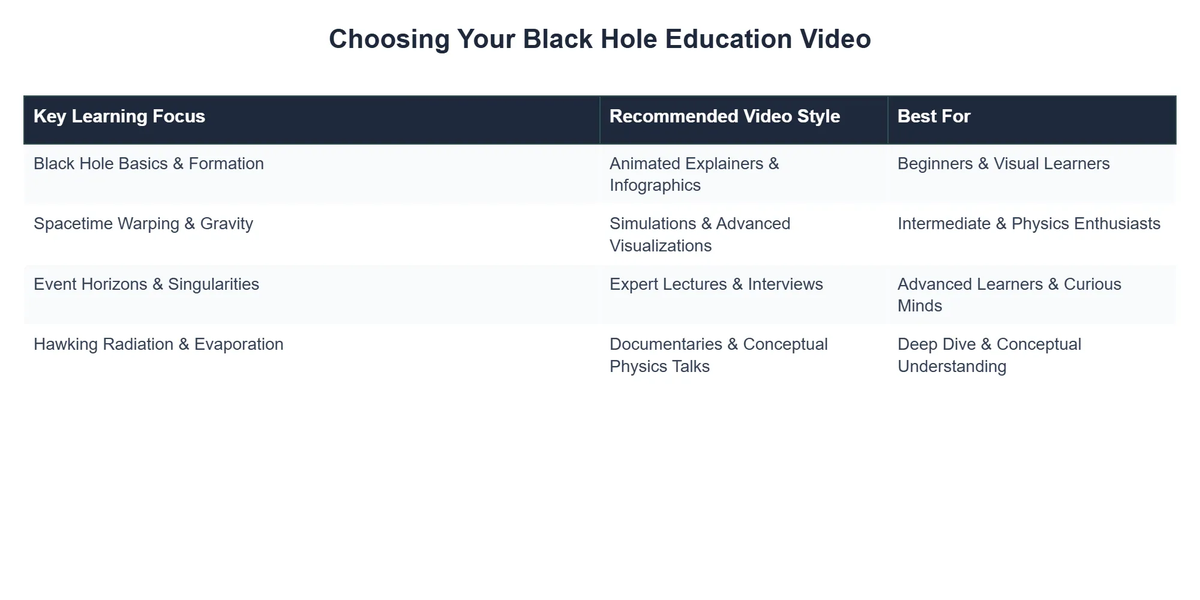
For those who have grasped the fundamentals and are eager to explore the frontiers of `cosmic education` regarding black holes, YouTube also offers a wealth of content on more advanced and speculative topics.
🌀 Hawking Radiation and the Information Paradox
Many channels delve into Stephen Hawking’s groundbreaking theory that black holes aren’t entirely “black” but emit radiation, eventually evaporating. This concept leads to the infamous information paradox: what happens to the information of everything that falls into a black hole when it evaporates?
- ✅ Recommended Channels: PBS Spacetime, Arvin Ash, and some university lecture series available on YouTube provide excellent explanations and debates on these complex topics.
〰️ Wormholes and Exotic Matter
While still largely theoretical, the concept of wormholes—hypothetical tunnels through spacetime connecting distant points—is often discussed in the context of black holes. These discussions often involve exotic matter and the extreme physics required for their existence.
- ✅ Critical Thinking: It’s important to differentiate between scientific speculation, theoretical physics, and science fiction when exploring these topics. Channels that clearly delineate these boundaries are highly valuable.
⚛️ Micro Black Holes and Primordial Black Holes
These are hypothetical black holes that could have formed in the early universe, or perhaps even be produced in particle accelerators. Videos discussing these delve into quantum gravity and the very early moments of cosmic history.
🌌 Black Holes and Extra Dimensions
Some theories, such as string theory, propose the existence of extra spatial dimensions. Black holes, in these contexts, could potentially offer clues or even manifest differently due to these hidden dimensions. For a fascinating take on this, consider exploring Janna Levin’s discussion on Extra Dimensions and How to Overcome Boots in… which touches upon the cutting edge of theoretical physics.
How to Maximize Your Black Hole Learning Experience on YouTube
Simply watching videos is a good start, but to truly deepen your `cosmic education` and make the most of the abundant `black hole videos` available, consider these strategies:
📚 Curate Your Own Playlists
- ✅ Thematic Grouping: Create playlists dedicated to specific black hole topics, like “Black Hole Formation,” “Event Horizon Explained,” or “Gravitational Waves.” This helps organize your learning path.
- ✅ Difficulty Progression: Arrange videos from introductory explanations to more advanced concepts within your playlists.
💬 Engage with the Community
- ✅ Read and Contribute to Comments: The comments section can be a treasure trove of additional insights, questions, and sometimes even corrections. Engage respectfully.
- ✅ Join Science Forums: Beyond YouTube, participate in online science communities (like Reddit’s r/cosmology) where you can ask questions and discuss theories with enthusiasts and experts alike. They often recommend excellent books and resources too, as discussed in threads like Books for those already familiar with cosmology?.
📝 Take Notes and Summarize
- ✅ Active Learning: Pause videos and jot down key terms, definitions, and concepts. This active engagement enhances retention.
- ✅ Visual Aids: Sketch diagrams or create mind maps based on the visual explanations in the videos.
🔍 Explore Related Content
- ✅ “Up Next” Suggestions: YouTube’s algorithm is surprisingly good at suggesting relevant videos once you start watching high-quality science content.
- ✅ Creator Recommendations: Many channels will cross-promote other reputable channels or specific videos.
🔗 Cross-Reference and Verify
- ✅ Multiple Sources: Don’t rely on just one channel for all your information. Watch videos from various reputable sources to gain a more complete and balanced understanding.
- ✅ Beyond YouTube: Supplement your video learning with articles from scientific journals, university websites, or dedicated black hole resources. Our guide on the Best Black Hole Websites: Essential Cosmic Exploration Resources can point you in the right direction.
Navigating Misconceptions: What to Watch Out For
While YouTube is a fantastic resource for `cosmic education`, it’s also a platform where misinformation can spread. When watching `black hole videos`, it’s vital to develop a discerning eye to separate fact from fiction, especially given the esoteric nature of the subject.
🛑 Sensationalism Over Science
- ✅ Exaggerated Titles: Be wary of videos with overly sensational or clickbait titles (e.g., “Scientists Discover Black Hole That Will Destroy Earth NEXT WEEK!”). While engaging, they often prioritize shock value over factual accuracy.
- ✅ Lack of Nuance: Black hole physics is complex and often involves probabilities, theoretical models, and ongoing research. Videos that present definitive answers to unresolved questions without acknowledging the scientific uncertainty should raise a red flag.
🤔 Common Black Hole Myths to Spot
- ✅ Black Holes as Cosmic Vacuum Cleaners: This is a pervasive myth. Black holes do not “suck up” everything in the universe. Their gravitational pull is only dominant at close range. Distant objects orbit them just as planets orbit a star.
- ✅ Black Holes Are Infinite: While their density at the singularity is theorized to be infinite, black holes have finite mass and size (defined by their event horizon).
- ✅ Blue Black Holes: There’s no scientific concept of a “blue black hole.” The term often arises from misinterpretations of artistic renderings or specific theoretical models. For more clarity on this, see Blue Black Hole Enigma: Decoding a Cosmic Misconception.
- ✅ Saturn Having a Black Hole: Absolutely not. This is a complete myth. Planets in our solar system are far too small to ever form black holes. Explore Saturn Black Hole Myth: Fact vs. Cosmic Fiction for a detailed debunking.
🚨 Identifying Unreliable Sources
- ✅ Absence of References: Reputable channels will often cite their sources, either directly in the video, in the description, or through on-screen text. Be skeptical of channels that make bold claims without any scientific backing.
- ✅ Conspiracy Theories: Steer clear of channels that blend scientific topics with conspiracy theories or pseudoscientific beliefs.
- ✅ Amateur Production with Grand Claims: While passion projects can be great, exercise caution if a channel with low production quality makes extraordinary claims without any demonstrable scientific expertise.
Your Ultimate Black Hole Video Playlist (Curated Selection)
To kickstart or deepen your journey into the enigmatic world of black holes, we’ve curated a selection of essential videos from the top channels discussed. These videos offer diverse perspectives, from fundamental explanations to cutting-edge theories, ensuring a comprehensive `cosmic education`.
Whether you’re curious about what happens if you fall into a black hole, how they form, or the latest discoveries from observatories, this playlist will serve as your go-to resource. Prepare to have your mind expanded as you journey through some of the most mind-bending phenomena in the universe.
Recommended Video
The Future of Black Hole Content on YouTube
As our understanding of black holes deepens and technology for visualization advances, the quality and depth of `black hole youtube` content will undoubtedly continue to grow. We can anticipate even more sophisticated simulations, real-time updates from new observatories (like the James Webb Space Telescope), and perhaps even interactive experiences that allow viewers to explore the warped spacetime around these cosmic giants.
The role of `astronomy YouTube channels` in public `cosmic education` is more vital than ever. They bridge the gap between complex scientific research and the curious public, making the universe’s most profound mysteries accessible to anyone with an internet connection. The future promises an even more immersive and informative journey into the abyss.
What are the best YouTube channels for black hole information?
Channels like Kurzgesagt, PBS Space Time, and Veritasium offer compelling, accurate content on black holes and related astrophysics.
Can I understand black holes without a physics background?
Absolutely! Many YouTube creators specialize in simplifying complex topics, making black holes understandable for a general audience through engaging visuals and clear explanations.
How do black holes form?
The most common way black holes form is from the gravitational collapse of massive stars at the end of their life cycle, creating a region of spacetime from which nothing, not even light, can escape.
Are there different types of black holes?
Yes, there are stellar-mass black holes (from collapsed stars), supermassive black holes (found at galaxy centers), intermediate-mass black holes, and theoretical primordial black holes.