


The Imperative of Data Protection in Our Hyper-Connected World
In an era defined by unprecedented connectivity and the pervasive influence of digital technologies, the concept of data protection has transcended mere compliance to become a cornerstone of trust, security, and individual autonomy. Every click, every search, every interaction online generates data – from your browsing habits to your health records, financial transactions, and even biometric identifiers. Protecting this vast ocean of information, especially your user data protection, is not just a regulatory obligation but a fundamental right in the digital future.
💡 Key Takeaways
- Understand emerging data threats in an AI-driven world.
- Learn proactive strategies for robust digital privacy.
- Discover how regulations are adapting to future data challenges.
- Empower yourself with knowledge to protect personal information.
“As AI permeates every facet of our lives, data protection isn’t just about privacy; it’s about preserving human autonomy in an increasingly data-centric future.”
— Kira Chen, Futurist & AI Ethics Analyst
As we navigate a world increasingly shaped by AI, IoT, and advanced computing, understanding the nuances of data protection becomes paramount for individuals, businesses, and governments alike. This guide delves into the evolving landscape of data privacy, outlining the challenges, solutions, and future trends that will define our digital tomorrow.
In This Article
- → The Imperative of Data Protection in Our Hyper-Connected World
- — 💡 Key Takeaways
- → 🌐 Understanding the Digital Data Landscape: Volume, Velocity, Variety
- — The Four Vs of Data Overload
- → ⚖️ Global Regulatory Frameworks: Pillars of Data Sovereignty
- — Key Regulations and Their Impact
- → 🔒 Emerging Threats & Vulnerabilities in a Connected World
- — Threat Vectors on the Rise
- → ⚙️ Best Practices for Robust Data Protection: A Multi-Layered Approach
- — For Organizations: Building a Secure Foundation
- — For Individuals: Empowering Your Digital Self
- → 🤖 The Role of Advanced Technologies in Enhancing Data Protection
- — Transformative Technologies for Data Security
- → 🌍 Data Sovereignty and Cross-Border Data Flows
- — Navigating the Complexities
- → 📈 The Future of Data Protection: Trends and Predictions
- — Key Future Trends
- → 🗓️ The Importance of Data Protection Day and Public Awareness
- — Why Data Protection Day Matters
- → 🤝 Ethical Considerations and the Human Element
- — Ethical Imperatives
- → Final Conclusion: Safeguarding Our Digital Future
🌐 Understanding the Digital Data Landscape: Volume, Velocity, Variety
The sheer scale and complexity of data being generated today pose significant challenges for protection. We’re not just talking about individual files; we’re dealing with “big data protection” – massive datasets that require sophisticated strategies.
The Four Vs of Data Overload
- ✅ Volume: Billions of devices, trillions of interactions. The sheer quantity of data generated daily is staggering, far exceeding human capacity to process without technological aid.
- ✅ Velocity: Data streams in real-time, from IoT sensors, social media feeds, and financial transactions. This rapid flow demands immediate processing and robust security measures.
- ✅ Variety: Data comes in structured forms (databases), unstructured forms (emails, videos, audio), and semi-structured forms (XML). Each type presents unique protection challenges.
- ✅ Veracity: The quality and trustworthiness of data are crucial. Protecting data means ensuring its integrity and accuracy against tampering or corruption.
This dynamic environment underscores why a static approach to security is no longer viable. Continuous adaptation and proactive measures are essential for effective consumer data protection.
⚖️ Global Regulatory Frameworks: Pillars of Data Sovereignty
In response to growing concerns over privacy, numerous governments and international bodies have enacted stringent data protection laws. These regulations aim to give individuals more control over their personal information and hold organizations accountable.
Key Regulations and Their Impact
- ✅ General Data Protection Regulation (GDPR) – EU: Widely considered the gold standard, GDPR emphasizes consent, transparency, and accountability. It grants individuals rights like the right to access, rectification, erasure (right to be forgotten), and data portability. Its extraterritorial reach means it affects any organization processing the data of EU citizens, regardless of location.
- ✅ California Consumer Privacy Act (CCPA) / California Privacy Rights Act (CPRA) – USA: Often dubbed “America’s GDPR,” CCPA grants Californians rights similar to GDPR, focusing on the right to know, delete, and opt-out of the sale of personal information. CPRA expands these rights and establishes a dedicated enforcement agency.
- ✅ Personal Information Protection Law (PIPL) – China: A comprehensive law that similarly imposes strict requirements on personal information handling, emphasizing consent, legitimate purpose, and cross-border data transfer rules.
- ✅ LGPD (Lei Geral de Proteção de Dados) – Brazil: Drawing heavily from GDPR, LGPD applies to the processing of personal data within Brazil or data collected in Brazil, emphasizing consent, data minimization, and strong security measures.
These regulations highlight a global trend towards stronger individual data rights and increased corporate responsibility for customer data protection policy implementation. Adherence is not optional; non-compliance can lead to hefty fines and reputational damage.
🔒 Emerging Threats & Vulnerabilities in a Connected World
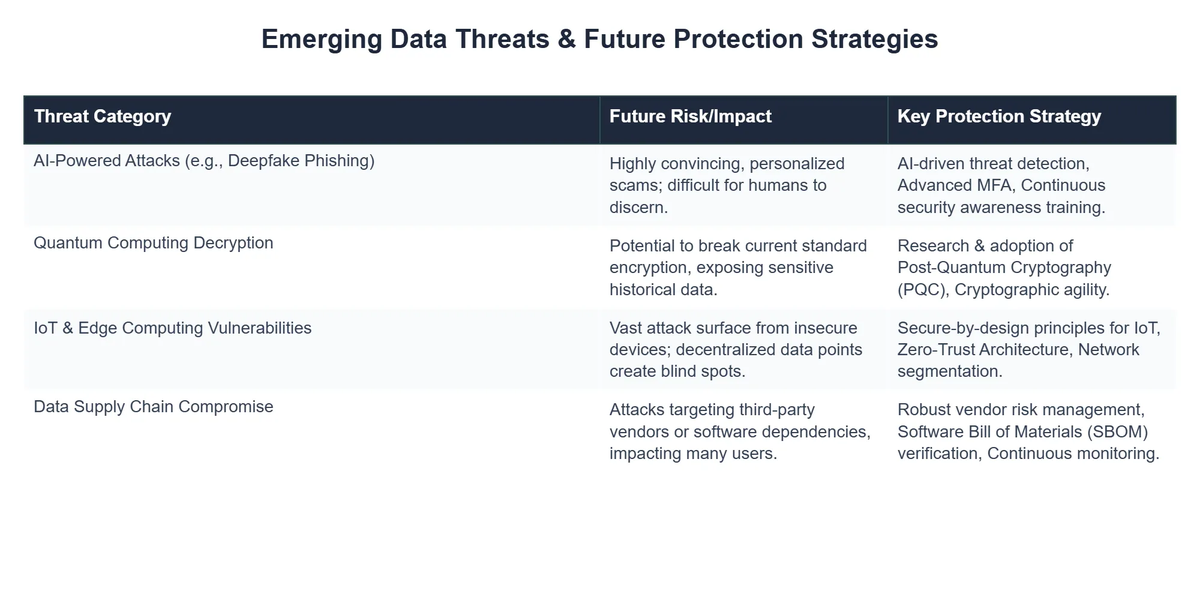
As technology advances, so do the methods of those seeking to exploit vulnerabilities. The digital future presents a new generation of sophisticated threats that demand innovative protection strategies.
Threat Vectors on the Rise
- ➡️ AI-Powered Cyberattacks: Malicious actors are leveraging AI to craft more sophisticated phishing campaigns, automate malware development, and enhance reconnaissance for targeted attacks.
- ➡️ IoT Vulnerabilities: The proliferation of interconnected devices, from smart home gadgets to industrial sensors, creates a vast attack surface. Many IoT devices lack robust security by design, making them easy targets for botnets and data breaches.
- ➡️ Quantum Computing Threats: While still nascent, quantum computing poses a long-term threat to current encryption standards. Governments and researchers are already exploring “post-quantum cryptography” to prepare for this future.
- ➡️ Deepfakes and Synthetic Media: AI-generated audio, video, and images are becoming increasingly realistic, making it difficult to distinguish genuine content from fabricated. This poses significant risks for misinformation, identity theft, and reputational damage, directly impacting user data protection.
- ➡️ Supply Chain Attacks: Compromising a single trusted vendor can open doors to thousands of organizations, as seen in incidents like SolarWinds. The interconnected nature of modern IT ecosystems makes this a potent threat.
Staying ahead of these threats requires constant vigilance, robust cybersecurity infrastructure, and a proactive approach to risk management. For insights into the foundational technologies shaping our digital landscape, explore History of ICT: Exploring Past, Present, and Future Trends.
⚙️ Best Practices for Robust Data Protection: A Multi-Layered Approach
Effective data protection isn’t a single solution but a comprehensive strategy involving technology, policy, and human awareness.
For Organizations: Building a Secure Foundation
- Implement a Strong Customer Data Protection Policy:
- ✅ Clearly define how personal data is collected, used, stored, and shared.
- ✅ Ensure transparency with users about data practices.
- ✅ Appoint a Data Protection Officer (DPO) where required.
- Adopt a “Security by Design” and “Privacy by Design” Mindset:
- ✅ Integrate security and privacy considerations from the initial stages of system and product development.
- ✅ Minimize data collection to only what is necessary (data minimization).
- Strong Access Controls and Authentication:
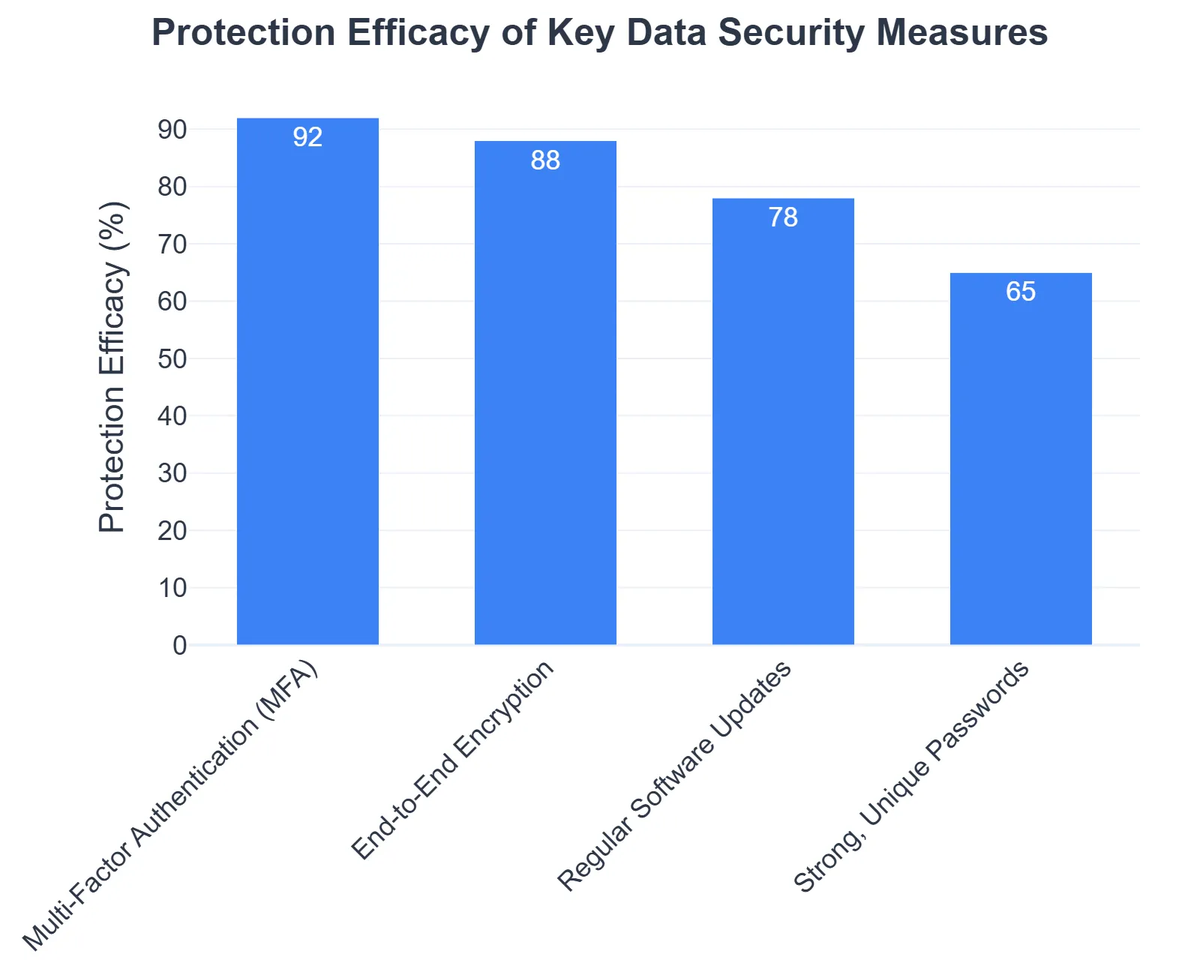
- ✅ Implement Multi-Factor Authentication (MFA) for all accounts.
- ✅ Enforce the principle of least privilege, granting users only the necessary access.
- ✅ Regularly review and revoke access rights.
- Data Encryption:
- ✅ Encrypt data both at rest (stored on servers, databases) and in transit (during transmission).
- ✅ Utilize strong, up-to-date encryption protocols.
- Regular Security Audits and Penetration Testing:
- ✅ Proactively identify vulnerabilities in systems and applications.
- ✅ Conduct regular risk assessments.
- Employee Training and Awareness:
- ✅ Educate staff on data protection policies, phishing scams, and secure computing practices.
- ✅ Foster a culture of security awareness throughout the organization.
- Incident Response Plan:
- ✅ Develop a clear, actionable plan for detecting, responding to, and recovering from data breaches.
- ✅ Practice the plan regularly.
For Individuals: Empowering Your Digital Self
- Practice Strong Password Hygiene:
- ✅ Use unique, complex passwords for different accounts.
- ✅ Employ a reputable password manager.
- ✅ Enable MFA wherever possible.
- Be Mindful of What You Share:
- ✅ Think twice before sharing personal information on social media or unknown websites.
- ✅ Understand the privacy settings of the apps and services you use.
- Regularly Review Privacy Settings:
- ✅ Take the time to customize privacy settings on social media platforms, browsers, and mobile devices.
- ✅ Limit user data collection by third-party apps.
- Be Wary of Phishing and Scams:
- ✅ Verify the sender of suspicious emails or messages.
- ✅ Do not click on unsolicited links or download attachments from unknown sources.
- Use Secure Networks:
- ✅ Avoid conducting sensitive transactions on public Wi-Fi.
- ✅ Use a Virtual Private Network (VPN) for added security when browsing.
- Keep Software Updated:
- ✅ Enable automatic updates for your operating system, web browser, and applications to patch security vulnerabilities.
Embracing these practices empowers both organizations and individuals to better safeguard sensitive information against the growing tide of digital threats.
🤖 The Role of Advanced Technologies in Enhancing Data Protection
Beyond traditional security measures, cutting-edge technologies are emerging as powerful allies in the fight for robust data protection.
Transformative Technologies for Data Security
- 💡 Zero-Trust Architecture (ZTA): Instead of assuming trust within a network perimeter, ZTA operates on the principle of “never trust, always verify.” Every user, device, and application attempting to access resources must be authenticated and authorized, regardless of its location. This significantly limits the impact of potential breaches.
- 💡 Blockchain for Data Integrity and Decentralized Identity: Blockchain’s immutable ledger can ensure data integrity, making it highly resistant to tampering. For identity, decentralized identity solutions leverage blockchain to give individuals more control over their personal information, reducing reliance on centralized identity providers.
- 💡 Homomorphic Encryption: This groundbreaking cryptographic technique allows computations to be performed on encrypted data without decrypting it first. This is revolutionary for privacy-preserving analytics, cloud computing, and machine learning, enabling big data protection without exposing the raw information.
- 💡 Privacy-Preserving AI (PPAI): As AI models increasingly consume vast amounts of data, PPAI techniques like Federated Learning (training models on decentralized datasets without sharing raw data) and Differential Privacy (adding noise to data to protect individual privacy while retaining statistical utility) are becoming crucial.
- 💡 Secure Multi-Party Computation (SMC): SMC enables multiple parties to jointly compute a function over their inputs while keeping those inputs private. This is invaluable for collaborative data analysis where individual data sets cannot be revealed.
These innovations are fundamentally changing how we approach security, moving towards more inherent, systemic protection rather than relying solely on perimeter defenses. For more on how AI is shaping our world, see Ameca Humanoid Robot: Unveiling the Future of Sentient AI.
🌍 Data Sovereignty and Cross-Border Data Flows
The global nature of the internet often clashes with national desires for data sovereignty – the idea that data is subject to the laws and governance structures of the country in which it is collected or processed. This tension is a major challenge for businesses operating internationally.
Navigating the Complexities
- ✅ Data Localization Requirements: Many countries are enacting laws that mandate certain types of data be stored and processed within their national borders. This can increase operational complexity and costs for global enterprises.
- ✅ Cloud Computing Challenges: Cloud providers often store data across various global data centers. Ensuring compliance with diverse data residency requirements is a significant challenge for customer data protection policy implementation.
- ✅ Standard Contractual Clauses (SCCs) and Transfer Mechanisms: Legal instruments like the EU’s SCCs provide frameworks for transferring personal data to countries outside the EU/EEA that do not have adequate data protection laws, though their validity is often debated and reviewed.
The push for data sovereignty reflects a broader movement towards greater national control over critical digital infrastructure and information, complicating the global flow of user data collection.
📈 The Future of Data Protection: Trends and Predictions
The landscape of data protection is dynamic, constantly evolving with technological advancements and societal shifts. Several key trends are set to define its future.
Key Future Trends
- Increased Emphasis on Explainable AI (XAI): As AI systems make more critical decisions, understanding how they arrive at conclusions becomes vital for accountability and transparency, especially in cases of automated user data collection and processing. This aligns with ethical AI guidelines, such as those promoted by the European Union (Ethics guidelines for trustworthy AI).
- Convergence of Cybersecurity and Data Privacy: These two fields, often treated separately, will become increasingly intertwined. A holistic approach that integrates both security and privacy from the outset will be essential for effective big data protection.
- Decentralized Architectures: Beyond blockchain, more decentralized approaches to data storage and processing (e.g., peer-to-peer networks, edge computing) could reduce reliance on centralized honeypots of data, distributing risk and enhancing privacy.
- Emergence of Data Unions and Collective Bargaining: Individuals may form “data unions” or similar collective entities to negotiate terms for their data with corporations, shifting power dynamics.
- Enhanced Biometric Security and Privacy Risks: While biometrics offer convenience, their widespread adoption raises unique privacy concerns. Future solutions will need to focus on secure storage and processing of biometric data, perhaps using techniques like cancelable biometrics.
- Privacy by Default and Data Minimization as Norms: Regulatory pressures and public demand will likely make these principles standard practice, meaning systems will be designed to collect and retain the least amount of data necessary.
- AI and ML for Proactive Threat Detection: Machine learning will play an even larger role in identifying anomalous behavior, predicting threats, and automating responses, moving security from reactive to proactive.
- Quantum-Resistant Cryptography Adoption: As quantum computing capabilities mature, the transition to new, quantum-safe encryption standards will become a critical, global undertaking.
These trends highlight a future where data protection is not just about compliance, but about fundamental shifts in architecture, ethics, and user empowerment. The conversation around Brain Machine Interface: Exploring the Future of Mind Control also brings up profound data protection implications for brain data.
🗓️ The Importance of Data Protection Day and Public Awareness
Celebrated annually on January 28th, Data Protection Day (also known as Privacy Day outside Europe) serves as a vital reminder of the importance of protecting personal information. It marks the anniversary of the Convention 108, the first legally binding international treaty dealing with data protection and privacy, signed in 1981 by the Council of Europe.
Why Data Protection Day Matters
- ✅ Raising Awareness: It educates individuals and organizations about their rights and responsibilities concerning data privacy.
- ✅ Promoting Best Practices: It encourages the adoption of robust data protection practices by businesses and individuals.
- ✅ Encouraging Dialogue: It fosters public discussion about the future of privacy and the challenges posed by technological advancements and user data collection.
This day underscores that data protection is a shared responsibility, requiring ongoing commitment from everyone involved in the digital ecosystem. For further discussion on the future of data and its governance, consider reading more about the Future Perfect?: Charting the Course of Tomorrow’s Technology.
🤝 Ethical Considerations and the Human Element
Beyond legal frameworks and technological solutions, the ethical dimensions of data protection are becoming increasingly prominent. How we use, share, and protect data reflects our values as a society.
Ethical Imperatives
- ➡️ Fairness and Non-Discrimination: Ensuring that data processing does not lead to unfair or discriminatory outcomes, especially with algorithmic decision-making.
- ➡️ Transparency and Accountability: Organizations must be transparent about their data practices and accountable for how they handle personal information. This includes clarity on what constitutes legitimate user data collection.
- ➡️ Human Oversight: Maintaining human oversight in automated systems to prevent unintended consequences and ensure ethical considerations are upheld.
- ➡️ The Right to Explanation: As AI systems make more decisions affecting individuals, the right to understand how those decisions were made becomes crucial.
- ➡️ Balancing Innovation and Privacy: Striking a balance between fostering technological innovation and safeguarding individual privacy is a continuous challenge that requires careful ethical navigation.
The European Commission, for instance, emphasizes these principles in its approach to artificial intelligence, aiming to foster trustworthy AI development (European approach to artificial intelligence).
Recommended Video
Final Conclusion: Safeguarding Our Digital Future
The journey towards a truly protected digital future is complex, marked by evolving threats, sophisticated technologies, and intricate ethical dilemmas. Data protection is no longer just a technical or legal concern; it is a fundamental pillar of trust, privacy, and societal well-being in our interconnected world. By embracing robust regulations, adopting advanced security measures, fostering individual awareness, and prioritizing ethical considerations, we can collectively build a more secure and privacy-respecting digital ecosystem. The commitment to safeguarding personal data is a continuous endeavor, essential for harnessing the full potential of technology while upholding human dignity and autonomy.
What are the biggest data protection challenges in the digital future?
Emerging challenges include sophisticated AI-powered cyberattacks, deepfake technology, and the vast scale of data collection from IoT devices.
How will AI impact data privacy?
AI can both enhance data protection through advanced security tools and pose risks by enabling more complex surveillance or data misuse if not ethically governed.
What new regulations are emerging for data protection?
Beyond GDPR, new regulations are focusing on AI governance, data localization, and consumer consent for biometric data and other sensitive information.
What can individuals do to improve their data protection?
Individuals should regularly update software, use strong, unique passwords, understand privacy settings, and be cautious about sharing personal data online.