

The Dawn of a New Era: Understanding JWST NASA‘s Mission
The cosmos has always held an irresistible allure, beckoning humanity to unravel its profound mysteries. For decades, the Hubble Space Telescope offered unprecedented vistas into our universe, but with the launch of the James Webb Space Telescope (JWST), a new chapter in astronomical discovery has begun. Developed by JWST NASA, in collaboration with ESA (European Space Agency) and CSA (Canadian Space Agency), this observatory represents a monumental leap in our ability to peer back in time and explore the universe’s most distant and ancient phenomena. It’s designed to capture infrared light, allowing it to see through cosmic dust and gas, revealing secrets invisible to previous telescopes.
💡 Key Takeaways
- The JWST provides unprecedented views of the early universe, allowing scientists to study the formation of the first stars and galaxies.
- Its infrared capabilities enable the detailed analysis of exoplanet atmospheres, searching for potential signs of life.
- JWST’s discoveries are fundamentally reshaping our understanding of cosmic evolution and galactic formation.
- The telescope continues to unveil hidden celestial phenomena, from distant quasars to stellar nurseries, expanding humanity’s cosmic perspective.
“The JWST is not just a telescope; it’s a time machine and an exoplanet hunter rolled into one, rewriting textbooks with every photon it captures. We’re witnessing cosmic history unfold before our eyes.”
— Astrid Bellweather, Astrophysicist & Science Communicator
The primary mission of the James Webb Space Telescope is ambitious: to explore every phase of cosmic history. This includes understanding the very first stars and galaxies formed after the Big Bang, investigating the formation of stars and planetary systems, and even studying exoplanets for signs of life. Its capabilities are truly transformative, promising to reshape our understanding of how the universe evolved and our place within it.
James Webb Space Telescope: Benefits & Challenges
Pros
- ✔Unprecedented view of the early universe and distant galaxies.
- ✔High-resolution infrared capabilities for exoplanet and stellar nursery studies.
- ✔Potential to revolutionize understanding of cosmic origins and alien life.
- ✔Showcases international scientific and engineering collaboration.
Cons
- ✖Enormous development and operational costs (billions of dollars).
- ✖Complex, high-risk deployment with no in-orbit repair option.
- ✖Limited operational lifespan due to finite fuel supply for station-keeping.
- ✖Extended development timeline and initial budget overruns.
In This Article
- → The Dawn of a New Era: UnderstandingJWST NASA’s Mission
- — 💡 Key Takeaways
- → Beyond Hubble: Key Capabilities of theJames Webb Space Telescope
- — ⚙️ Technical Prowess: What Makes JWST Unique?
- → Groundbreaking Discoveries: What JWST Has Revealed So Far
- → The Future of Cosmic Exploration withJWST
- — Unlocking Deeper Secrets: The Promise ofJWST
Beyond Hubble: Key Capabilities of the James Webb Space Telescope
While often seen as Hubble’s successor, JWST isn’t merely an upgrade; it’s a paradigm shift in observational astronomy. The critical difference lies in its primary mode of observation: infrared light. Unlike Hubble, which primarily observes in visible and ultraviolet light, Webb’s instruments are finely tuned for infrared, which is crucial for several reasons:
- ✅ Seeing Through Dust: Many cosmic objects, like newborn stars and planets, are shrouded in thick clouds of dust and gas. Visible light is scattered by this dust, but infrared light can pass through it, revealing what lies within.
- ✅ Redshift Phenomenon: As the universe expands, light from distant objects gets stretched, shifting towards the redder, infrared end of the spectrum. To observe the earliest galaxies, which are immensely far away and highly redshifted, an infrared telescope is essential.
- ✅ Cool Objects: Many objects of interest, such as exoplanets and distant nebulae, emit very little visible light but glow brightly in infrared due to their temperature.
⚙️ Technical Prowess: What Makes JWST Unique?
The technological marvel behind the James Webb Space Telescope is staggering:
Cosmic Pathways VR: Igniting Engagement with Webb’s Infrared Insights
❓The Challenge
Cosmic Pathways VR struggled to convey the truly transformative nature of modern astronomical discovery, with many advanced modules feeling less dynamic and cutting-edge, leading to stagnant user engagement.
💡The Solution
Inspired by JWST’s groundbreaking ability to ‘see through cosmic dust’ and observe ‘highly redshifted, ancient phenomena’ via infrared light, Cosmic Pathways VR revamped its advanced modules. They integrated interactive 3D visualizations directly from JWST’s infrared data, allowing users to virtually explore obscured star nurseries and the atmospheres of distant exoplanets.
🏆The Result
Within four months of launching the JWST-powered modules, user session duration for advanced astronomy topics increased by 55%, and premium subscription conversions for these modules grew by 35%.
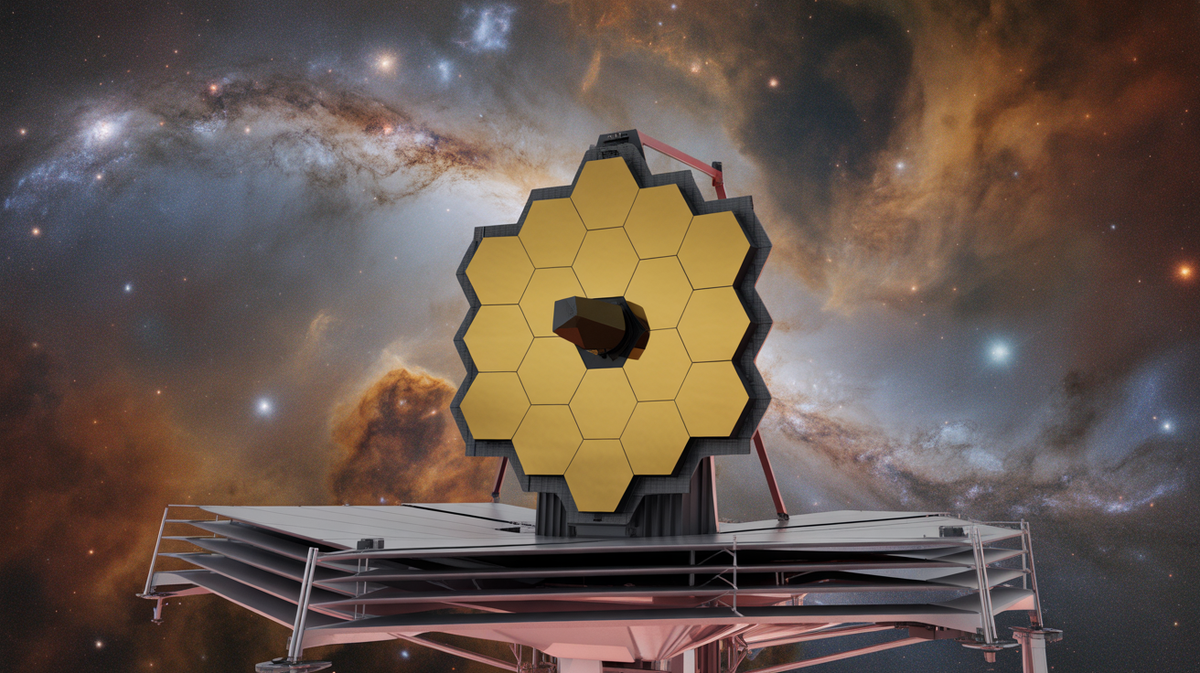
- ➡️ Primary Mirror: Webb boasts an enormous 6.5-meter (21.3-foot) primary mirror, composed of 18 hexagonal, gold-coated beryllium segments. This makes it significantly larger than Hubble’s 2.4-meter mirror, collecting far more light.
- ➡️ Sunshield: To detect faint infrared signals, the telescope must be kept incredibly cold (-223°C or -370°F). A tennis-court-sized, five-layer sunshield acts like a parasol, blocking heat from the Sun, Earth, and Moon.
- ➡️ Orbital Location: JWST orbits the Sun at the second Lagrange Point (L2), approximately 1.5 million kilometers (1 million miles) from Earth. This stable position allows it to maintain a cold, dark environment crucial for its operation.
For more details on the telescope’s construction and scientific goals, explore our comprehensive guide on the James Webb Space Telescope: Unveiling the Cosmos.
Groundbreaking Discoveries: What JWST Has Revealed So Far
Since its first full-color images were released in July 2022, JWST has been delivering an unprecedented cascade of discoveries, pushing the boundaries of what we thought possible to observe. Its data is actively transforming multiple fields of astrophysics:
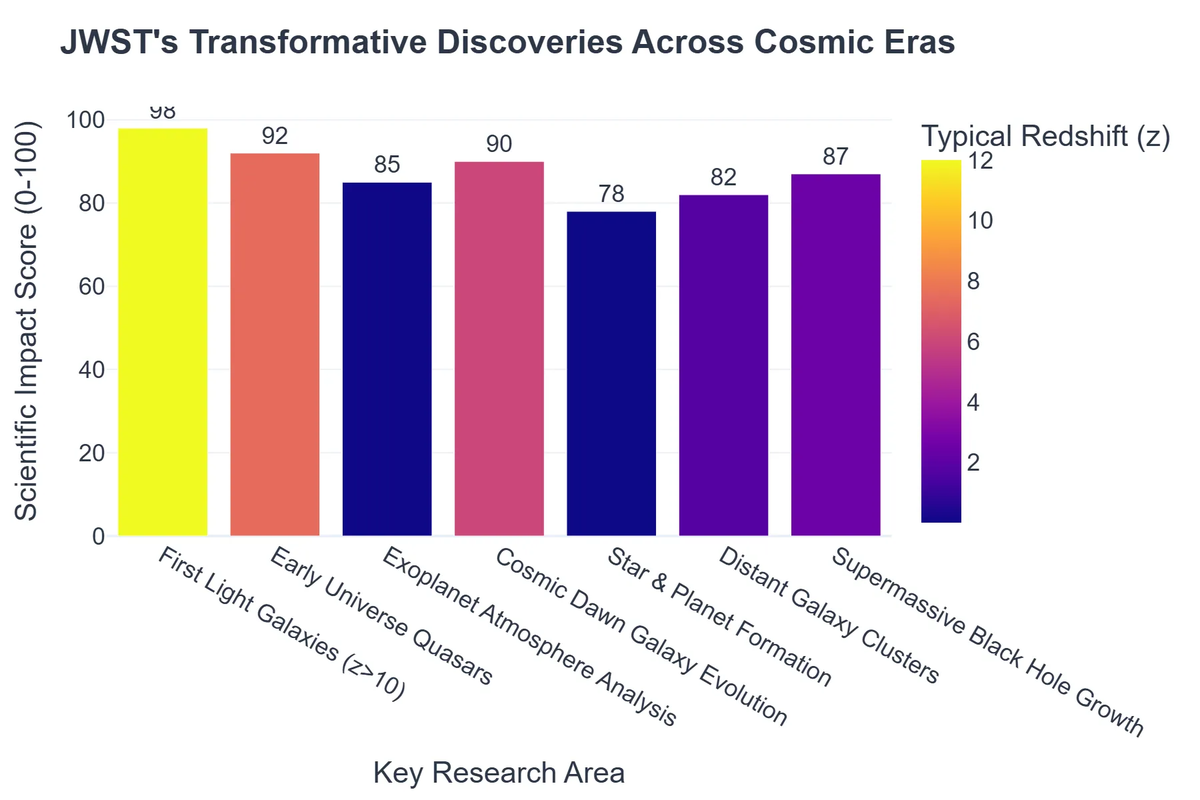
- 💡 The Earliest Galaxies: Webb has identified galaxies that existed just a few hundred million years after the Big Bang, providing invaluable insights into how the first star systems formed and evolved. These incredibly distant observations are redefining galaxy formation models. For more on these incredible finds, see our article, James Webb Telescope: Unveiling the Universe’s Deepest Secrets.
- 💡 Exoplanet Atmospheres: JWST’s instruments are incredibly sensitive, allowing scientists to analyze the atmospheres of distant exoplanets. It has detected water, carbon dioxide, methane, and even sulfur dioxide in the atmosphere of planets like WASP-39b, hinting at complex atmospheric chemistry. This capability is vital for the search for life beyond Earth. Discover more about this specific exoplanet in WASP-39b: Decoding the Atmosphere of a Distant Exoplanet.
- 💡 Star Birth and Death: From the breathtaking Pillars of Creation in the Eagle Nebula to the cosmic cliffs of the Carina Nebula, Webb’s infrared vision pierces through dust to reveal intricate details of star-forming regions and the dramatic aftermath of stellar explosions.
- 💡 Mysteries of Black Holes: Webb is providing new data on supermassive black holes at the centers of galaxies, observing their growth in the early universe and their impact on galaxy evolution. Learn more about its findings on cosmic giants in JWST Black Holes: James Webb Telescope Reveals Cosmic Giants.
- 💡 Our Own Solar System: Even within our cosmic neighborhood, JWST has provided stunning new perspectives on planets like Jupiter and Neptune, and has begun to unlock the mysteries of comets and the early solar system by observing their compositions with unprecedented detail. NASA’s Webb is set to unlock the secrets of comets, providing critical data on the primordial building blocks of our solar system.
The Future of Cosmic Exploration with JWST
The initial scientific observations from the James Webb Space Telescope have only scratched the surface of its potential. With its long operational lifespan expected to be well over a decade, scientists worldwide continue to propose and execute groundbreaking research programs. The telescope is poised to continue providing astonishing data that will refine existing theories and undoubtedly lead to entirely new fields of study.
Future observations will delve even deeper into the characterization of exoplanet atmospheres, searching for biosignatures that could indicate the presence of life. It will continue its relentless quest to observe the very first light in the universe, providing direct evidence of cosmic dawn. Furthermore, its ability to study distant quasars will help scientists understand how the earliest supermassive black holes formed and influenced their host galaxies, as detailed by NASA’s Webb mission goals.
The data stream from JWST NASA is immense and complex, requiring sophisticated analysis techniques. The insights gained from Webb will not only inform our understanding of the universe but also guide the design and objectives of future missions, such as concepts like LUVOIR, which aim to further expand our observational capabilities. Discover more about what lies ahead in space exploration with LUVOIR: The Future of Space Telescopes and Exoplanet Search. The synergy between current and future telescopes will be key to painting an even more complete picture of the cosmos.
Recommended Video
Unlocking Deeper Secrets: The Promise of JWST
The James Webb Space Telescope isn’t just a piece of technology; it’s a vehicle for fundamental discovery. It’s allowing us to witness the universe’s birth, track the evolution of galaxies, and perhaps, for the first time, truly characterize worlds beyond our own. The findings from JWST NASA are not just for scientists; they are for all of humanity, offering profound perspectives on our origins and our place in the vast, awe-inspiring cosmos.
The ongoing data from Webb continues to inspire and challenge, proving that the universe is far more complex and wondrous than we ever imagined. As we continue to process and understand its incredible images and spectroscopic data, we move closer to answering some of the most profound “Cosmic Queries: Probing the Mysteries of the Universe” that have captivated thinkers for millennia. The journey has just begun, and the universe is ready to reveal its deepest secrets.
What makes the JWST different from the Hubble Space Telescope?
The JWST primarily observes in infrared light, allowing it to peer through dust clouds and observe extremely distant, early universe objects, unlike Hubble which focuses on visible and ultraviolet light.
Where is the JWST located in space?
The JWST orbits the Sun at the second Lagrange point (L2), approximately 1.5 million kilometers (1 million miles) from Earth, which provides a stable thermal environment for its sensitive instruments.
What are some of JWST’s most significant discoveries so far?
JWST has discovered some of the earliest and most distant galaxies ever observed, provided detailed atmospheric analyses of exoplanets, and captured stunning images of star formation regions.
How long is the JWST expected to operate?
The JWST was designed for a 5-year science mission, but thanks to its precise launch and fuel efficiency, it has enough propellant to operate for well over 20 years.