


Big Bounce vs. Big Freeze: The Universe’s Competing Fates
The cosmos, in its grand, unfolding drama, poses perhaps no greater mystery than its ultimate destiny. From the fiery origins of the Big Bang, what lies ahead for the vast expanse we call the Universe? Two dominant, yet starkly different, cosmological models vie for scientific consensus: the big freeze universe (or heat death) and the Big Bounce universe.
💡 Key Takeaways
- The Big Bounce posits a cyclical universe, expanding from a Big Bang, then contracting to a Big Crunch, only to restart.
- The Big Freeze (Heat Death) suggests the universe will expand indefinitely, cooling until all energy is uniformly distributed and unusable.
- Current cosmological evidence, particularly concerning dark energy, largely supports the Big Freeze scenario.
- Both theories represent extreme, but plausible, scientific predictions for the universe’s ultimate destiny.
“While the Big Freeze feels like a slow, inevitable fade to black, the Big Bounce offers a tantalizing echo of rebirth. It reminds us that even at the grandest scales, the universe might be a story of infinite chapters, not just a single, final act.”
— Astrid Bellweather, Astrophysicist & Science Fiction Consultant
These theories offer profound insights into the mechanics of the cosmos and challenge our understanding of time, space, and existence itself. Join us as we probe these Cosmic Queries: Probing the Mysteries of the Universe, exploring the evidence, implications, and the cosmic ballet that might lead to either an eternal slumber or an endless cycle of rebirth.
In This Article
- → Big Bounce vs. Big Freeze: The Universe’s Competing Fates
- — 💡 Key Takeaways
- → The Big Freeze (Heat Death): A Gradual Decline
- — ❄️ What is the Big Freeze Universe?
- — 🔬 Scientific Basis and Evidence for the Big Freeze
- → The Big Bounce: A Universe Reborn?
- — 🔄 Understanding the Big Bounce Model
- — 🧪 Theoretical Foundations and Challenges of the Big Bounce
- → The Decisive Role of Dark Energy
- → Big Freeze vs. Big Bounce: A Comparative Analysis
- → 🤔 Philosophical and Existential Implications
- → Conclusion: An Unfolding Cosmic Saga
The Big Freeze (Heat Death): A Gradual Decline
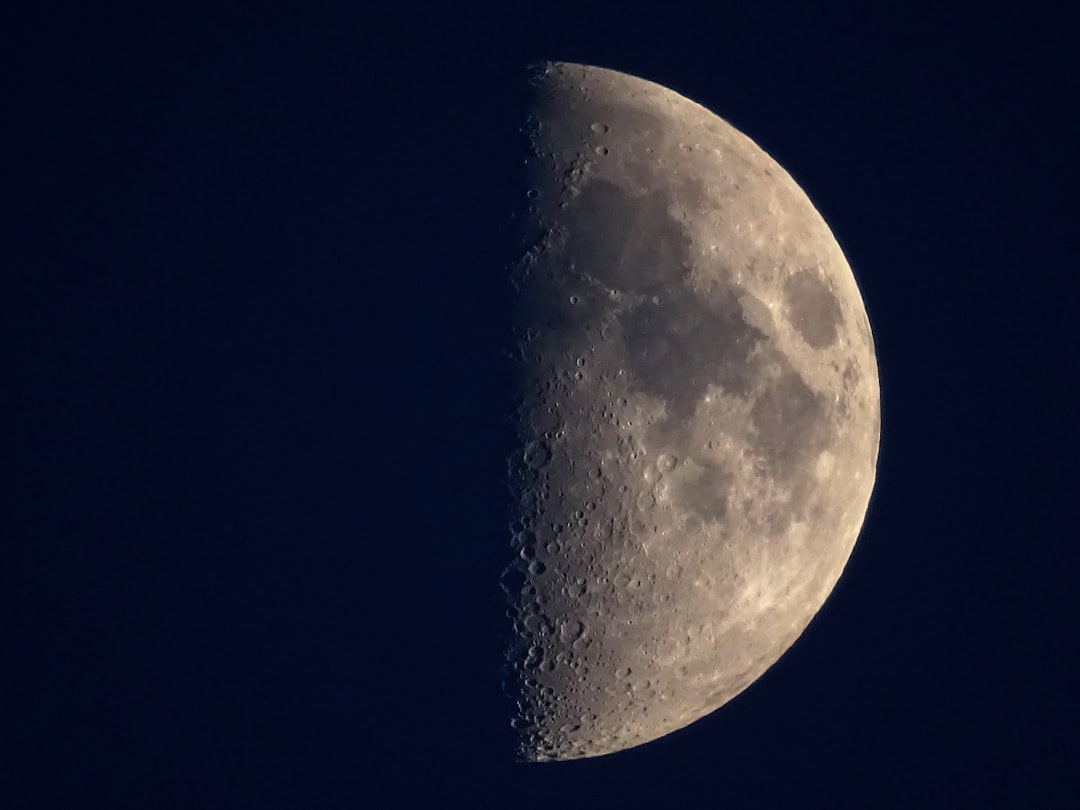
The Big Freeze, also known as the “heat death” of the universe, represents the most widely accepted ultimate fate according to current cosmological observations. It’s a scenario of slow, inexorable decay, driven by the relentless expansion of space.
❄️ What is the Big Freeze Universe?
In the Big Freeze scenario, the universe continues to expand indefinitely, causing its temperature to asymptotically approach absolute zero. This continued expansion leads to several key events:
- ✅ Dilution of Matter: Galaxies move further apart, and the density of matter and radiation continually decreases.
- ✅ Star Formation Ceases: As gas and dust clouds become too diffuse, new stars can no longer form. Existing stars eventually exhaust their nuclear fuel, becoming white dwarfs, neutron stars, or black holes.
- ✅ Black Hole Evaporation: Over immense timescales, even supermassive black holes are predicted to evaporate via Hawking radiation, leaving behind only photons and leptons.
- ✅ Ultimate Thermal Equilibrium: The universe reaches a state of maximum entropy, where all energy is uniformly distributed, and no further thermodynamic processes can occur. It becomes a cold, dark, empty void.
This state, devoid of usable energy gradients, is the “heat death” – not due to extreme heat, but due to the cessation of all energy transfer.
🔬 Scientific Basis and Evidence for the Big Freeze
The primary evidence supporting the Big Freeze comes from observations of the universe’s expansion:
- ➡️ Accelerated Expansion: Observations of distant supernovae in the late 1990s revealed that the universe’s expansion is not only ongoing but is accelerating. This acceleration is attributed to a mysterious force known as dark energy.
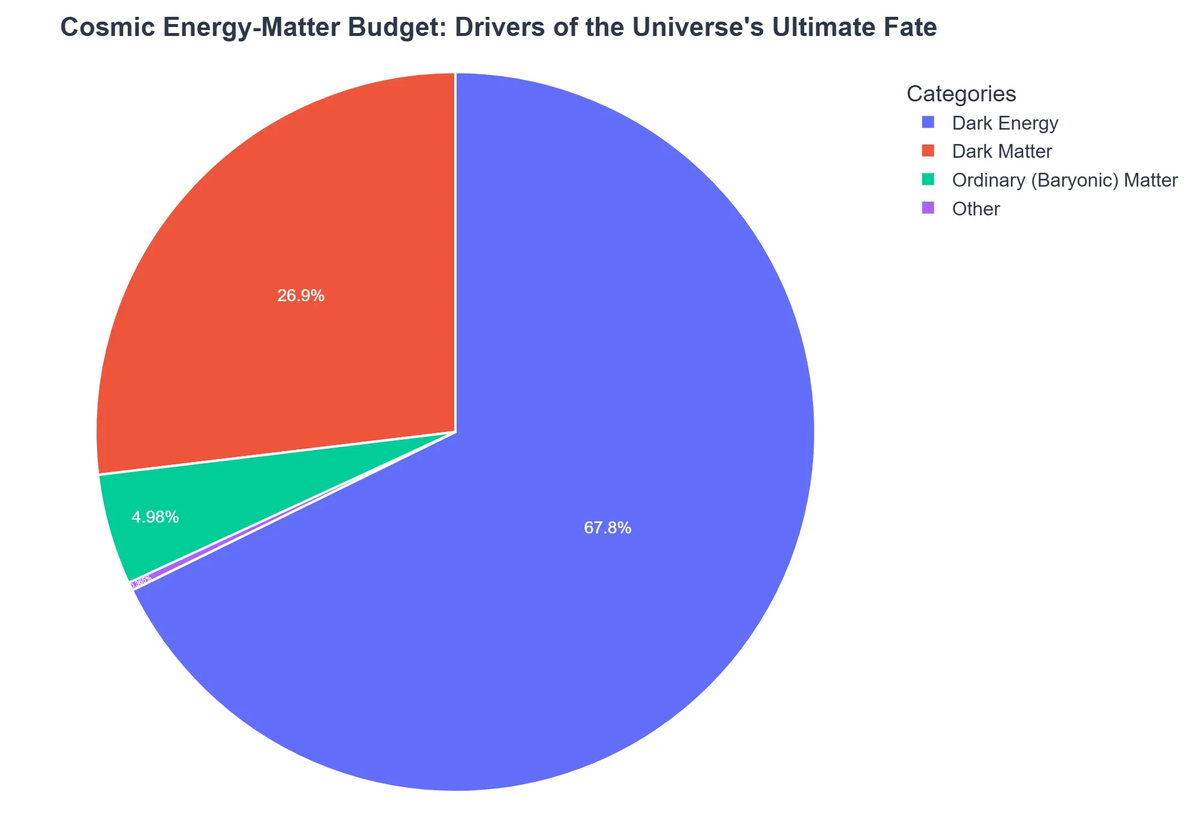
- ➡️ Dominance of Dark Energy: Current cosmological models suggest that dark energy constitutes about 68% of the universe’s total energy density. Its repulsive gravitational effect counteracts the attractive gravity of matter, driving expansion.
- ➡️ Thermodynamics: The second law of thermodynamics, which states that entropy (disorder) in a closed system always increases, naturally leads to a state of maximum entropy, which aligns with the heat death scenario.
Given our current understanding of dark energy and the universe’s observed properties, the Big Freeze remains the most scientifically favored ultimate fate. For more on how the universe began, explore Universe Creation Theories: From Nothingness to Cosmos.
The Big Bounce: A Universe Reborn?
In stark contrast to the eternal decline of the Big Freeze, the Big Bounce proposes a cyclical universe, one that undergoes an endless series of expansions and contractions. It offers a fascinating alternative to the conventional Big Bang theory.
🔄 Understanding the Big Bounce Model
The Big Bounce theory suggests that the Big Bang was not the singular beginning of everything, but rather a “bounce” from a preceding cosmic contraction, or Big Crunch. In this model:
- 💡 Cyclic Nature: The universe expands for a period, then reverses, contracting back to an extremely dense state.
- 💡 Infinite Recurrence: This cycle then repeats, with a new expansion phase following each contraction. Each “bounce” could potentially wipe clean the slate, with new physical laws or constants emerging.
- 💡 Pre-Big Bang Universe: The Big Bounce implies a universe that existed before our current expansion phase, addressing questions about what came “before” the Big Bang. This makes it an intriguing topic when discussing Beyond the Big Bang: Exploring Universe Theories.
🧪 Theoretical Foundations and Challenges of the Big Bounce
The Big Bounce theory often arises from attempts to address certain cosmological puzzles, such as the initial singularity problem of the Big Bang and the homogeneity of the early universe. Some theoretical frameworks that support it include:
- ✅ Loop Quantum Gravity (LQG): This theory, which attempts to unify quantum mechanics with general relativity, suggests that gravity becomes repulsive at extremely high densities, preventing a singularity and instead causing a bounce.
- ✅ Cyclic Models: Some models propose the universe has a specific geometry or unusual matter content that could lead to a reversal of expansion.
However, the Big Bounce faces significant challenges:
- ➡️ Lack of Observational Evidence: Crucially, there is no direct observational evidence that the universe is slowing down its expansion, let alone contracting. All current data points to accelerated expansion.
- ➡️ The Role of Dark Energy: Dark energy, with its repulsive gravity, appears to be pushing the universe towards eternal expansion, making a contraction (and thus a bounce) highly improbable under current understanding.
- ➡️ Entropy Problem: A persistent challenge for cyclic models is how to avoid an ever-increasing build-up of entropy across bounces, which would eventually lead to a form of heat death anyway.
While fascinating, the Big Bounce remains a theoretical alternative, often discussed alongside other Big Bounce and Big Crunch: Exploring Alternative Cosmological Models.
The Decisive Role of Dark Energy
Understanding the ultimate fate of the universe is inextricably linked to the enigmatic force known as dark energy. Discovered in the late 1990s, its influence has profoundly shifted cosmological predictions.
- ⚛️ Cosmic Accelerator: Dark energy acts as a repulsive force, counteracting gravity and causing the universe’s expansion to accelerate. It’s akin to an anti-gravitational pressure.
- ⚛️ Dominant Force: Current estimates suggest dark energy makes up roughly 68% of the universe’s total energy density, far outweighing matter (both ordinary and dark matter).
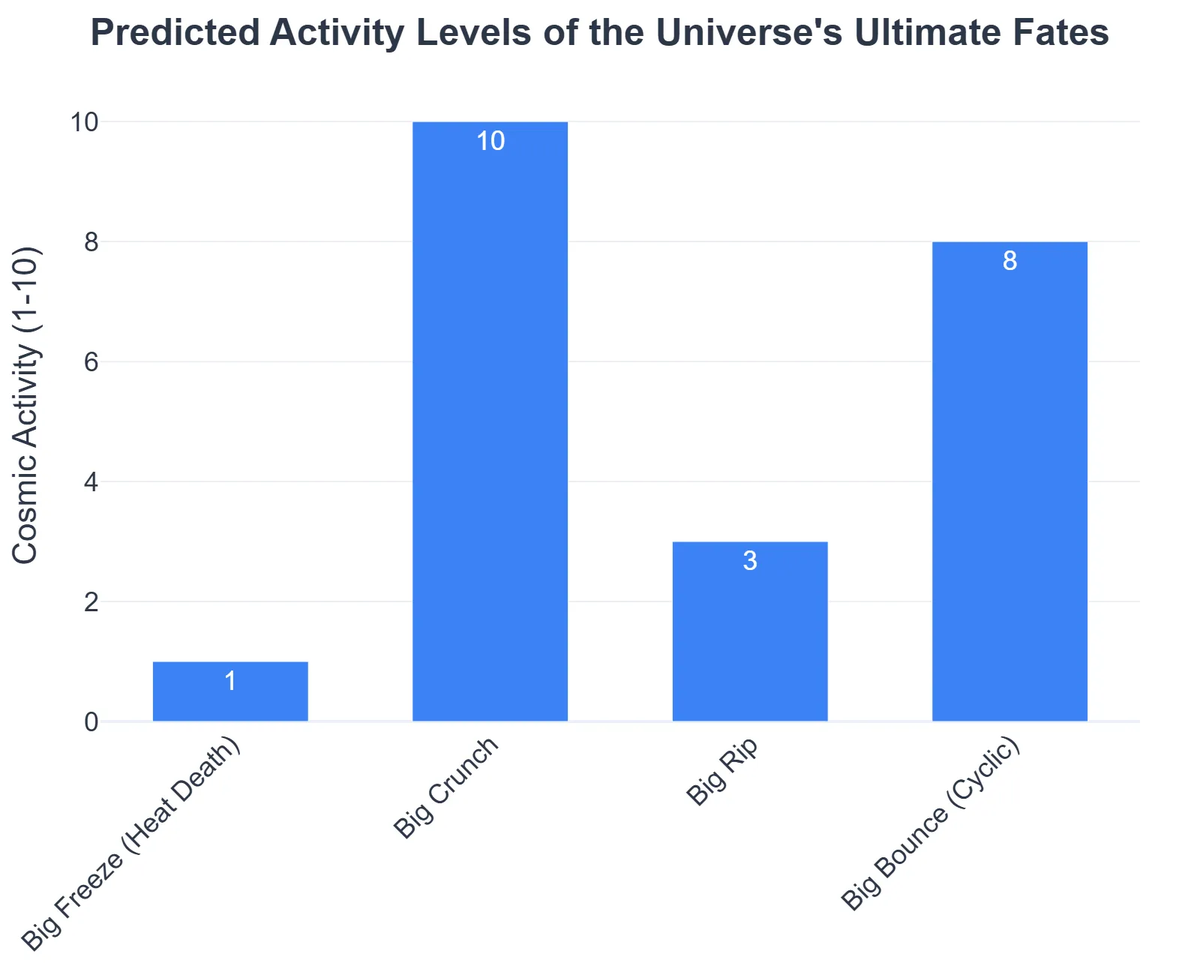
- ⚛️ Determining Destiny: The precise nature and behavior of dark energy are crucial. If it remains constant, a Big Freeze is the likely outcome. If its density changes over time (e.g., becomes stronger), it could lead to an even more extreme “Big Rip” scenario, tearing apart even atoms. If it were to weaken significantly or reverse, a Big Crunch (and potentially a Big Bounce) might become possible.
As of now, all evidence points to dark energy maintaining its influence, cementing the Big Freeze as the frontrunner for the universe’s ultimate end.
Big Freeze vs. Big Bounce: A Comparative Analysis
Let’s lay out the key differences between these two compelling theories:
| Feature | Big Freeze (Heat Death) | Big Bounce |
|---|---|---|
| Expansion | Continuous, accelerating, indefinite. | Cyclic (expansion followed by contraction). |
| End State | Cold, dark, empty, maximum entropy; all activity ceases. | Rebirth into a new expansion phase after a “bounce.” |
| Role of Dark Energy | Drives and sustains the accelerated expansion, preventing collapse. | Would need to somehow dissipate or reverse its effect for contraction to occur. |
| Pre-Big Bang? | Does not inherently address what came before the Big Bang. | Posits a prior universe that contracted to form the current one. |
| Current Evidence | Strongly supported by observed accelerated cosmic expansion. | No direct observational evidence; relies on theoretical physics (e.g., LQG). |
While the Big Bounce offers a conceptually appealing idea of cosmic rebirth, the overwhelming observational data, particularly regarding dark energy, currently favors the Big Freeze as the most probable ultimate fate of the universe. This perspective is echoed across scientific discourse, as highlighted by resources like Ultimate fate of the universe – Wikipedia.
🤔 Philosophical and Existential Implications
Beyond the scientific models, the ultimate fate of the universe touches upon profound philosophical and existential questions. Both the Big Freeze and the Big Bounce offer starkly different perspectives on our place in the cosmos.
- 🌌 The Big Freeze: This paints a picture of eventual cosmic loneliness and finality. If the universe truly ends in a cold, dark silence, does it render our existence, our endeavors, ultimately meaningless? Or does it emphasize the preciousness and fleeting nature of life and consciousness in this brief, vibrant period? Discussions about finding comfort in such a future are explored even in forums like How do you find comfort in the big freeze? : r/philosophy.
- 🔄 The Big Bounce: Conversely, a cyclic universe offers a sense of eternal recurrence and renewal. While our specific universe might end, the cycle continues, suggesting an infinite sequence of beginnings and ends. This could be seen as comforting or, depending on perspective, as reducing all existence to a repetitive loop.
These cosmological models are not just scientific hypotheses; they are narratives about the grandest story of all, shaping our contemplation of purpose, impermanence, and the very fabric of reality.
Recommended Video
Conclusion: An Unfolding Cosmic Saga
The debate between the Big Freeze and the Big Bounce encapsulates humanity’s enduring quest to understand its cosmic origins and destiny. While current scientific evidence, particularly the observation of accelerating cosmic expansion driven by dark energy, strongly points towards the Big Freeze as the ultimate fate, the scientific journey is far from over.
The Big Bounce remains a fascinating theoretical alternative, continually refined by new insights from quantum gravity and other cutting-edge physics. As our instruments become more sensitive and our theoretical models more robust, we edge closer to unraveling these profound Universe Creation Theories: From Nothingness to Cosmos. Regardless of the eventual outcome, the universe’s ultimate fate invites us to ponder the immense scales of time and space, and our place within this ever-evolving, magnificent cosmos.
Frequently Asked Questions
What is the Big Bounce theory?
The Big Bounce theory suggests that the universe undergoes a cyclical process of expansion (Big Bang) and contraction (Big Crunch), with each cycle leading to a new Big Bang.
What is the Big Freeze (Heat Death) theory?
The Big Freeze, or Heat Death, theory proposes that the universe will expand forever, causing it to cool down as energy disperses, eventually reaching a state of maximum entropy where no work can be done.
What is the current scientific consensus on the universe’s fate?
Current observations, particularly regarding the accelerating expansion of the universe driven by dark energy, strongly favor the Big Freeze (Heat Death) scenario.
Could the Big Bounce still be possible?
While less favored by current data, some theoretical models and interpretations of quantum gravity continue to explore the Big Bounce as a plausible alternative, suggesting our Big Bang might have been a “bounce” from a previous universe.