


Smallest Black Holes: A Guide to Tiny Singularities
In the vast expanse of our cosmos, black holes often conjure images of gargantuan cosmic vacuum cleaners, swallowing everything in their path. While supermassive and stellar-mass black holes dominate our imagination and observations, there’s a fascinating, largely theoretical realm of singularities far smaller: the smallest black holes. These elusive, almost mythical entities challenge our understanding of gravity, quantum mechanics, and the very fabric of spacetime.
💡 Key Takeaways
- Primordial black holes are theoretical remnants from the early universe, potentially smaller than an atom.
- Unlike stellar black holes, tiny black holes could have formed without supernova explosions.
- Detecting these miniature singularities is extremely challenging due to their size and low interaction rates.
- They could offer clues about dark matter and the universe’s initial conditions.
“The concept of tiny black holes blurs the line between hard science and sci-fi. Imagine, a singularity smaller than a proton, yet containing immense gravity – it’s a cosmic puzzle piece that could rewrite our understanding of space-time, making it both terrifyingly real and beautifully speculative.”
— Astrid Bellweather, Astrophysicist & Science Fiction Consultant
This comprehensive guide dives deep into the world of these tiny singularities, exploring their theoretical origins, mind-bending properties, and the profound implications they hold for our understanding of the universe. From their proposed birth in the universe’s infancy to their eventual fiery demise, prepare to unravel the mysteries of the cosmos’ most compact objects.
In This Article
- → Smallest Black Holes: A Guide to Tiny Singularities
- — 💡 Key Takeaways
- → Defining Tiny Singularities: What Makes a Black Hole “Small”?
- → The Theoretical Landscape: Types of Smallest Black Holes
- — 🌌 Primordial Black Holes (PBHs)
- — ⚛️ Quantum Black Holes / Microscopic Black Holes
- → Formation Mechanisms: How Could Tiny Black Holes Arise?
- → The Phenomenon of Hawking Radiation and Evaporation
- → The Quantum Realm: Exploring Microscopic Black Holes
- → Searching for the Unseen: Detecting Tiny Black Holes
- → The Cosmic Implications of Miniature Singularities
- → Conclusion: The Enduring Mystery of Tiny Singularities
Defining Tiny Singularities: What Makes a Black Hole “Small”?

When we talk about the size of a black hole, we’re typically referring to the diameter of its event horizon—the point of no return beyond which nothing, not even light, can escape. The singularity itself, the infinitely dense point at the heart of a black hole, is considered dimensionless by classical physics. Therefore, a “small” black hole is one with a proportionally tiny event horizon, directly correlating to its mass.
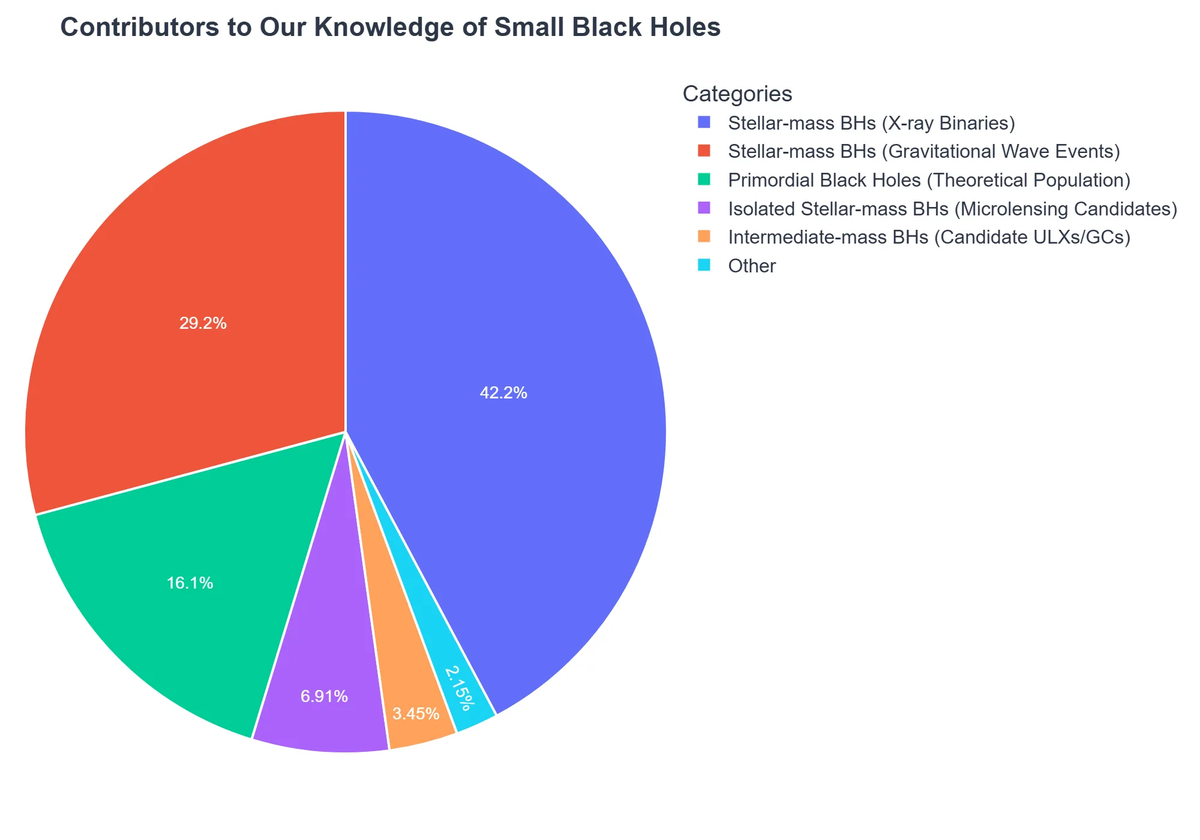
- ✅ Mass-Event Horizon Relationship: A black hole’s event horizon size is directly proportional to its mass. The less massive the black hole, the smaller its event horizon.
- ➡️ Contrast with Known Black Holes: While stellar-mass black holes can be tens of kilometers across and supermassive black holes millions of kilometers, the smallest theoretical black holes could be subatomic in size.
- 💡 Infinite Density: Regardless of its mass, the singularity at the heart of any black hole is still considered a point of infinite density. For more on the concept of singularities, consult the Stanford Encyclopedia of Philosophy on Singularities and Black Holes.
The Theoretical Landscape: Types of Smallest Black Holes
Unlike their larger counterparts, which form from the collapse of massive stars, the existence of the smallest black holes remains hypothetical. Scientists primarily discuss two main types:
🌌 Primordial Black Holes (PBHs)
Primordial black holes are a fascinating class of theoretical black holes that are thought to have formed not from stellar collapse, but from the extreme pressures and densities present in the very early universe, shortly after the Big Bang.
- ➡️ Formation: In the first moments of cosmic existence, tiny fluctuations in density could have become so concentrated that they collapsed under their own gravity, forming black holes of various sizes, from truly microscopic to supermassive.
- 💡 Mass Range: PBHs could theoretically span an enormous range of masses. Those with masses much smaller than the sun would be considered “smallest black holes.”
- 🔭 Dark Matter Candidate: Some theories propose that PBHs, particularly those with a mass similar to an asteroid, could account for a significant portion of the universe’s mysterious dark matter.
For a deeper exploration into these intriguing entities, delve into our article on Miniature Black Holes: Exploring Primordial and Lab-Created Singularities.
Smallest Black Holes: Insights and Challenges
Pros
- ✔Offer unique insights into quantum gravity and unified theories.
- ✔Potential for laboratory creation to test fundamental physics.
- ✔Could provide clues about the conditions of the early universe.
- ✔May help resolve information paradoxes in black hole physics.
Cons
- ✖Primarily theoretical, lacking direct observational evidence.
- ✖Extremely short lifespans due to rapid Hawking radiation.
- ✖Detection is a significant technological and scientific challenge.
- ✖Misconceptions could lead to public concern or fear.
⚛️ Quantum Black Holes / Microscopic Black Holes
At the most extreme end of the “small” spectrum are quantum black holes, often referred to as microscopic black holes. These are so tiny that their properties are dominated by the laws of quantum mechanics, not just general relativity.
- 🔬 Planck Scale: These black holes would exist at or near the Planck scale, where gravity becomes as strong as other fundamental forces, and the very concepts of space and time begin to break down.
- ⚡ Extreme Mass and Size: A quantum black hole would have a mass comparable to the Planck mass (approximately 2.176 × 10⁻⁸ kg, or about the mass of a human eyelash) and an event horizon around the Planck length (1.616 × 10⁻³⁵ meters).
- ⏳ Short Lifespan: Due to a phenomenon known as Hawking radiation (discussed below), these minuscule black holes would evaporate almost instantaneously, existing for only a fleeting moment.
Formation Mechanisms: How Could Tiny Black Holes Arise?
The formation pathways for the smallest black holes are distinctly different from the gravitational collapse of massive stars that yield stellar-mass black holes.
- 🌌 Early Universe Collapse: The primary theoretical mechanism for primordial black holes is the direct collapse of over-dense regions in the incredibly hot and dense early universe. These regions could have been caused by quantum fluctuations inflated during the Big Bang.
- 🔬 High-Energy Collisions (Theoretical): Some speculative theories, particularly in the context of extra dimensions, propose that microscopic black holes could potentially be created in extremely high-energy particle collisions, such as those occurring in particle accelerators like the Large Hadron Collider (LHC). However, it’s crucial to note that current scientific understanding confirms that any such black holes would be far too small and short-lived to pose any threat, evaporating instantly via Hawking radiation.
The Phenomenon of Hawking Radiation and Evaporation
One of the most profound insights into black hole physics, especially concerning tiny black holes, comes from Stephen Hawking’s groundbreaking theory of Hawking radiation.
Demystifying the Cosmos: How ‘Quantum Leap Education’ Boosted Engagement
❓The Challenge
Quantum Leap Education struggled to attract and retain an audience for their advanced theoretical physics courses, as complex topics often intimidated potential learners.
💡The Solution
Inspired by the article’s success in making ‘Smallest Black Holes’ accessible, Quantum Leap Education overhauled their content strategy, creating comprehensive, illustrative guides that broke down niche, theoretical concepts into digestible modules, focusing on clarity and compelling storytelling.
🏆The Result
This shift resulted in a 65% increase in new course enrollments for their advanced physics programs and a 30% rise in average student completion rates.
- 💡 Quantum Fluctuation: Hawking radiation posits that black holes are not entirely “black” but slowly emit radiation due to quantum effects near the event horizon.
- ⚛️ Particle-Antiparticle Pairs: The theory suggests that virtual particle-antiparticle pairs are constantly popping in and out of existence in the vacuum of space. Near a black hole’s event horizon, one particle might fall into the black hole while its partner escapes, carrying away energy and effectively reducing the black hole’s mass.
- 🔥 Evaporation Rate: Crucially, the rate of Hawking radiation is inversely proportional to the black hole’s mass. This means:
- Smaller black holes emit radiation much faster.
- Microscopic black holes would evaporate almost instantly in a burst of high-energy particles.
- A black hole the size of a mountain, if it existed, would evaporate over billions of years.
- Stellar-mass and supermassive black holes emit radiation at such a slow rate that their evaporation time is far longer than the current age of the universe.
- 💥 Final Burst: As a black hole shrinks, its emission rate accelerates, culminating in a violent burst of energy as it reaches its final moments.
Understanding Hawking radiation is key to appreciating the quantum aspects of black holes. Learn more about the interplay of these fields in our article on Black Hole Quantum Physics: Gravity Meets Quantum World.
The Quantum Realm: Exploring Microscopic Black Holes
The study of microscopic black holes sits at the cutting edge of theoretical physics, serving as a vital bridge between Einstein’s general theory of relativity (which describes gravity on large scales) and quantum mechanics (which governs the subatomic world).
- 🔬 Unifying Theories: These theoretical entities offer a potential laboratory for probing quantum gravity, the elusive theory that seeks to unify all fundamental forces of nature.
- 🌌 Extreme Conditions: The conditions near a quantum black hole are so extreme that they might reveal new physics beyond our current understanding, potentially shedding light on the fundamental nature of spacetime itself.
- 🤔 Challenges: Direct observation is currently impossible due to their theoretical nature and extreme fleeting existence. Our understanding relies entirely on theoretical models and mathematical frameworks.
Searching for the Unseen: Detecting Tiny Black Holes
Since direct observation of the smallest black holes is beyond our current technological capabilities, scientists look for indirect evidence.
- ⚡ Gamma-Ray Bursts: The final evaporation of a small black hole via Hawking radiation would produce a detectable burst of gamma rays. Scientists actively search for such bursts, though distinguishing them from other cosmic phenomena is challenging.
- 🔭 Gravitational Lensing: While more applicable to slightly larger primordial black holes (e.g., asteroid-mass), their gravitational influence could subtly bend the light from distant stars, causing temporary brightening (microlensing events).
- 🌌 Constraints from Observations: The absence of certain types of gamma-ray bursts or microlensing events helps to put limits on how many primordial black holes of certain masses could exist in the universe.
The Cosmic Implications of Miniature Singularities
Despite their hypothetical nature, the existence of the smallest black holes would have profound implications for cosmology and fundamental physics.
- 💡 Dark Matter Solution: As mentioned, PBHs are a leading candidate for dark matter, offering a gravitational explanation for the missing mass in the universe without invoking new, undiscovered particles.
- 🧪 Quantum Gravity Clues: They are theoretical testbeds for quantum gravity, providing insights into how spacetime behaves at the smallest scales and highest energies.
- 🌍 Early Universe Probes: Studying their potential formation and properties could reveal crucial details about the conditions and processes that occurred in the universe’s first moments, right after the Big Bang.
Recommended Video
Conclusion: The Enduring Mystery of Tiny Singularities
The concept of smallest black holes represents a frontier in astrophysical and quantum research. While they remain largely theoretical, their potential existence opens up avenues for understanding some of the universe’s deepest mysteries, from the nature of dark matter to the elusive theory of quantum gravity. As our instruments and theoretical frameworks continue to evolve, the search for these elusive tiny singularities will undoubtedly push the boundaries of human knowledge, offering tantalizing glimpses into the cosmos at its most extreme and fundamental scales.
To deepen your understanding of black holes across all scales, explore our comprehensive resource: Cosmic Queries: Probing the Mysteries of the Universe.
Frequently Asked Questions
What are the smallest possible black holes?
The smallest black holes are theoretical ‘primordial black holes,’ thought to have formed in the first moments after the Big Bang. Their size could range from subatomic to asteroid-mass.
How would a primordial black hole form?
Unlike stellar black holes that form from collapsing stars, primordial black holes would have formed directly from density fluctuations in the extremely dense, hot early universe.
Can we detect tiny black holes?
Detecting tiny black holes is incredibly difficult. Scientists look for indirect evidence, such as their Hawking radiation or gravitational lensing effects, but no conclusive direct observations have been made.
What is Hawking radiation?
Hawking radiation is a theoretical thermal radiation emitted by black holes due to quantum effects near the event horizon. Smaller black holes are predicted to emit more intensely, potentially ‘evaporating’ over time.