


The question of what was before the Big Bang is arguably one of the most profound and challenging mysteries in all of science. For centuries, humanity has pondered the origins of everything, leading to philosophical, theological, and eventually, scientific inquiries. While the Big Bang theory provides our most robust scientific framework for the universe’s evolution after a certain point, it doesn’t, by itself, tell us what — if anything — existed before that initial cosmic expansion. This article delves into the current scientific understanding, exploring the conceptual challenges and the leading theoretical models attempting to unravel these pre-origin mysteries.
💡 Key Takeaways
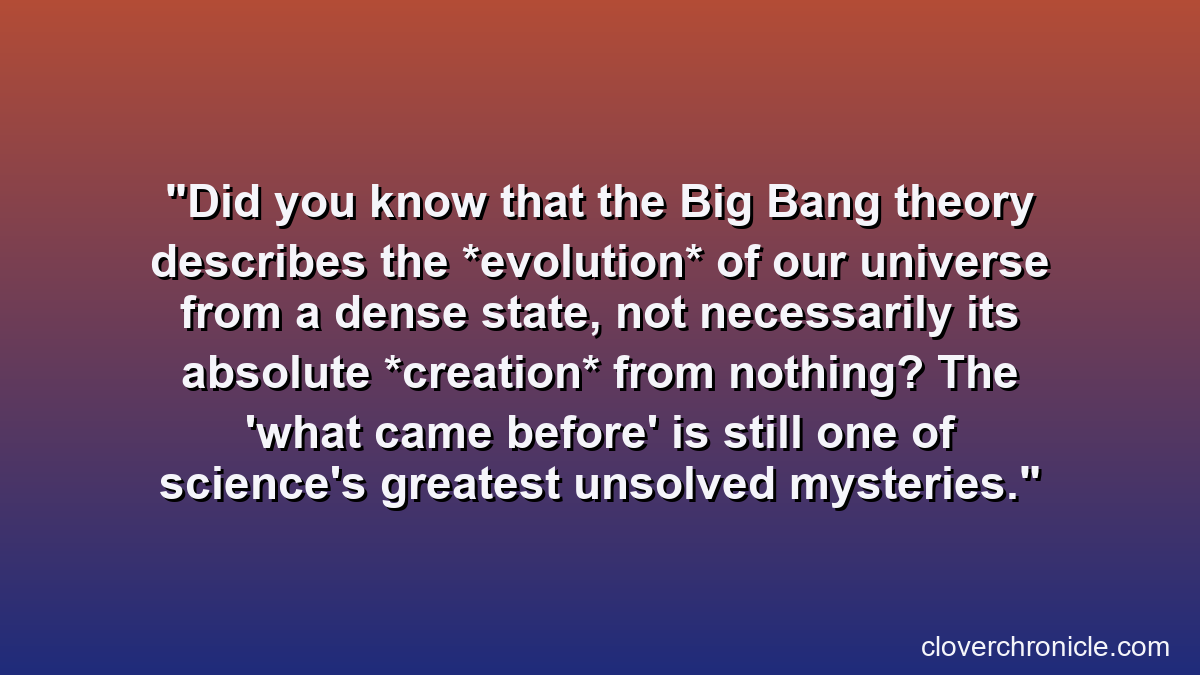
- The Big Bang describes the universe’s expansion, not necessarily its absolute beginning from ‘nothing.’
- Leading theories include cyclic universes, eternal inflation leading to multiverses, and quantum foam models.
- Understanding ‘before’ the Big Bang requires new physics beyond general relativity, such as quantum gravity.
- The concept challenges our fundamental understanding of time and causality itself.
“While the Big Bang marks the observable universe’s genesis, the ‘before’ is where science fiction and theoretical physics truly intertwine. It’s the ultimate canvas for exploring the fabric of reality itself, stretching our minds beyond the confines of our cosmic horizon.”
— Astrid Bellweather, Astrophysicist & Science Fiction Consultant
Understanding the universe’s beginnings requires us to push the boundaries of known physics. It’s a journey into speculative yet rigorously debated scientific territory, offering glimpses into a reality far stranger and more complex than we can easily imagine. For a broader exploration of these fundamental questions, consider our main resource on Cosmic Queries: Probing the Mysteries of the Universe.
In This Article
- — 💡 Key Takeaways
- → Understanding the Big Bang: Our Cosmic Starting Point
- — What the Big Bang Theory Explains (and Doesn’t)
- — The Observable Universe and the Limits of Evidence
- → The Conceptual Challenge: What Does “Before” Even Mean?
- — Time and Space Born with the Universe
- — Beyond Conventional Physics
- → Leading Theories on What Was Before the Big Bang
- — The Big Bounce Theory (Cyclic Universe)
- — Multiverse Hypotheses (Inflationary Cosmology)
- — Quantum Gravity Theories (Loop Quantum Gravity, String Theory)
- → The Unanswered Questions and Future Research
- — Limitations of Current Scientific Models
- — The Role of Observational Astronomy and Particle Physics
- → Conclusion: Embracing the Mystery of Universe Origins
Understanding the Big Bang: Our Cosmic Starting Point
Before we can even begin to discuss what might have come before, it’s crucial to grasp what the Big Bang theory actually describes. It’s not an explosion in space, but rather an expansion of space itself.
What the Big Bang Theory Explains (and Doesn’t)
- ✅ Expansion of the Universe: The theory posits that the universe began in an extremely hot, dense state about 13.8 billion years ago and has been expanding and cooling ever since.
- ✅ Cosmic Microwave Background (CMB): It accurately predicts the existence and properties of the CMB, the faint afterglow radiation from the early universe.
- ✅ Abundance of Light Elements: It explains the observed ratios of hydrogen, helium, and lithium in the universe.
- ✅ Formation of Large-Scale Structures: It provides a framework for how galaxies and galaxy clusters formed over time.
- ➡️ What it DOESN’T explain: The Big Bang theory does not describe the initial singularity itself (the moment of “creation”) or what initiated the expansion. It models the universe from an incredibly tiny, hot, and dense state, but not the conditions or “existence” prior to that state. For a more detailed look, refer to our Big Bang Theory: A Comprehensive Guide to the Universe’s Origin.
The Observable Universe and the Limits of Evidence
Our ability to look back in time is limited by the age of the universe and the speed of light. The farthest we can “see” is the Cosmic Microwave Background, which represents the universe when it was about 380,000 years old. Before this, the universe was opaque, filled with a plasma where light couldn’t travel freely.
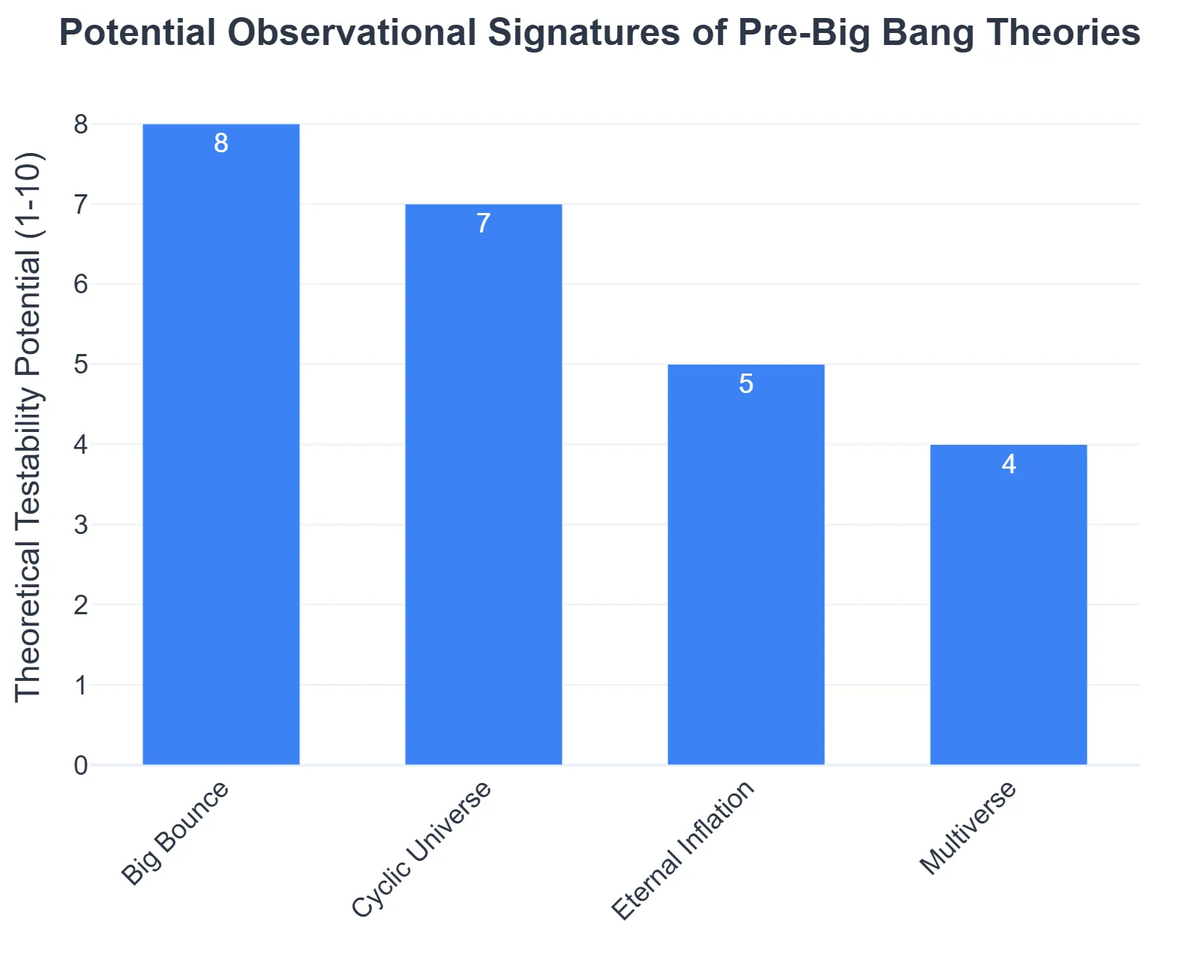
- 💡 Cosmic Horizon: This visible boundary is often called the cosmic horizon, and it means we cannot directly observe any events that might have occurred in the very first fractions of a second of the Big Bang, let alone any potential pre big bang universe.
- ➡️ Theoretical Inference: Our understanding of this earliest epoch relies heavily on theoretical physics, such as general relativity and particle physics, extrapolated to extreme conditions.
The Conceptual Challenge: What Does “Before” Even Mean?

The phrase “before the Big Bang” presents a significant conceptual hurdle. Our everyday understanding of “before” implies a preceding moment in time. However, many cosmological models suggest that time itself, along with space, emerged with the Big Bang.
Time and Space Born with the Universe
According to general relativity, time and space are not fixed backdrops but dynamic entities woven into the fabric of the cosmos. As Stephen Hawking famously theorized, if the universe began as a singularity, then time, as we understand it, may also have begun at that point. Asking what came “before” could be like asking what is “north of the North Pole” – a question that loses meaning within the defined coordinate system.
- ✅ No External Clock: If time originated with the Big Bang, there would be no external “clock” against which to measure a “before.”
- ➡️ Singularity Problem: The Big Bang singularity represents a breakdown in our current laws of physics, a point where density and temperature are infinite, and our equations cease to be applicable.
Beyond Conventional Physics
Addressing the question of a pre big bang state necessitates moving beyond the standard model of particle physics and classical general relativity. This leads physicists to explore theories of quantum gravity, which aim to unify general relativity (gravity) with quantum mechanics (the other fundamental forces).
- ⚙️ Quantum Realm: At scales smaller than the Planck length (approximately 1.6 x 10⁻³⁵ meters) and times shorter than the Planck time (approximately 5.4 x 10-44 seconds), quantum effects of gravity are expected to dominate. This is precisely the domain relevant to the universe’s earliest moments.
- 🔬 Theoretical Constructs: Concepts like string theory, loop quantum gravity, and other quantum cosmological models attempt to describe the universe at these extreme scales, potentially offering insights into a state that preceded the hot Big Bang.
Leading Theories on What Was Before the Big Bang
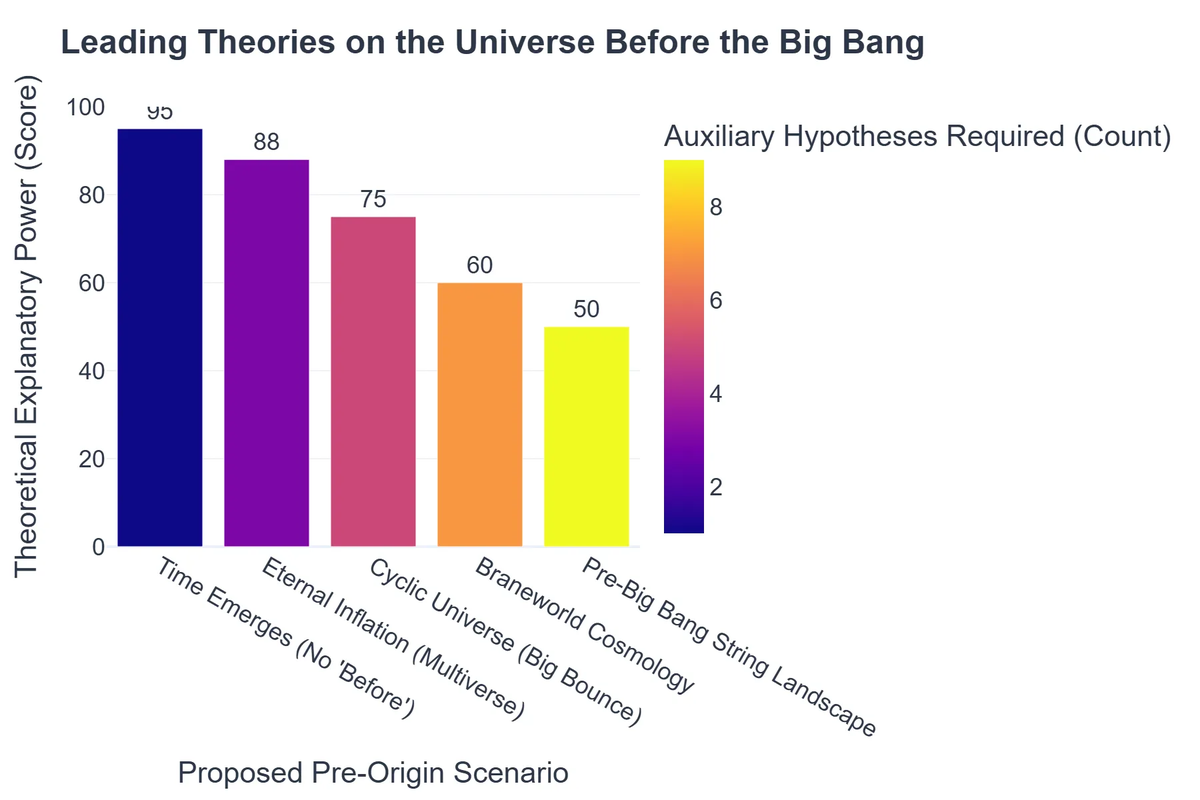
While direct observation is impossible, theoretical physics offers several compelling, albeit speculative, answers to the question of universe origins. These theories attempt to describe a state or process that could have given rise to our Big Bang.
The Big Bounce Theory (Cyclic Universe)
One of the most intuitive ideas for what was before the Big Bang is that our universe isn’t the first. The Big Bounce theory proposes a cyclic universe, where the current expansion will eventually reverse, leading to a “Big Crunch,” which then immediately “bounces” into another Big Bang, restarting the cycle. This means our Big Bang wasn’t a beginning, but a transition. Learn more about competing fates of the universe in our article on Big Bounce vs. Big Freeze: The Universe’s Competing Fates.
- ➡️ Explanation: Instead of a singularity, the universe contracts to a minimum but non-zero size, then re-expands. This avoids the singularity problem.
- ➡️ Implications: This model suggests an eternal universe, cycling through expansions and contractions. It also implies that fundamental constants might change with each bounce.
Multiverse Hypotheses (Inflationary Cosmology)
The theory of cosmic inflation, while primarily addressing issues within the early Big Bang (like its flatness and homogeneity), also has profound implications for a pre big bang universe. Many inflationary models suggest that our universe might be just one “bubble” in a much larger, eternally inflating multiverse.
- ➡️ Eternal Inflation: In some models, inflation never truly ends, but rather bubbles off new universes continuously. Our Big Bang would simply be one such bubble nucleating from this inflating “parent” space.
- ➡️ Bubble Universes: Each bubble could have different physical laws, constants, and dimensions, making our universe just one of an infinite number of possibilities. For further reading, check out Beyond the Big Bang: Exploring Universe Theories.
Quantum Gravity Theories (Loop Quantum Gravity, String Theory)
These are frameworks that attempt to unify gravity with quantum mechanics. They aim to provide a more complete description of spacetime at the most fundamental level, potentially resolving the Big Bang singularity.
- ➡️ Planck Epoch and Quantum Fluctuations: In these theories, the singularity is “smeared out” or replaced by a phase transition at the Planck scale. Instead of arising from nothing, the universe might have emerged from a “quantum foam” of fluctuating spacetime.
- ➡️ The “No-Boundary” Proposal: Stephen Hawking and James Hartle proposed that spacetime might not have a boundary in the past, much like the Earth’s surface doesn’t have an edge. This removes the need for a specific “beginning” in the conventional sense, as described in an article from MIT Physics.
The Unanswered Questions and Future Research
Despite these fascinating theories, the question of what was before the Big Bang remains open. Science thrives on empirical evidence, and currently, there is no direct observational proof for any of the proposed pre big bang universe scenarios.
Limitations of Current Scientific Models
- 🚫 Testability: Many of these theories are incredibly difficult, if not impossible, to test with current technology. The energies and scales involved are far beyond what we can replicate in laboratories.
- 🤔 Falsifiability: A cornerstone of the scientific method is falsifiability. Some multiverse or pre-Big Bang theories lack clear predictions that could be disproven by observation, making them philosophical concepts rather than verifiable scientific theories.
The Role of Observational Astronomy and Particle Physics
While direct observation of the “pre-Big Bang” is unlikely, advancements in astronomy and particle physics continue to push the boundaries of our understanding:
- 🔭 Cosmic Microwave Background Polarization: Detecting specific patterns of polarization in the CMB could provide evidence for inflationary models, which might hint at processes that could lead to a multiverse. NASA’s Webb Telescope, while focused on the early universe, could provide data relevant to cosmological models.
- ⚛️ Particle Accelerators: Experiments at facilities like the Large Hadron Collider help us understand the fundamental forces and particles at extremely high energies, shedding light on conditions that existed just fractions of a second after the Big Bang.
- 🧠 Theoretical Progress: Continued development in quantum gravity, string theory, and loop quantum gravity aims to construct more consistent and testable models of spacetime at its most fundamental level.
Recommended Video
Conclusion: Embracing the Mystery of Universe Origins
The question of what was before the Big Bang is not merely a philosophical curiosity; it’s at the forefront of modern cosmology. While our current scientific models excel at describing the evolution of the universe after the Big Bang, the conditions that gave rise to it remain deeply enigmatic. Theories like the Big Bounce, various multiverse scenarios, and quantum gravity models offer intriguing possibilities for the universe origins, suggesting our cosmos might be part of an eternal cycle, a larger cosmic landscape, or emerge from a quantum realm beyond our current comprehension.
As we continue to refine our understanding of the universe’s ultimate beginnings, one thing remains clear: the cosmos holds secrets far grander than we can fully grasp. The ongoing quest to unravel these profound mysteries is a testament to humanity’s enduring curiosity and relentless pursuit of knowledge.
Frequently Asked Questions
Is the concept of ‘before’ the Big Bang meaningful?
Many physicists suggest that time itself began with the Big Bang, meaning ‘before’ might not exist in a conventional sense. It’s a conceptual frontier that pushes the boundaries of our current understanding.
What are some leading theories about what came before?
Prominent theories include the Cyclic Universe model (where the universe undergoes cycles of expansion and contraction), Eternal Inflation (suggesting our universe is one of many in a vast multiverse), and models involving Quantum Foam or a pre-existing ‘parent’ universe.
Does the Big Bang theory describe the absolute beginning of everything?
Not necessarily. The Big Bang describes the expansion of our observable universe from an extremely hot, dense state. It doesn’t definitively explain what initiated that state or what existed prior to it, making ‘pre-origin’ a separate, profound question.