

Understanding the Threat: Why NASA’s Asteroid Strategy Matters
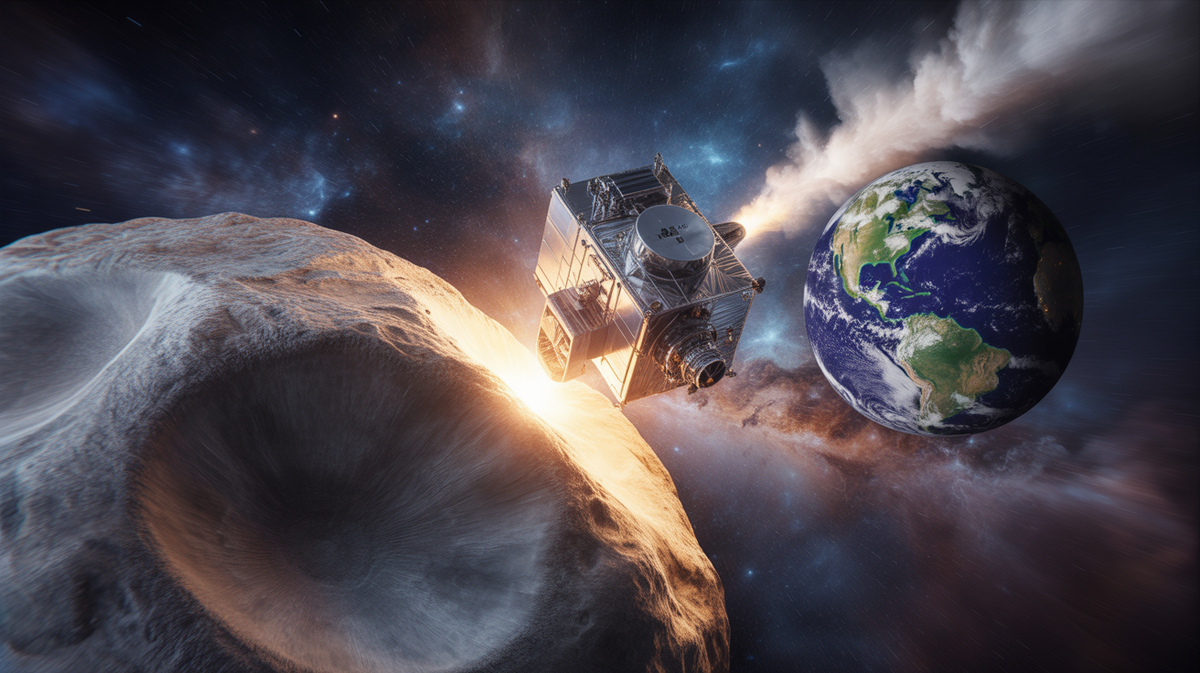
The vastness of space holds countless wonders, but also potential dangers. Among the most significant near-term threats to life on Earth are Near-Earth Objects (NEOs) – asteroids and comets whose orbits bring them close to our planet. While large, civilization-ending impacts are exceedingly rare, smaller events could still cause significant regional devastation. This reality underpins the critical importance of the fostered NASA asteroid strategy: a proactive, multi-faceted approach to identify, track, and, if necessary, mitigate the threat posed by these cosmic wanderers.
💡 Key Takeaways
- NASA actively tracks and catalogs over 30,000 Near-Earth Objects (NEOs) to assess potential threats.
- The Double Asteroid Redirection Test (DART) successfully demonstrated kinetic impact as a viable method for altering an asteroid’s trajectory.
- Future asteroid defense strategies include advanced telescopes, early warning systems, and international collaboration.
- Planetary defense is an ongoing, evolving field crucial for Earth’s long-term safety.
“Planetary defense is no longer confined to the realms of science fiction; it is a critical, tangible effort led by NASA to proactively secure our home planet from celestial threats. Every discovery and mission brings us closer to ensuring our safety.”
— Astrid Bellweather, Astrophysicist & Science Communicator
For decades, scientists and engineers at NASA have been developing robust capabilities to ensure the safety of our planet. This isn’t just about scientific curiosity; it’s a dedicated effort in planetary defense, safeguarding humanity’s future. The potential consequences of an unmitigated impact are severe, ranging from localized destruction to global climate disruption, making this an area of paramount importance in Cosmic Queries: Probing the Mysteries of the Universe.
In This Article
- → Understanding the Threat: Why NASA’s Asteroid Strategy Matters
- — 💡 Key Takeaways
- — What Are Near-Earth Objects (NEOs)?
- → NASA’s Pillars of Planetary Defense: A Strategic Approach
- — 1. 📡 Detection and Tracking: The First Line of Defense
- — 2. 🔬 Characterization: Understanding the Enemy
- — 3. 🛡️ Mitigation: Developing Deflection Technologies
- → Key Missions and Technologies in NASA Asteroid Deflection
- — 🚀 The DART Mission: A Landmark in Planetary Defense
- — 🔭 NEO Surveyor: The Future of Detection
- — 🔬 OSIRIS-REx and Beyond: Understanding Asteroid Composition
- → International Collaboration and Future Outlook for NASA Asteroid Defenses
- — 🌍 Global Partnerships
- — 📈 The Road Ahead: Continuous Improvement
What Are Near-Earth Objects (NEOs)?
- 🔭 Asteroids: Rocky, airless remnants left over from the early formation of our solar system. Most orbit the Sun in the main asteroid belt between Mars and Jupiter.
- ☄️ Comets: Icy bodies that release gas and dust as they approach the Sun, forming a visible coma and often a tail. They typically originate from the colder, outer reaches of the solar system (Kuiper Belt or Oort Cloud).
- 📏 Defining a Threat: NASA’s Planetary Defense Coordination Office (PDCO) focuses on NEOs that come within 0.05 astronomical units (about 4.6 million miles) of Earth and are large enough to cause significant damage (generally over 140 meters in diameter).
NASA’s Pillars of Planetary Defense: A Strategic Approach
NASA’s asteroid strategy is built upon a comprehensive framework designed to detect threats, understand their characteristics, and develop methods for defense. This framework involves continuous monitoring, advanced research, and global collaboration, all coordinated by the Planetary Defense Coordination Office (PDCO).
1. 📡 Detection and Tracking: The First Line of Defense
The most crucial step in planetary defense is knowing what’s out there. NASA employs a global network of telescopes, both ground-based and space-based, dedicated to searching the skies for new NEOs and precisely tracking the orbits of known ones. This continuous observation is vital for predicting potential future close approaches or impacts.
- ➡️ Survey Telescopes: Projects like the Catalina Sky Survey, NEOWISE (a space telescope), and the upcoming NEO Surveyor mission are constantly scanning the sky.
- 🎯 Orbit Prediction: Once an NEO is discovered, multiple observations allow scientists to refine its orbit, predicting its path years, decades, or even centuries into the future.
- ⚠️ Hazard Assessment: Based on size, trajectory, and closest approach distance, each NEO is assessed for its potential hazard level.
For more insights into the broader efforts, read about Defending Earth: The Critical Role of Asteroid Missions.
2. 🔬 Characterization: Understanding the Enemy
Knowing an asteroid’s size, composition, rotation, and other physical properties is vital for devising an effective mitigation strategy. Different materials and structures respond differently to deflection attempts.
NASA’s Asteroid Defense Strategy: Pros and Cons
Pros
- ✔Directly protects Earth from catastrophic asteroid impacts.
- ✔Drives advancements in space technology and planetary defense research.
- ✔Fosters international cooperation on a shared global threat.
- ✔Enhances early detection and tracking capabilities for Near-Earth Objects (NEOs).
Cons
- ✖Requires substantial financial investment and long-term funding commitment.
- ✖Current technology has limitations, especially for large or short-notice threats.
- ✖Missions require significant lead times and are inherently complex.
- ✖Potential for unintended consequences or mission failure during deflection attempts.
- 💡 Radar Astronomy: Goldstone and Arecibo (before its collapse) observatories use radar to map asteroid surfaces and determine their shapes and rotation rates.
- ✅ Sample Return Missions: Missions like OSIRIS-REx provide invaluable data by collecting samples directly from asteroids. The OSIRIS-REx Mission: Asteroid Bennu Sample Return to Earth returned samples from asteroid Bennu, offering unprecedented insights into asteroid composition and structure.
- 🌌 Spectroscopy: Analyzing the light reflected from asteroids helps determine their mineralogical composition.
3. 🛡️ Mitigation: Developing Deflection Technologies
Should a hazardous asteroid be detected on an impact trajectory, NASA, in coordination with international partners, explores various mitigation strategies. These methods aim to alter an asteroid’s path just enough to avoid Earth.
- 🚀 Kinetic Impactor: This involves crashing a spacecraft into the asteroid to alter its velocity and, consequently, its orbit. This is the most mature technology currently available.
- ⚙️ Gravity Tractor: A spacecraft would fly alongside the asteroid for an extended period, using its own minuscule gravitational pull to slowly “tug” the asteroid off course. This method is slow but precise and would not require direct impact.
- 💥 Nuclear Detonation (Last Resort): While highly controversial and complex, this method involves detonating a nuclear device near or on the asteroid to either disrupt it or push it off course. It is considered only as a last resort for very large, imminent threats.
NASA’s comprehensive strategy is outlined in documents such as the “NASA Planetary Defense Strategy and Action Plan” available on their official website. Learn more about NASA’s strategy here.
Key Missions and Technologies in NASA Asteroid Deflection
The theory of planetary defense has moved into practical application with several groundbreaking NASA asteroid mission projects, demonstrating the agency’s commitment to protecting Earth.
🚀 The DART Mission: A Landmark in Planetary Defense
The Double Asteroid Redirection Test (DART) mission was a pivotal moment in humanity’s ability to defend itself from cosmic threats. It was the world’s first full-scale demonstration of asteroid deflection technology.
- 🎯 Mission Goal: To impact a small asteroid moonlet, Dimorphos, which orbits the larger asteroid Didymos, and measure the change in its orbital period.
- ✅ Successful Impact: On September 26, 2022, the DART spacecraft successfully impacted Dimorphos. Read the official NASA announcement about DART’s success.
- 📈 Results: The impact successfully shortened Dimorphos’s orbit around Didymos by 33 minutes, exceeding expectations and proving the kinetic impactor concept viable.
For an in-depth look at this pioneering mission, explore our article on NASA DART Mission: Defending Earth from Asteroids.
🔭 NEO Surveyor: The Future of Detection
While existing telescopes are effective, the NEO Surveyor mission represents a significant leap forward in our ability to detect potentially hazardous asteroids. This infrared space telescope will be optimized to find dark asteroids that are difficult to spot with visible light telescopes.
- 🌐 Comprehensive Sky Survey: NEO Surveyor will conduct a wide-field infrared survey to discover the vast majority of NEOs, especially those that could pose a threat.
- 📈 Improved Characterization: Its infrared capabilities will also provide better estimates of asteroid sizes, crucial for hazard assessment.
🔬 OSIRIS-REx and Beyond: Understanding Asteroid Composition
While not a deflection mission, the NASA OSIRIS-REx: Asteroid Sample Return Mission provided critical data essential for planetary defense. By collecting a sample from asteroid Bennu and returning it to Earth, OSIRIS-REx offered unparalleled insights into the composition, regolith mechanics, and internal structure of a carbonaceous asteroid. Such knowledge is indispensable for planning effective deflection strategies, as an asteroid’s material properties significantly influence how it would respond to a kinetic impact or other mitigation efforts.
Recommended Video
International Collaboration and Future Outlook for NASA Asteroid Defenses
Planetary defense is a global endeavor. No single nation can shoulder the responsibility of protecting Earth alone. NASA’s asteroid strategy is deeply intertwined with international partnerships and ongoing research to refine capabilities and prepare for any potential future threats.
🌍 Global Partnerships
NASA works closely with international space agencies and organizations, including the European Space Agency (ESA), the United Nations Office for Outer Space Affairs (UNOOSA), and the International Asteroid Warning Network (IAWN).
- 🤝 Information Sharing: IAWN facilitates the global exchange of asteroid observation data and hazard assessments.
- 🧪 Joint Research: Collaborations on mission concepts, deflection technologies, and impact simulation exercises enhance collective preparedness.
- 🗣️ Policy Development: UNOOSA leads international discussions on appropriate responses to potential asteroid impacts, ensuring a coordinated global approach.
📈 The Road Ahead: Continuous Improvement
The success of the DART mission marked a monumental step, but it is just one component of a long-term strategy. NASA continues to invest in research and development to enhance every aspect of planetary defense.
- 🔬 Advanced Detection: Future telescopes and data analysis techniques will improve the efficiency and completeness of NEO surveys.
- 💡 New Deflection Concepts: Research into methods like laser ablation, ion beam shepherds, and enhanced kinetic impactors continues.
- 🔄 Rapid Response: Developing faster, more agile mission capabilities to respond to short-warning threats is an ongoing priority.
- 🛰️ Mission Readiness: Ensuring that the necessary spacecraft, instruments, and personnel are ready for deployment if and when a real threat emerges.
The NASA and asteroid defense strategy is dynamic, evolving with technological advancements and increased understanding of our cosmic neighborhood. It’s a testament to human ingenuity and foresight, ensuring that humanity is prepared for whatever the universe might throw our way.
What is NASA’s primary goal in asteroid defense?
NASA’s primary goal is to detect, track, and characterize Near-Earth Objects (NEOs) that could pose a threat, and to develop strategies to mitigate potential impacts.
How did the DART mission contribute to asteroid defense?
The DART mission successfully demonstrated the kinetic impactor technique by intentionally crashing a spacecraft into Dimorphos, a moonlet of the asteroid Didymos, proving that an asteroid’s path can be altered.
Are there other asteroid defense methods besides kinetic impact?
Yes, other proposed methods include gravity tractors (using a spacecraft’s gravitational pull), solar sails, and even nuclear options, though kinetic impact is currently the most developed and tested.
How often does NASA find new asteroids?
NASA discovers new asteroids frequently, with thousands added to the catalog each year through ground-based and space-based telescopes.