


The New Horizons Mission: A Pioneering Journey to the Solar System’s Edge
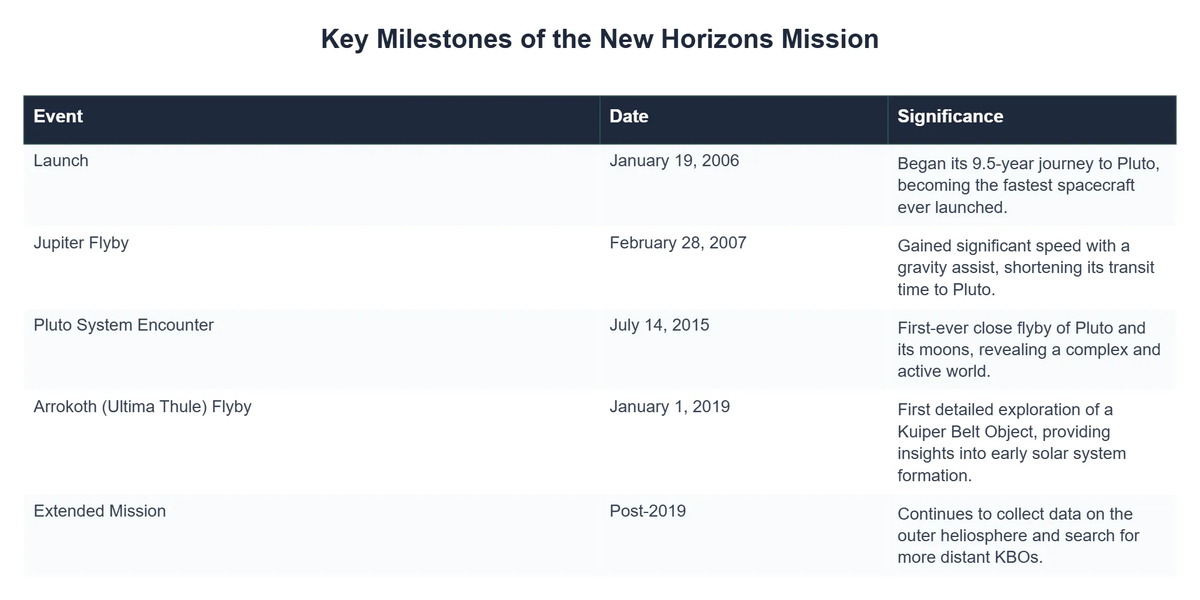
In the vast expanse of our solar system, few missions have captivated the public imagination and pushed the boundaries of exploration quite like NASA’s New Horizons. Launched on January 19, 2006, this audacious mission embarked on an unprecedented journey to the distant reaches of our cosmic neighborhood, aiming to unravel the mysteries of Pluto exploration and the enigmatic Kuiper Belt.
💡 Key Takeaways
- New Horizons made the first-ever close flyby of Pluto in 2015, revolutionizing our understanding of the dwarf planet.
- The mission revealed Pluto’s surprising geological activity, including ice mountains and nitrogen glaciers.
- Beyond Pluto, New Horizons continued into the Kuiper Belt, performing a historic flyby of Arrokoth, the most distant object ever explored.
- It provided invaluable data on the early solar system’s formation and the nature of icy dwarf worlds.
“New Horizons didn’t just visit Pluto; it transformed our understanding of planetary evolution at the solar system’s edge, proving that even distant ice worlds hold vibrant, complex stories waiting to be told.”
— Astrid Bellweather, Astrophysicist & Science Communicator
The primary objective was clear: perform the first-ever close flyby of Pluto and its moons, gathering critical data to understand the dwarf planet’s geology, atmosphere, composition, and interior. Prior to New Horizons, our understanding of Pluto was limited to blurry telescopic images, leaving it largely a celestial enigma. The probe was designed to be incredibly fast, necessary to reach the outer solar system within a reasonable timeframe, completing its 3-billion-mile journey to Pluto in just nine and a half years.
The mission’s success hinged on state-of-the-art technology and meticulous planning, allowing New Horizons to carry a suite of advanced scientific instruments despite its compact size. This technological marvel was poised to transform our understanding of the outer solar system, a region that holds vital clues about the formation and evolution of planetary systems, including our own. For more details on the spacecraft itself, delve into our article on New Horizons Space Probe: Exploring Pluto, Arrokoth, and Beyond.
In This Article
Pluto Up Close: Unveiling a Dwarf Planet
On July 14, 2015, after a journey spanning nearly a decade, New Horizons made its historic close approach to Pluto. The data streamed back to Earth immediately began to paint a picture far more complex and dynamic than scientists had ever anticipated. This wasn’t merely a barren, icy rock; it was a vibrant, geologically active world.
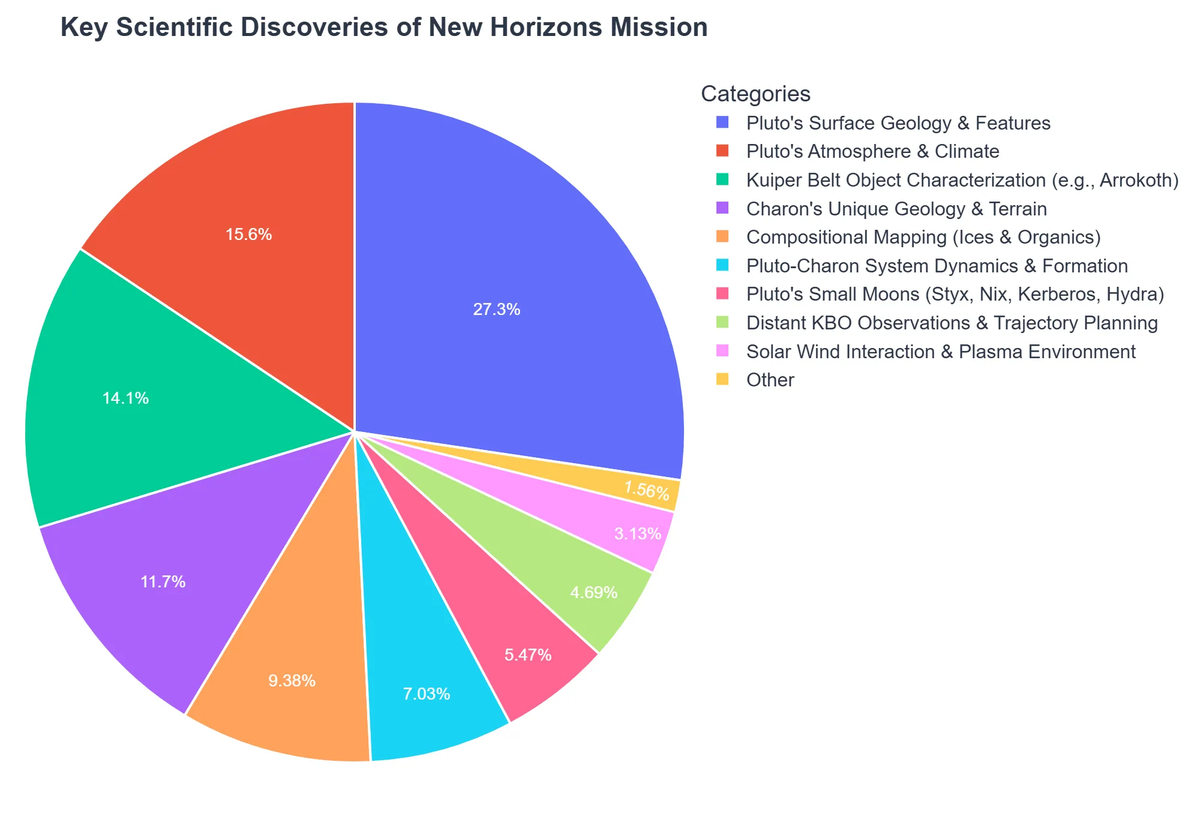
Key discoveries from the Pluto flyby include:
- ✅ Sputnik Planitia: A vast, heart-shaped glacier of nitrogen, methane, and carbon monoxide ice, suggesting ongoing geological activity. The lack of craters in this region indicates active resurfacing processes.
- ✅ Towering Mountains: Icy mountains, some as tall as the Rockies, were observed, indicating that Pluto’s crust is rigid enough to support such structures.
- ✅ Hazy Atmosphere: Multiple layers of atmospheric haze were detected, stretching hundreds of kilometers above the surface. This haze gives Pluto a distinctive blue tint.
- ✅ Complex Moons: New Horizons provided detailed views of Pluto’s largest moon, Charon, revealing a surprisingly varied terrain, including canyons deeper and longer than the Grand Canyon. The smaller moons, Nix and Hydra, also presented unexpected shapes and reflective surfaces.
- ✅ Evidence of Cryovolcanism: Features resembling cryovolcanoes suggest that Pluto may erupt with liquid water, ammonia, or methane.
The sheer volume and quality of data transformed Pluto from a point of light into a recognizable world, challenging preconceived notions about small, distant celestial bodies. It showcased the power of Spacecraft Flybys: Exploring Distant Worlds as a method of planetary exploration.
Beyond Pluto: Exploring the Kuiper Belt and Arrokoth
With its primary objective of studying Pluto achieved, the New Horizons mission was extended to explore the Kuiper Belt, a vast ring of icy bodies beyond Neptune’s orbit. This region is a remnant of the early solar system, holding primitive building blocks that could offer insights into planetary formation.
On January 1, 2019, New Horizons achieved another historic first: the most distant planetary flyby in history, encountering the Kuiper Belt Object (KBO) 2014 MU69, officially named Arrokoth. This small, bilobed object, resembling a cosmic snowman, provided incredible insights:
- ➡️ Contact Binary: Arrokoth is a “contact binary,” meaning it formed from two distinct objects that gently came together and stuck. This provides direct evidence for the “pebble accretion” model of planetesimal formation, where small particles gradually clump together.
- ➡️ Pristine Composition: As a cold classical KBO, Arrokoth is believed to be one of the most pristine objects ever studied, having remained largely unaltered since the birth of the solar system. Its uniform color and smooth appearance support this idea.
The exploration of Arrokoth and the Kuiper Belt is crucial for understanding the diversity of objects in our solar system’s distant frontier. While New Horizons focuses on these icy, distant bodies, NASA also prioritizes missions closer to home, such as those studying `nasa asteroids near earth` via projects like NEA Scout: NASA’s Solar Sail Asteroid Mission. Such diverse missions provide a holistic view of cosmic phenomena. The New Horizons mission continues to search for more distant KBOs to observe, extending its groundbreaking journey even further into the unknown. Learn more about the mission’s ongoing journey in New Horizons Mission: Beyond Pluto.
For more information on the Kuiper Belt’s exploration, you can visit NASA Science: Kuiper Belt Exploration.
Recommended Video
Scientific Impact and Future Endeavors
The data from New Horizons has fundamentally reshaped our understanding of the outer solar system, providing invaluable insights that continue to be analyzed by scientists worldwide. It has demonstrated that even dwarf planets can be geologically active and possess complex systems, challenging the previous classifications and expanding the scope of planetary science.
The mission’s success highlights the ingenuity and perseverance required for deep-space exploration. The images and data transmitted over billions of miles are not just scientific triumphs; they are a testament to human curiosity and our relentless drive to explore. The findings have contributed significantly to the broader field of Cosmic Queries: Probing the Mysteries of the Universe, influencing models of solar system formation and evolution.
New Horizons is still operational, sending back data about the interplanetary environment in the far reaches of our solar system. It is currently measuring dust, charged particles, and plasma, extending its scientific legacy even further. While New Horizons explores the extreme outer limits, NASA’s broader portfolio also includes critical missions related to `nasa new earth` discoveries and tracking `nasa near earth objects` to safeguard our planet. These diverse missions underscore the comprehensive nature of NASA’s scientific pursuits.
The New Horizons mission has truly redefined our cosmic backyard, proving that the most profound discoveries often lie at the very edges of our known universe. For a historical perspective on its launch, consider reviewing 15 Years Ago: New Horizons Launched to Pluto and Beyond – NASA.
When did NASA’s New Horizons mission launch?
The New Horizons spacecraft launched on January 19, 2006, from Cape Canaveral, Florida.
When did New Horizons reach Pluto?
New Horizons made its historic close flyby of Pluto on July 14, 2015, providing humanity’s first detailed look at the dwarf planet.
What is the Kuiper Belt?
The Kuiper Belt is a vast disc-shaped region beyond Neptune’s orbit, home to thousands of icy bodies, including dwarf planets like Pluto and Eris, and numerous comets.
What was the most distant object visited by New Horizons?
After Pluto, New Horizons performed a flyby of Arrokoth (formerly Ultima Thule) on January 1, 2019, making it the most distant object ever explored by a spacecraft.