


Understanding Black Holes: Cosmic Giants of Gravity
In the vast expanse of the cosmos, few objects capture the imagination quite like black holes. These enigmatic regions of spacetime exhibit gravitational forces so immense that nothing—not even light—can escape their grasp. They represent one of the most extreme predictions of Albert Einstein’s theory of general relativity, and their study continues to push the boundaries of modern astrophysics.
💡 Key Takeaways
- Black holes are regions of spacetime where gravity is so intense that nothing, not even light, can escape.
- They form primarily from the remnants of massive stars or through the collapse of supermassive gas clouds in galactic centers.
- Key components include the event horizon (the point of no return) and the singularity (the infinitely dense center).
- Studying black holes offers crucial insights into gravity, the nature of spacetime, and the evolution of the universe.
“Black holes aren’t just cosmic vacuum cleaners; they are the universe’s ultimate laboratories, pushing the boundaries of our understanding of physics and reality itself.”
— Astrid Bellweather, Astrophysicist & Science Communicator
Far from being mere cosmic vacuum cleaners, black holes are fundamental components of the universe, playing crucial roles in galaxy formation and evolution. Unveiling their nature is key to understanding the fabric of reality itself. For more foundational information on the broader field, explore our comprehensive guide on Cosmic Queries: Probing the Mysteries of the Universe.
In This Article
The Anatomy of a Black Hole: Beyond the Point of No Return
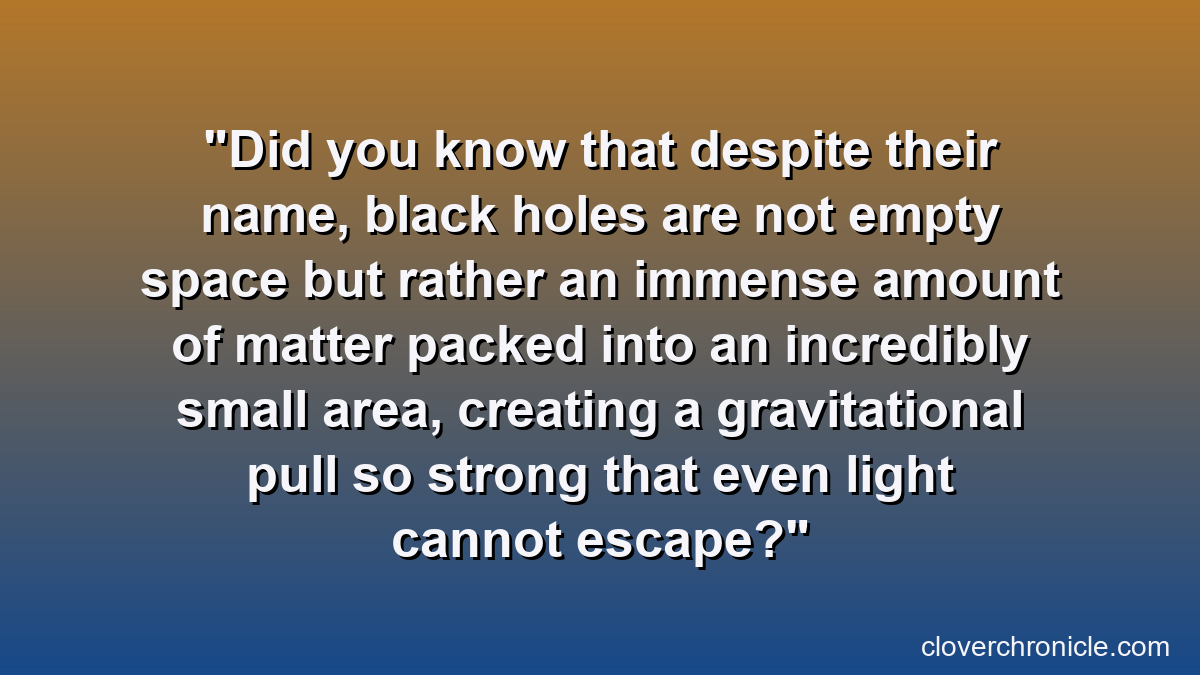
While often depicted as “holes” in space, black holes are actually incredibly dense concentrations of mass. Their defining features are not what’s inside them, but the boundary around them:
- ✅ Singularity: At the very center of a black hole lies the singularity, a point where matter is crushed to infinite density. All the mass of the black hole is theoretically concentrated here.
- ✅ Event Horizon: This is the most famous boundary associated with black holes. It’s the “point of no return”—a spherical surface surrounding the singularity from which nothing, not even light, can escape. Once an object crosses the Event Horizon, it is irrevocably drawn into the black hole. This boundary is not a physical surface, but rather a theoretical limit defined by gravity’s strength.
- ✅ Accretion Disk: Many black holes are surrounded by swirling disks of gas and dust known as accretion disks. As matter spirals inward towards the event horizon, it heats up to extreme temperatures due to friction, emitting powerful X-rays and other forms of radiation that we can detect.
- ✅ Relativistic Jets: Some black holes, particularly supermassive ones, can eject powerful jets of high-energy particles outward from their poles, often perpendicular to the accretion disk. These jets can extend for millions of light-years and are a significant source of energy in the universe.
The study of these features provides critical black hole facts, helping us piece together their complex nature. To delve deeper into the observational evidence, consider reading about Are Black Holes Real? Undeniable Evidence from Astronomy.
🌌 Types of Black Holes
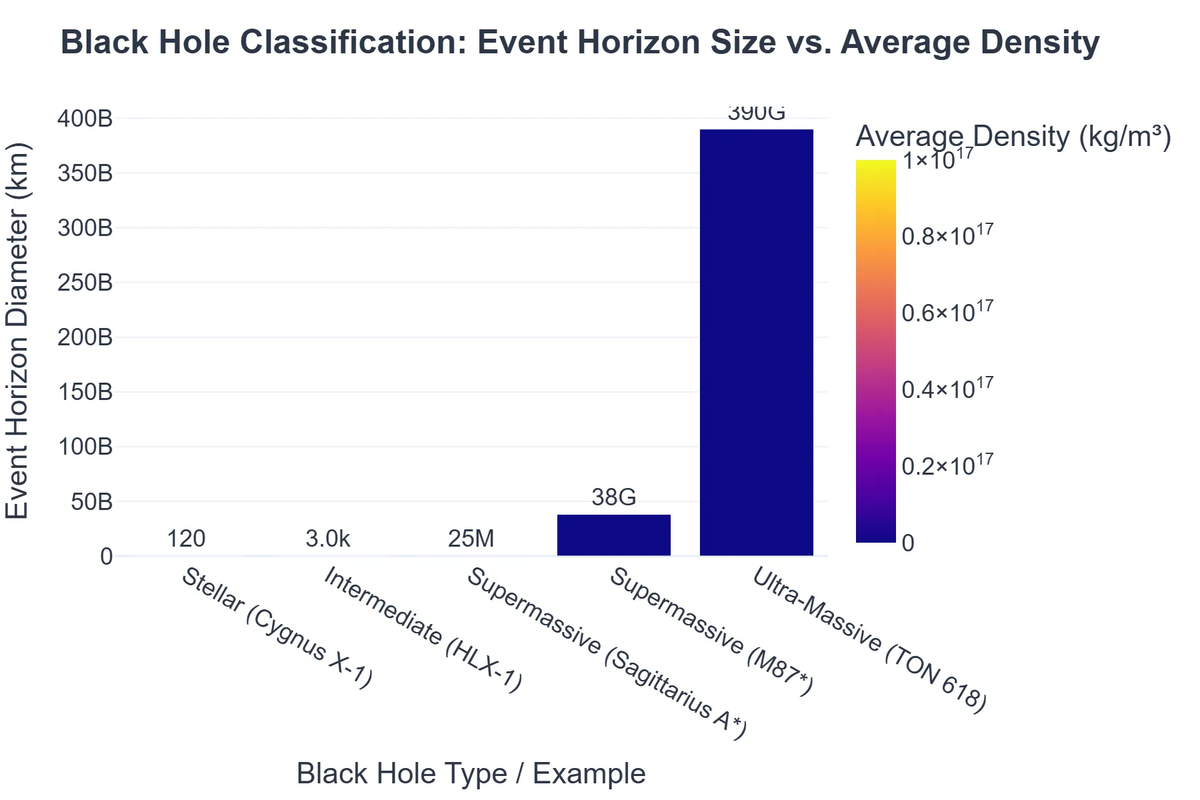
Scientists classify black holes primarily by their mass, which dictates their size and behavior:
- Stellar-Mass Black Holes: These are the most common type, forming from the gravitational collapse of massive stars (typically 3 to 20 times the mass of our Sun) at the end of their life cycles. They are relatively small, only tens of kilometers across.
- Supermassive Black Holes (SMBHs): Found at the center of nearly every large galaxy, including our own Milky Way (Sgr A*), SMBHs range from millions to billions of times the mass of the Sun. Their formation mechanism is still a subject of intense research, but they play a pivotal role in galaxy evolution.
- Intermediate-Mass Black Holes (IMBHs): This category represents a missing link, with masses between stellar-mass and supermassive black holes (hundreds to hundreds of thousands of solar masses). Their existence is harder to confirm, but astronomers are actively searching for evidence of them, possibly forming in dense star clusters.
- Micro Black Holes (Primordial Black Holes): Hypothesized to have formed in the early universe, these would be very small, potentially even subatomic in size. Their existence has not been confirmed, and they are distinct from the other types as they wouldn’t form from stellar collapse.
Each type presents unique challenges and insights into the broader field of space phenomena.
Detecting the Invisible: How Astronomers Find Black Holes
Since black holes do not emit light, detecting them directly is impossible. Instead, astronomers rely on indirect evidence, observing their gravitational influence on surrounding matter and light:
- ➡️ Accretion Disk Emissions: The most common method involves observing the intense X-rays and other radiation emitted by matter superheated as it spirals into an accretion disk around a black hole. Telescopes like the Chandra X-ray Observatory are crucial for these observations.
- ➡️ Gravitational Effects on Stars: Astronomers can detect black holes by observing the peculiar orbits of stars or gas clouds that are gravitationally bound to an unseen, massive object. This is how the supermassive black hole at the center of the Milky Way was confirmed.
- ➡️ Gravitational Lensing: While rare, a black hole’s immense gravity can bend the path of light from distant objects, acting like a cosmic magnifying glass. This effect, called gravitational lensing, can reveal the presence of otherwise invisible masses.
- ➡️ Gravitational Waves: The LIGO and Virgo observatories have revolutionized black hole detection by directly observing gravitational waves—ripples in spacetime—produced by the mergers of two black holes. This groundbreaking method provides direct proof of their existence and allows us to study black hole mergers in unprecedented detail.
The ability to detect these incredibly distant and powerful objects is a testament to human ingenuity and technological advancement. The Hubble Space Telescope and Black Holes: Unveiling Cosmic Secrets has played a significant role in this quest.
Recommended Video
Unraveling Black Hole Mysteries and Future Research
Despite significant progress, black holes remain among the universe’s most profound enigmas. Scientists are actively working to address several key black hole mysteries:
- 💡 Hawking Radiation: Theoretical physicist Stephen Hawking proposed that black holes are not entirely “black” but emit a faint thermal radiation due to quantum effects near the event horizon. Confirming Hawking Radiation would bridge general relativity and quantum mechanics, a monumental step in physics.
- 💡 The Information Paradox: What happens to the information of matter that falls into a black hole? Does it truly disappear, violating a fundamental principle of quantum mechanics, or is it preserved in some form? This remains one of the most perplexing problems in theoretical physics.
- 💡 Role in Galaxy Evolution: The tight correlation between the mass of a supermassive black hole and the properties of its host galaxy suggests a symbiotic relationship. Understanding how SMBHs influence star formation and galactic structure is a critical area of research.
- 💡 Gravitational Wave Astronomy: The era of gravitational wave astronomy is just beginning. Future observatories will enable us to detect more mergers, study different types of black holes, and potentially even observe the echoes of the early universe.
These ongoing investigations promise to unveil even more about these captivating cosmic structures. The quest to understand them is a central pillar of modern cosmic exploration, and for more insights into these fascinating objects, see our guide on Mysterious Black Holes: Decoding the Universe’s Enigmas.
What is a black hole?
A black hole is a region of spacetime where gravity is so strong that nothing—no particles or even electromagnetic radiation like light—can escape from it.
How do black holes form?
Stellar black holes form from the gravitational collapse of a massive star at the end of its life, while supermassive black holes are thought to grow by accreting matter and merging with other black holes in the centers of galaxies.
Can black holes ‘suck in’ everything in the universe?
No, black holes do not ‘suck’ in everything. Their gravitational pull is only dominant at very close ranges. Outside their event horizon, their gravity behaves just like any other object of the same mass, and objects can orbit them safely.
What is an event horizon?
The event horizon is the boundary around a black hole beyond which events cannot affect an outside observer. It’s often referred to as the ‘point of no return’ because once something crosses it, it cannot escape.