Searching for Dark Matter at the LHC: A Cosmic Quest
Imagine a universe where over 80% of its matter remains completely invisible, undetectable by any light or radiation. This isn’t science fiction; it’s the reality of dark matter, one of the universe’s most profound and enduring mysteries. For decades, scientists have gathered compelling gravitational evidence of its existence, observing its unseen influence on galaxies and galaxy clusters. Yet, the fundamental particles that make up this pervasive substance continue to elude direct detection.
💡 Key Takeaways
- Dark matter constitutes about 27% of the universe’s mass-energy, yet remains undetected directly.
- The Large Hadron Collider (LHC) is a primary tool for physicists seeking to create or indirectly observe dark matter particles.
- Experiments at the LHC aim to find new particles, like WIMPs, that could be candidates for dark matter.
- While direct evidence is still elusive, the LHC’s high-energy collisions offer unique insights into potential dark matter interactions.
“The search for dark matter at the LHC isn’t just about finding a particle; it’s about rewriting our cosmic narrative. It’s the ultimate blend of audacious engineering and profound philosophical inquiry, a real-life scientific saga worthy of the grandest space opera.”
— Astrid Bellweather, Astrophysicist & Science Fiction Consultant
Enter the Large Hadron Collider (LHC) at CERN, the world’s most powerful particle accelerator. While renowned for its discovery of the Higgs boson, the LHC is also at the forefront of the hunt for dark matter. Its unparalleled energy capabilities provide a unique opportunity to potentially create these elusive particles in controlled laboratory conditions. This article delves into the monumental effort to uncover dark matter at the LHC, exploring the methods, challenges, and the profound implications of success or failure in this cosmic quest. For a comprehensive overview of the field, dive into our main resource: Cosmic Queries: Probing the Mysteries of the Universe.
In This Article
- → Searching for Dark Matter at the LHC: A Cosmic Quest
- — 💡 Key Takeaways
- → What is Dark Matter, and Why is it So Elusive?
- — 🌌 The Invisible Scaffolding of the Universe
- — ⚛️ Beyond the Standard Model
- → The Large Hadron Collider (LHC): Our Ultimate Particle Detective
- — 🔬 A Glimpse into the Early Universe
- — 🎯 Why the LHC is Key to the Dark Matter Search
- → How Do Scientists Search for Dark Matter at the LHC?
- — 👻 The “Missing Energy” Signature
- — ✨ Colliding for New Particles
- — ⚛️ Experiments Leading the Charge: ATLAS and CMS
- → Leading Theories and Candidate Particles
- — 🕸️ WIMPs: The Frontrunners
- — 🕳️ Axions, Sterile Neutrinos, and Beyond
- → Challenges and the Road Ahead
- — 🚧 The Needle in the Haystack
- — 🌠 What if the LHC Doesn’t Find It?
- → Conclusion
What is Dark Matter, and Why is it So Elusive?

Before we explore the LHC’s role, it’s crucial to understand what dark matter is and why it poses such a significant challenge to our understanding of the cosmos.
🌌 The Invisible Scaffolding of the Universe
Dark matter isn’t just a theoretical construct; its presence is inferred from a wealth of astrophysical observations:
- ✅ Galaxy Rotation Curves: Stars at the edges of galaxies orbit faster than expected based on the visible matter alone, suggesting an unseen gravitational pull.
- ✅ Gravitational Lensing: Light from distant galaxies is bent around massive galaxy clusters more strongly than visible matter can account for, indicating additional mass.
- ✅ Cosmic Microwave Background (CMB): The early universe’s temperature fluctuations, captured in the CMB, are best explained by a universe composed mostly of dark matter and dark energy.
- ✅ Structure Formation: Dark matter’s gravitational influence is essential for the formation of the large-scale structures we see in the universe, like galaxies and galaxy clusters.
Unlike ordinary matter (protons, neutrons, electrons), dark matter does not absorb, reflect, or emit light. This “darkness” is precisely what makes it so hard to detect. It interacts very weakly, if at all, with electromagnetic forces, meaning it doesn’t interact with light. For a deeper dive into this cosmic enigma, check out our guide on Dark Matter: A Comprehensive Guide and Explanation.
⚛️ Beyond the Standard Model
The particles that make up dark matter are not part of the Standard Model of Particle Physics, which describes all known fundamental particles and forces (excluding gravity). This means finding dark matter would represent a monumental breakthrough, confirming the existence of new physics beyond our current understanding. The quest for unification and the search for phenomena beyond the Standard Model are driving forces in modern physics research. You can learn more about these efforts at Quantum Zeitgeist.
The Large Hadron Collider (LHC): Our Ultimate Particle Detective
The LHC is a marvel of engineering and scientific collaboration, designed to probe the fundamental building blocks of matter and forces. Its extreme energies make it a unique tool in the search for dark matter.
🔬 A Glimpse into the Early Universe
Located in a 27-kilometer tunnel beneath the Franco-Swiss border, the LHC accelerates protons to nearly the speed of light before colliding them head-on. These collisions generate immense energy, briefly recreating conditions that existed fractions of a second after the Big Bang. By studying the debris from these collisions, physicists hope to uncover new particles and forces.
🎯 Why the LHC is Key to the Dark Matter Search
The prevailing theories suggest that dark matter consists of new, heavy particles. If these particles are indeed heavy, then significant energy is required to produce them. The LHC provides precisely this: the energy needed to potentially create dark matter particles (like WIMPs, which we’ll discuss later) from the pure energy of the proton collisions. This makes the hadron collider dark matter search one of the most promising avenues for discovery.
How Do Scientists Search for Dark Matter at the LHC?
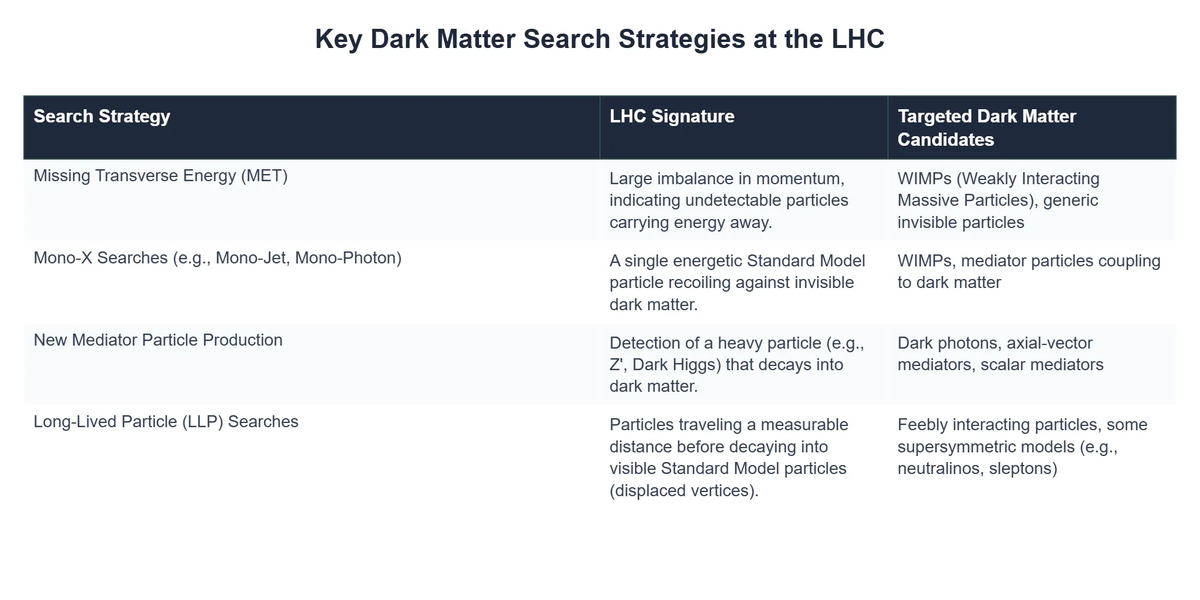
Since dark matter particles are theorized to interact very weakly, they wouldn’t leave direct tracks in the LHC’s detectors. Instead, scientists look for indirect signs of their presence.
👻 The “Missing Energy” Signature
The primary method for searching for dark matter at the LHC involves looking for “missing energy.” According to the law of conservation of momentum, the total momentum of particles after a collision must equal the total momentum before the collision. If a dark matter particle were produced in an LHC collision, it would fly out of the detector without interacting, carrying away energy and momentum.
- ➡️ Before Collision: Two protons collide with known, high momentum.
- ➡️ After Collision: Detectors measure the energy and momentum of all visible particles (quarks, electrons, muons, photons, etc.).
- ➡️ The Clue: If the total momentum of the visible particles is less than the initial momentum, and there are no other known particles to account for the difference, physicists infer that invisible, weakly interacting particles (like dark matter) have escaped. This “missing transverse energy” is the signature they seek.
✨ Colliding for New Particles
LHC experiments are designed to produce dark matter particles directly. This typically involves scenarios where:

- Direct Production: A collision produces one or more dark matter particles alongside known Standard Model particles (like a quark or a Higgs boson). The known particles are detected, while the dark matter particles escape, leaving the missing energy signature.
- Mediator Particles: Some theories propose that dark matter interacts with known particles via a “mediator” particle. The LHC can look for these mediator particles, which might decay into dark matter or have their own unique signatures.
⚛️ Experiments Leading the Charge: ATLAS and CMS
The two largest general-purpose detectors at the LHC, ATLAS and CMS, are at the forefront of the dark matter search. Both experiments are designed to measure a vast array of particle interactions and are optimized to detect the subtle “missing energy” signature. They conduct numerous searches for various theoretical dark matter candidates. Learn more about the efforts at CERN in CERN’s Dark Matter Quest: Experiments at the Forefront.
For instance, the ATLAS experiment actively pursues several dark matter search strategies, as detailed on their official updates page: Searching for Dark Matter with the ATLAS detector.
Leading Theories and Candidate Particles
While the LHC’s approach is largely model-independent, many searches are guided by specific theoretical predictions for dark matter candidates.
🕸️ WIMPs: The Frontrunners
For a long time, the leading candidate for dark matter has been the Weakly Interacting Massive Particle, or WIMP. WIMPs are hypothetical particles that:
- 💡 Are Massive: They would have a mass significantly greater than protons or neutrons.
- 💡 Interact Weakly: They would interact via the weak nuclear force and gravity, but not the strong or electromagnetic forces. This explains their elusiveness.
The appeal of WIMPs lies in a concept called the “WIMP miracle,” where their predicted interaction strength and mass naturally explain the observed abundance of dark matter in the universe, if they were produced in the early Big Bang.
🕳️ Axions, Sterile Neutrinos, and Beyond
While WIMPs are prominent, they are not the only game in town. Other theoretical candidates include:
Searching for Dark Matter at the LHC: Advantages and Challenges
Pros
- ✔Potential for revolutionary discoveries in fundamental physics and cosmology.
- ✔Leverages existing, world-leading infrastructure (LHC) for high-energy collisions.
- ✔Can explore a wide range of theoretical dark matter candidates, like WIMPs.
- ✔Advances experimental techniques and data analysis methods in particle physics.
Cons
- ✖No guarantee of discovery, leading to potentially inconclusive or null results.
- ✖Extremely challenging due to dark matter’s weak interaction with ordinary matter.
- ✖Requires significant financial and human resources for experiment operation and analysis.
- ✖Results might be ambiguous and require further verification or complementary approaches.
- ➡️ Axions: Very light particles proposed to solve a different problem in particle physics (the strong CP problem), but which could also constitute dark matter.
- ➡️ Sterile Neutrinos: Heavier, hypothetical cousins of the known neutrinos, which would interact even more weakly.
- ➡️ MACHOs (Massive Compact Halo Objects): While largely ruled out as the primary component, these could be astrophysical objects like black holes or brown dwarfs. For more on black holes, see Unveiling Black Holes: From Cosmic Collisions to Supermassive Mysteries.
The LHC primarily targets WIMP-like candidates due to its energy range, but it can also probe some models involving mediator particles that interact with lighter dark matter candidates.
Challenges and the Road Ahead
The search for dark matter at the LHC is one of the most challenging endeavors in modern physics.
🚧 The Needle in the Haystack
The biggest challenge is the extremely weak interaction strength of dark matter particles. If they exist and are produced, their signals are exceedingly rare and easily masked by the “noise” from the much more common interactions of Standard Model particles. Distinguishing a genuine dark matter signature from background events requires incredibly precise detectors, sophisticated data analysis techniques, and immense computing power.
🌠 What if the LHC Doesn’t Find It?
Despite years of searching, the LHC has yet to yield definitive evidence of dark matter. This non-detection has significant implications:
- ➡️ It puts increasingly stringent limits on the properties of WIMP-like dark matter, pushing the favored mass range higher or ruling out certain interaction strengths.
- ➡️ It encourages physicists to consider other theoretical models for dark matter that might not be accessible at the LHC’s current energy levels (e.g., extremely light particles like axions, or very heavy particles beyond current LHC reach).
- ➡️ It emphasizes the importance of complementary experiments, such as direct detection experiments (which aim to catch dark matter particles interacting with ordinary matter on Earth) and astronomical observations (which continue to map dark matter’s gravitational distribution in the universe). Understanding dark matter’s role in the universe extends beyond the LHC, touching on its shaping of cosmic structures, as explored in Dark Matter’s Role in the Universe: Unveiling the Invisible Architect.
Recommended Video
Conclusion
The search for dark matter at the Large Hadron Collider is a testament to humanity’s relentless quest to understand the fundamental nature of reality. While the definitive discovery of dark matter particles at the LHC remains elusive, the experiments continue to push the boundaries of our knowledge, ruling out theoretical models and guiding future research.
Regardless of whether the LHC ultimately creates dark matter, its contributions to the field are invaluable. It provides crucial constraints on new physics theories and informs the design of next-generation experiments. The cosmic quest for dark matter is far from over, and the insights gleaned from the LHC will undoubtedly play a pivotal role in eventually unveiling the universe’s invisible scaffolding.
Frequently Asked Questions
What is dark matter and why is it important?
Dark matter is a hypothetical form of matter that accounts for approximately 27% of the universe’s mass-energy. It’s crucial because its gravitational effects are observed on galaxies and galaxy clusters, indicating its presence despite being invisible to current detection methods. Understanding it is key to a complete cosmological model.
How does the LHC attempt to find dark matter?
The LHC searches for dark matter in several ways: by looking for missing energy in particle collisions (suggesting undetectable particles like dark matter candidates carried it away), by trying to directly produce hypothetical dark matter particles, and by searching for ‘dark photons’ or other mediating particles that could interact with dark matter.
What are some leading dark matter candidates being sought at the LHC?
Among the leading candidates are Weakly Interacting Massive Particles (WIMPs), which would have mass but interact only weakly with ordinary matter. Other candidates include axions, sterile neutrinos, and particles predicted by supersymmetry, many of which the LHC’s experiments are designed to probe.