The dawn of the 21st century has heralded an unprecedented era in space exploration, marked by renewed ambition and escalating competition. What was once the domain of a few national agencies has now broadened to include a vibrant ecosystem of private companies and emerging space powers. This invigorated push, often dubbed the “new space race,” is primarily focused on two celestial bodies that hold immense scientific, economic, and strategic potential: the Moon and Mars.
💡 Key Takeaways
- Both government agencies and private companies are driving the current surge in lunar and Martian missions.
- Technological advancements like reusable rockets and advanced life support systems are making deep space travel more feasible.
- The ‘new space race’ is characterized by international collaboration, economic opportunities, and the potential for permanent off-world habitats.
- Future missions aim not just for exploration but for sustainable human presence on the Moon and Mars.
“The current push to Moon and Mars isn’t just about discovery; it’s about expanding humanity’s narrative beyond a single planet. It’s the ultimate ‘what if’ scenario playing out in real-time, fascinating for both science and storytelling.”
— Astrid Bellweather, Astrophysicist & Science Fiction Consultant
From establishing permanent lunar outposts to laying the groundwork for human missions to the Red Planet, the stakes are higher than ever. Nations and commercial entities alike are pouring resources into cutting-edge technology and audacious missions, redefining humanity’s relationship with the cosmos. This article will delve into the exciting developments surrounding the latest moon mission efforts and the groundbreaking advancements in the latest Mars mission endeavors, exploring the key players, their ambitious goals, and the profound implications for our future in space.
In This Article
- — 💡 Key Takeaways
- → The Resurgence of Lunar Exploration: Artemis and Beyond
- — 🚀 NASA’s Artemis Program: A Return to the Moon
- — 🛠️ Commercial Lunar Payload Services (CLPS) and Private Landers
- → Pushing Boundaries on the Red Planet: Current Mars Missions
- — 🔍 Perseverance Rover and Ingenuity Helicopter
- — 🇨🇳 China’s Tianwen-1 Mission: A Comprehensive Approach
- — 🇦🇪 UAE’s Hope Mars Mission: Atmospheric Insights
- → The Race for Mars Sample Return
- → The Role of Private Companies in the New Space Race
- — ⭐ SpaceX’s Starship: Mars Colonization Ambitions
- — 🌍 Blue Origin and Others: Expanding Lunar Infrastructure
- → Why the New Space Race Matters: Scientific, Economic, and Geopolitical Stakes
- — 🧪 Unlocking Scientific Discoveries
- — 💰 Resource Utilization and the Space Economy
- — 🌐 Geopolitical Implications and International Dynamics
- → Conclusion: A New Era of Exploration
The Resurgence of Lunar Exploration: Artemis and Beyond
After decades of focusing primarily on orbital missions and deep-space probes, humanity is turning its gaze back to our nearest celestial neighbor with renewed vigor. The Moon is no longer just a stepping stone but a destination in itself, crucial for long-duration spaceflight and potential resource utilization.
🚀 NASA’s Artemis Program: A Return to the Moon
NASA’s Artemis program stands at the forefront of this lunar resurgence, aiming to return humans to the Moon, including the first woman and person of color, and establish a long-term presence. The program is designed to be sustainable, paving the way for eventual human missions to Mars.
- ✅ Artemis I (Completed): An uncrewed test flight of the Orion spacecraft and Space Launch System (SLS) rocket, successfully orbiting the Moon and returning to Earth. This mission validated the critical hardware for future crewed flights.
- ➡️ Artemis II (Upcoming): The first crewed flight test of the Orion spacecraft, taking astronauts on a lunar flyby. This will be a crucial step in preparing for a lunar landing.
- 💡 Artemis III (Upcoming): The mission planned to land astronauts on the lunar South Pole, a region of particular interest due to the presence of water ice in permanently shadowed craters.
The program also includes the development of the Lunar Gateway, a small space station orbiting the Moon, which will serve as a staging point for lunar surface missions and a vital hub for deep-space exploration. For more details on NASA’s lunar ambitions, you can visit the official Artemis program page.
🛠️ Commercial Lunar Payload Services (CLPS) and Private Landers
A significant shift in lunar exploration is the increasing role of private companies through NASA’s Commercial Lunar Payload Services (CLPS) initiative. This program allows NASA to purchase end-to-end payload delivery services from commercial vendors, fostering a robust lunar economy.
- ➡️ Peregrine Mission One (Astrobotic): Although encountering propulsion issues, this mission demonstrated the challenges and ambitions of commercial lunar delivery.
- 💡 IM-1 (Intuitive Machines – Nova-C lander): Successfully landed Odysseus, the Nova-C lander, near the lunar South Pole in February 2024, marking the first U.S. lunar landing in over 50 years and the first by a private company. This achievement underscores the growing capability of the private sector in space.
- ✅ Future CLPS Missions: Multiple other companies, including Firefly Aerospace and Draper, are slated for upcoming missions to deliver scientific instruments and technology demonstrations to the Moon.
Pushing Boundaries on the Red Planet: Current Mars Missions
Mars continues to captivate scientists and the public alike, holding the promise of past or present life and the potential for future human habitats. The past few years have seen remarkable progress in understanding the Red Planet, thanks to a fleet of advanced robotic explorers.
🔍 Perseverance Rover and Ingenuity Helicopter
NASA’s Perseverance rover, which landed in Jezero Crater in February 2021, is at the forefront of Mars exploration. Its primary mission objectives are to search for signs of ancient microbial life, characterize the planet’s geology and past climate, and collect Martian rock and regolith samples for a potential return to Earth.
- 💡 Groundbreaking Discoveries: Perseverance has explored diverse geological features, identified organic molecules, and provided unprecedented insights into Mars’s watery past.
- ✅ Ingenuity’s Legacy: The Ingenuity helicopter, a technology demonstration flown alongside Perseverance, achieved over 70 successful flights, far exceeding its initial five-flight target. It proved that powered flight is possible on Mars, revolutionizing how future planetary missions might explore distant worlds. For more on its incredible journey, check out our piece on the Curiosity Mars Mission: A Decade of Red Planet Discoveries, which also covers Ingenuity’s broader impact.
🇨🇳 China’s Tianwen-1 Mission: A Comprehensive Approach
China’s Tianwen-1 mission, which arrived at Mars in February 2021, demonstrated an impressive leap in their space capabilities by deploying an orbiter, lander, and rover in a single mission. This ambitious undertaking positioned China as a major player in interplanetary exploration.
- ➡️ Zhurong Rover: The Zhurong rover successfully explored Utopia Planitia, collecting data on the region’s geology, soil composition, and potential subsurface water ice. Its operations have significantly contributed to our understanding of Mars’s surface.
- ✅ Orbiter’s Role: The Tianwen-1 orbiter continues to map the Martian surface, relay data from Zhurong, and study the planet’s atmosphere and magnetosphere. For a detailed look at this mission, see our article on Tianwen-1: China’s Ambitious Mission to Mars.
🇦🇪 UAE’s Hope Mars Mission: Atmospheric Insights
The United Arab Emirates’ Hope Mars Mission, also arriving in 2021, marked the Arab world’s first interplanetary mission. Its orbiter has been studying the Martian atmosphere and climate dynamics, providing a global view of the planet’s weather patterns and how hydrogen and oxygen escape into space.
Latest Moon and Mars Missions: The New Space Race – Pros and Cons
Pros
- ✔Accelerates scientific discovery and understanding of the universe.
- ✔Drives technological innovation applicable to Earth and beyond.
- ✔Fosters international cooperation and competition, pushing boundaries.
- ✔Inspires future generations in STEM fields.
Cons
- ✖Involves immense financial costs that could be used for terrestrial issues.
- ✖Poses significant risks to human life and equipment.
- ✖Raises ethical concerns regarding planetary contamination and resource ownership.
- ✖Could potentially lead to the militarization of space.
- 💡 Global Perspective: Hope provides crucial data on the Martian atmosphere, complementing surface missions and helping to understand the planet’s evolution from a potentially habitable world to its current state.
The Race for Mars Sample Return
Perhaps the most ambitious Mars mission concept currently underway is the Mars Sample Return (MSR) campaign. This multi-mission effort aims to bring the samples collected by the Perseverance rover safely back to Earth for in-depth laboratory analysis, which is considered the holy grail of Mars science.
- ➡️ Joint NASA-ESA Efforts: MSR is a highly complex international collaboration between NASA and the European Space Agency (ESA). It involves a Sample Retrieval Lander, a Mars Ascent Vehicle to launch samples from the Martian surface, and an Earth Return Orbiter.
- ✅ Unlocking Mars’s Secrets: Bringing samples to Earth would allow scientists to use sophisticated laboratory equipment far more powerful than anything that can be sent to Mars. This could provide definitive answers about past life on Mars and the planet’s geological history. Learn more about this critical endeavor in our dedicated piece on the Mars Sample Return Mission: Bringing Mars Home.
The Role of Private Companies in the New Space Race
While government agencies continue to lead fundamental research and development, the private sector has emerged as a formidable force, accelerating innovation and driving down costs. This commercialization is a defining feature of the new space race.
⭐ SpaceX’s Starship: Mars Colonization Ambitions
SpaceX, led by Elon Musk, is developing Starship, a fully reusable super heavy-lift launch system designed to transport humans and cargo to the Moon, Mars, and beyond. Its immense payload capacity and reusability represent a paradigm shift in space travel.
- 💡 Mars Dreams: Starship is central to SpaceX’s long-term vision of making humanity a multi-planetary species, with ambitious goals for Mars colonization.
- ✅ Testing and Development: Starship’s iterative testing and development, including numerous prototypes and test flights, are rapidly advancing its capabilities, though significant challenges remain.
🌍 Blue Origin and Others: Expanding Lunar Infrastructure
Other private companies are also playing crucial roles. Blue Origin, founded by Jeff Bezos, is developing the Blue Moon lunar lander as part of NASA’s Artemis program, aiming to deliver large payloads and eventually humans to the lunar surface. Companies like Astrobotic and Intuitive Machines (as seen with their successful Nova-C landing) are demonstrating the viability of commercial lunar services.
- ➡️ Diversifying Access: The rise of these companies is creating a more diverse and resilient space economy, providing multiple pathways for accessing the Moon and eventually Mars.
Why the New Space Race Matters: Scientific, Economic, and Geopolitical Stakes
The current surge in lunar and Martian exploration is not merely about planting flags or collecting rocks. It carries profound implications for science, global economics, and international relations. This intensified competition and collaboration are redefining our collective future.

🧪 Unlocking Scientific Discoveries
Every mission to the Moon and Mars brings us closer to answering fundamental questions about the universe. From understanding the origins of life to the formation of planets, the data collected from these missions is invaluable. For a broader understanding of such inquiries, consider exploring our main pillar page: Cosmic Queries: Probing the Mysteries of the Universe.
- ✅ Life Beyond Earth: Missions like Perseverance are directly searching for biosignatures, while lunar missions explore potential resource deposits that could support future scientific outposts.
- 💡 Planetary Evolution: Data from Mars missions helps us understand how planets evolve, offering insights into Earth’s past and future.
💰 Resource Utilization and the Space Economy
The Moon, in particular, is being eyed for its potential resources, such as water ice (for life support and rocket fuel) and rare elements. Mars also holds potential for in-situ resource utilization (ISRU) to sustain human outposts.
- ➡️ Trillion-Dollar Industry: The long-term vision includes a thriving space economy, with industries developing around lunar mining, space manufacturing, and asteroid resource extraction.
- 📈 Economic Growth: Investments in space technology spur innovation on Earth, creating jobs and advancing technological capabilities across various sectors.
🌐 Geopolitical Implications and International Dynamics
The new space race has significant geopolitical dimensions. It’s a contest of technological prowess, national prestige, and strategic advantage. The “ownership” and utilization of celestial bodies are increasingly becoming subjects of international debate, as highlighted by recent discussions (see Who owns the Moon? A new space race means it could be up for grabs).
- 🤝 Collaboration vs. Competition: While competition drives innovation, international collaboration (like the Mars Sample Return mission) is crucial for tackling the immense challenges of deep-space exploration and ensuring peaceful utilization of space.
- ⚖️ Regulatory Frameworks: The rapid pace of space activities necessitates the development of new international laws and agreements to govern lunar and Martian activities, ensuring sustainability and preventing conflict.
Recommended Video
Conclusion: A New Era of Exploration
The “new space race” to the Moon and Mars is more than just a series of missions; it’s a testament to humanity’s enduring drive to explore and innovate. With the combined might of established space agencies and agile private companies, we are on the cusp of truly unprecedented breakthroughs. From setting foot on the lunar south pole to bringing Martian samples back to Earth, the next decade promises to redefine our understanding of our solar system and our place within it.
This race is not just about who gets there first, but how we collectively expand humanity’s footprint beyond Earth, leveraging both competition and collaboration to push the boundaries of what’s possible. The insights gained from these cosmic queries will undoubtedly benefit generations to come, shaping our technological capabilities, economic landscape, and perhaps, our very identity as a multi-planetary species.
Frequently Asked Questions
What defines the ‘new space race’ compared to the original?
The new space race involves not only traditional government agencies but also numerous private companies and often emphasizes sustainability, resource utilization, and permanent human presence.
Which countries are leading the Moon and Mars missions?
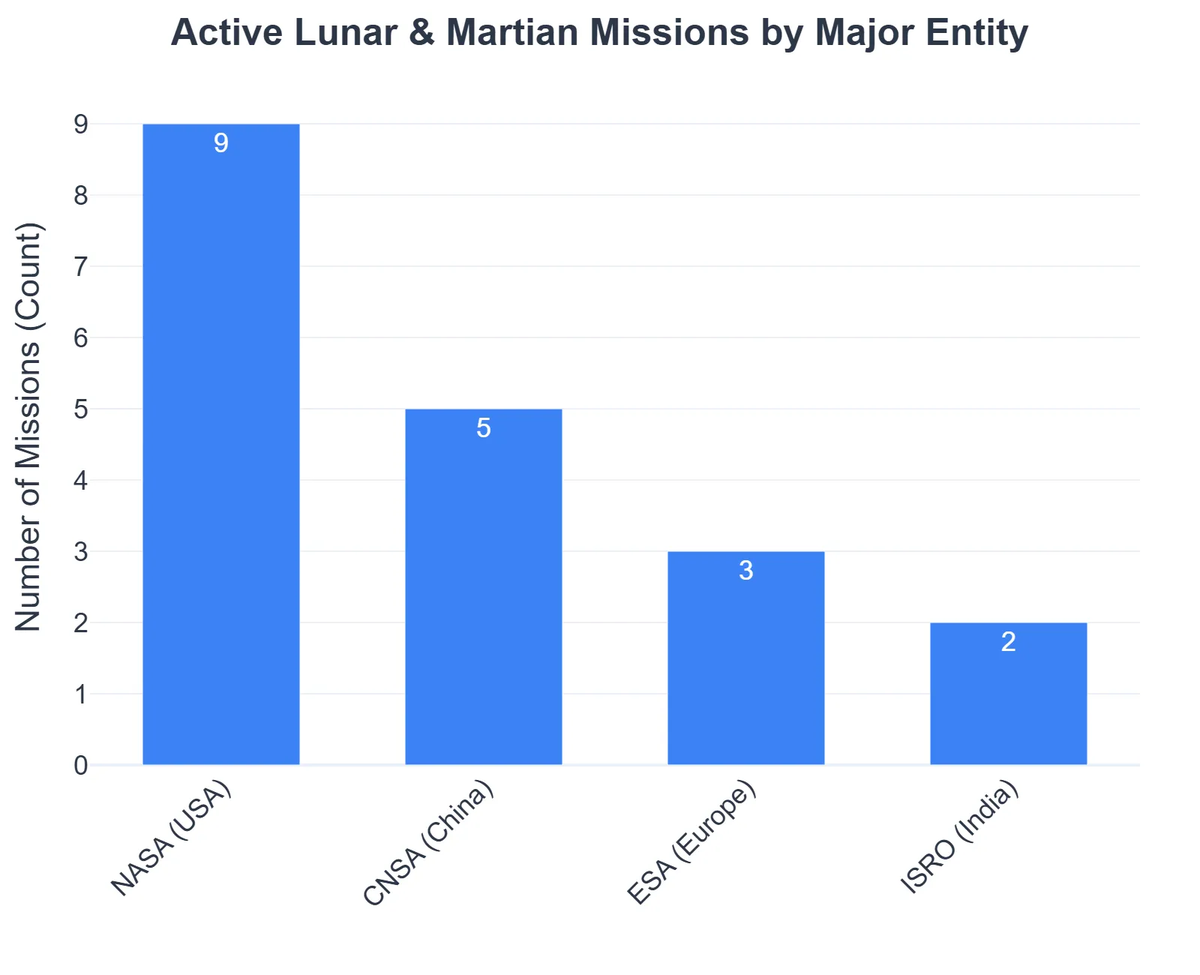
The United States (NASA), China (CNSA), and Europe (ESA) are prominent, with emerging players like India (ISRO) and the UAE, alongside private companies like SpaceX and Blue Origin.
What are the primary goals of current Moon missions?
Current lunar missions aim to establish sustainable bases, test technologies for Mars, extract resources like water ice, and conduct scientific research on the Moon’s poles.
What are the biggest challenges for Mars missions?
Major challenges include long travel times, radiation exposure, developing self-sustaining life support, managing dust, and ensuring successful landing and return operations.