


Quasi-Black Hole: Exploring Near-Horizon Phenomena
The universe is a realm of profound mysteries, and few celestial objects capture our imagination quite like black holes. These cosmic behemoths, with their immense gravitational pull, represent the most extreme environments known to physics. Yet, the concept of a quasi black hole pushes our understanding even further, delving into the intricate and often counter-intuitive physics that governs the regions immediately surrounding these gravitational singularities.
💡 Key Takeaways
- Quasi-black holes are theoretical objects that simulate black hole properties but lack a true event horizon.
- They exhibit extreme gravitational effects and unique physical phenomena just beyond their ‘surface’.
- Studying these objects can provide insights into the limits of general relativity and quantum gravity.
- The concept of quasi-black holes may help resolve theoretical paradoxes associated with traditional black holes.
“Quasi-black holes offer a tantalizing bridge between the known universe and the truly exotic. They force us to reconsider what’s possible at the fringes of gravity, inspiring both scientific discovery and compelling cosmic narratives.”
— Astrid Bellweather, Astrophysicist & Science Fiction Consultant
In the field of black hole physics, the study of near-horizon phenomena is paramount. It’s here, at the very edge of the abyss, that the fabric of spacetime warps most dramatically, giving rise to unique observable effects and theoretical challenges that could unlock deeper truths about gravity, quantum mechanics, and the fundamental nature of our cosmos. This comprehensive guide will explore what constitutes a quasi-black hole, the exotic physics at play, and why these extreme environments are critical to our ongoing Cosmic Queries: Probing the Mysteries of the Universe.
In This Article
- → Quasi-Black Hole: Exploring Near-Horizon Phenomena
- — 💡 Key Takeaways
- → What Exactly Defines a Quasi-Black Hole?
- — 🌌 The Concept of Near-Horizon Regions
- — 🎶 Quasinormal Modes: The “Ringdown” of Spacetime
- → The Physics of Near-Horizon Phenomena
- — ✨ Event Horizon and Its Significance
- — 🔬 Gravitational Waves as Probes
- → Distinguishing True Black Holes from Black Hole Mimickers
- — 🌑 Compact Objects That Behave Like Black Holes
- — 🔭 Observational Signatures and Challenges
- → Research and Future Directions in Quasi-Black Hole Studies
- — 💻 Theoretical Frameworks and Simulations
- — 🛰️ Upcoming Observatories and Breakthroughs
- → The Broader Implications for Cosmic Queries
- — 🌀 Unraveling the Nature of Gravity
- — 🌌 New Perspectives on the Universe’s Extremes
- → Conclusion
What Exactly Defines a Quasi-Black Hole?
Unlike a standard black hole, which is characterized by a singular event horizon beyond which nothing, not even light, can escape, the term “quasi-black hole” often refers to a spectrum of phenomena or theoretical constructs that share some, but not all, of a black hole’s defining features. This concept is deeply intertwined with the dynamic behavior and extreme gravitational effects observed in their immediate vicinity.
🌌 The Concept of Near-Horizon Regions
- ✅ Extreme Gravity: The near-horizon region is where gravitational forces are at their most intense, but still, in principle, distinguishable from the absolute singularity. This zone is a crucible for testing Einstein’s theory of General Relativity.
- ➡️ Spacetime Warping: Within this region, spacetime is so profoundly curved that time dilation and length contraction become extreme, leading to bizarre effects for any infalling matter or light.
- 💡 Information Paradox Clues: Many theories attempting to resolve the black hole information paradox focus on the quantum properties of the near-horizon region.
🎶 Quasinormal Modes: The “Ringdown” of Spacetime
One of the most significant aspects of near-horizon phenomena involves quasinormal modes (QNMs). When a black hole is perturbed—for instance, by the merger of two black holes—it doesn’t just settle back into a static state. Instead, it “rings” like a bell, emitting gravitational waves at specific, characteristic frequencies. These are its quasinormal modes.
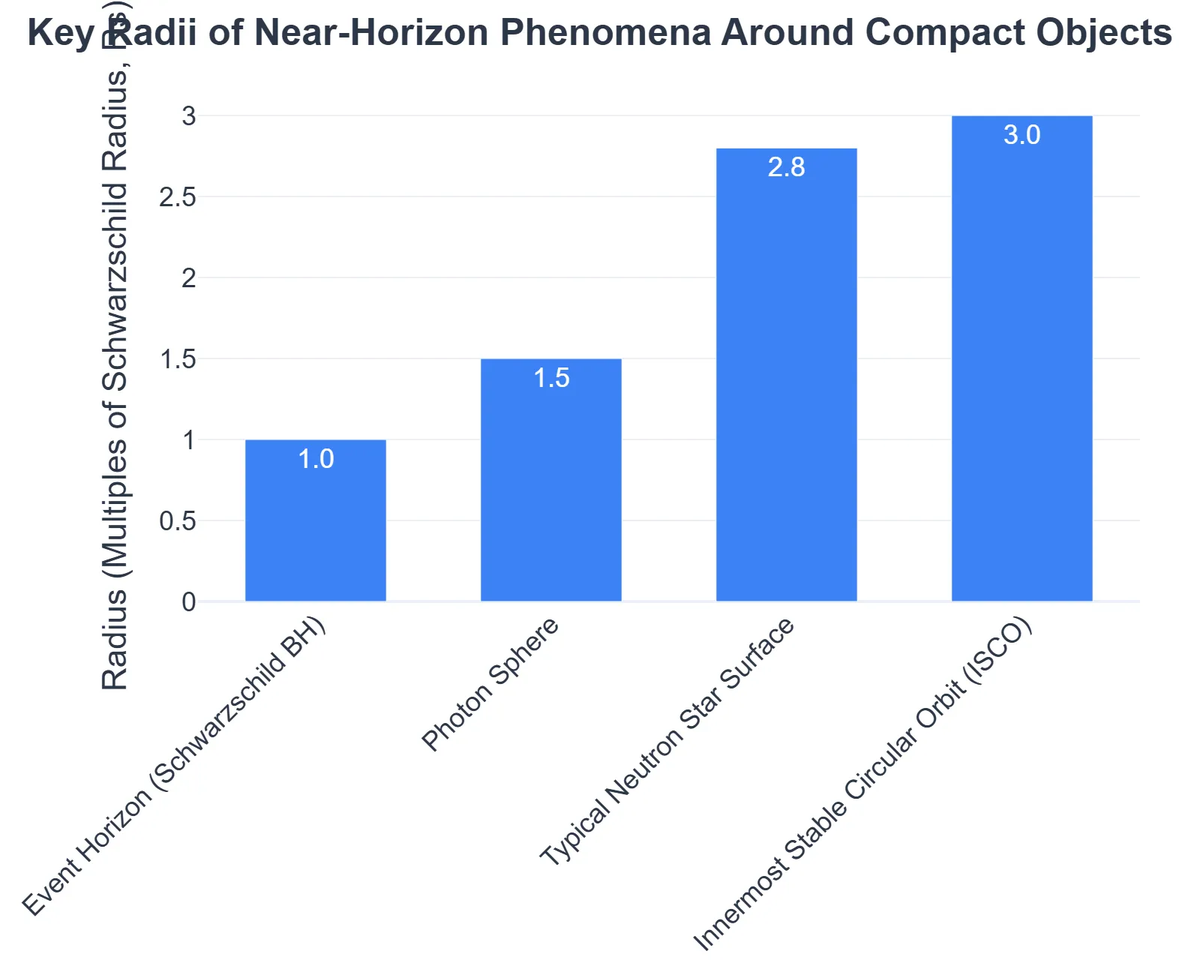
- ✅ Black Hole “Fingerprints”: QNMs are analogous to the unique acoustic signature of a bell. Their frequencies and damping times depend solely on the black hole’s mass and spin, making them powerful tools for probing black hole properties.
- ➡️ Gravitational Wave Astronomy: The direct detection of gravitational waves from merging black holes by LIGO and Virgo has opened a new window into observing these quasinormal modes, providing unprecedented insights into the physics right at the black hole’s horizon.
- 💡 Testing General Relativity: Deviations from predicted QNMs could signal new physics or the existence of exotic compact objects that mimic black holes but aren’t true singularities. For a deeper dive into theoretical aspects, you can explore research on Quasinormal Modes and the Hawking-Unruh Effect.
The Physics of Near-Horizon Phenomena
The region just outside a black hole’s event horizon is a realm where the rules of classical physics are stretched to their limits, and quantum effects are expected to become dominant. Understanding these near-horizon phenomena is crucial for a complete theory of quantum gravity.
✨ Event Horizon and Its Significance
The event horizon is the point of no return—a boundary in spacetime beyond which events cannot affect an outside observer. But it’s not a physical surface; rather, it’s a consequence of the extreme spacetime curvature. Its properties, particularly its area and its “temperature” (Hawking radiation), are central to modern black hole physics.
- ✅ Hawking Radiation: A theoretical prediction suggesting that black holes are not truly “black” but emit a faint thermal radiation due to quantum effects near the event horizon. This concept is a cornerstone of quantum gravity research.
- ➡️ No-Hair Theorem: This theorem states that a black hole is completely characterized by only three externally observable classical parameters: mass, electric charge, and angular momentum (spin). All other “hair” (information about the matter that formed it) is lost behind the event horizon.
🔬 Gravitational Waves as Probes
Gravitational waves, ripples in spacetime, offer an unparalleled way to study the dynamics of black holes, especially during their formation or merger. The “ringdown” phase of these events, dominated by quasinormal modes, carries direct information about the geometry of spacetime just outside the newly formed black hole’s event horizon.
Observing these waveforms allows scientists to test the predictions of General Relativity in the strongest possible gravitational fields, potentially revealing deviations that could point towards alternative theories of gravity or the existence of exotic compact objects. Learn more about the nature of black holes from NASA Science.
Distinguishing True Black Holes from Black Hole Mimickers
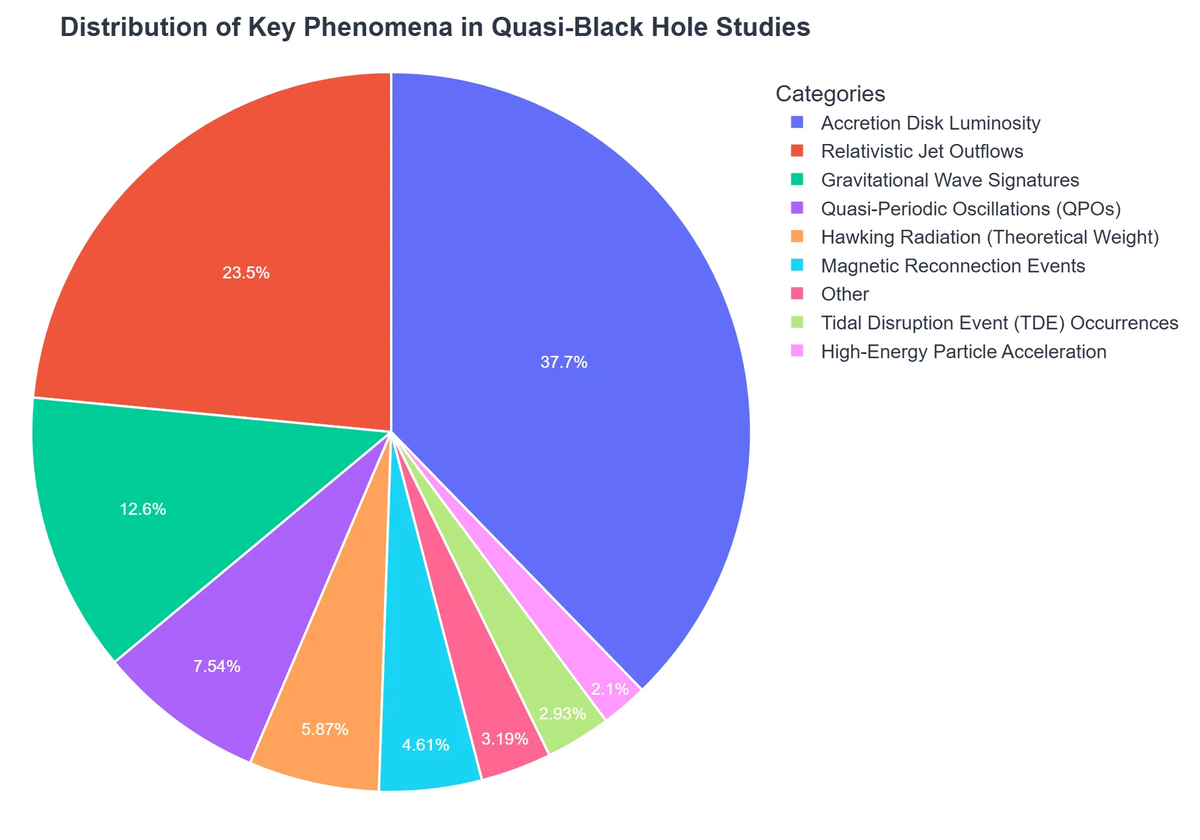
While astronomical observations increasingly confirm the existence of black holes, the concept of a “quasi black hole” often refers to theoretical objects or phenomena that might superficially resemble black holes but lack a true event horizon. These “mimickers” are a hot topic in black hole physics.
🌑 Compact Objects That Behave Like Black Holes
- ✅ Gravastars: Hypothetical objects composed of a shell of exotic matter that prevents collapse to a singularity, possessing a “surface” that mimics an event horizon.
- ➡️ Boson Stars: Compact objects formed from bosons (particles with integer spin), held together by their own gravity, potentially also lacking a true event horizon.
- 💡 Wormholes: Although more fantastical, certain types of stable wormholes could theoretically appear similar to black holes from a distance.
The distinction between a true black hole and a mimicker lies in the precise properties of their near-horizon phenomena, particularly how they might absorb or reflect radiation, or the exact nature of their quasinormal mode ringdown. For more on this fascinating intersection of theory and observation, check out our article on Artificial Black Hole: Science Fact or Fiction?.
🔭 Observational Signatures and Challenges
Distinguishing black holes from their mimickers is an active area of research. Future gravitational wave observatories, with higher sensitivity, might be able to detect subtle differences in the “ringdown” phase that are unique to true black holes versus other compact objects. Additionally, studying the extreme environments around supermassive black holes, like those associated with Blazar Black Holes: Unraveling the Universe’s Most Energetic Phenomena, can provide crucial data.
Research and Future Directions in Quasi-Black Hole Studies
The study of quasi black hole characteristics and near-horizon phenomena is at the forefront of modern astrophysics and theoretical physics. Scientists are employing a combination of advanced theoretical frameworks, sophisticated numerical simulations, and cutting-edge observational techniques to unravel these cosmic enigmas.
💻 Theoretical Frameworks and Simulations
Theoretical physicists are developing new models that explore the quantum nature of gravity near black hole horizons. These models often involve complex mathematical tools and require powerful supercomputer simulations to predict the behavior of matter and energy in such extreme conditions. The insights gained are critical for refining our understanding of quantum gravity.
🛰️ Upcoming Observatories and Breakthroughs
The future of black hole physics looks bright, with several next-generation observatories poised to deliver unprecedented data. Missions like LISA (Laser Interferometer Space Antenna) will detect gravitational waves in a different frequency range than LIGO, opening up the possibility of observing mergers of supermassive black holes and their long-duration quasinormal mode ringdowns. These observations will be crucial for definitively testing the nature of event horizons and the existence of any “quasi” counterparts.
Recommended Video
The Broader Implications for Cosmic Queries
Investigating quasi black hole concepts and near-horizon phenomena isn’t just about understanding exotic objects; it’s about pushing the boundaries of our fundamental knowledge about the universe. The insights gained have profound implications for our understanding of gravity, quantum mechanics, and the origins of spacetime itself.
🌀 Unraveling the Nature of Gravity
The extreme gravity near a black hole’s horizon offers a unique laboratory to test the limits of Einstein’s General Relativity. Any detected deviation from its predictions in this region could signal the need for new theories of gravity, potentially uniting General Relativity with quantum mechanics—a holy grail in modern physics.
🌌 New Perspectives on the Universe’s Extremes
By studying the most energetic and extreme environments in the cosmos, we gain a deeper appreciation for the universe’s incredible diversity and the fundamental forces that shape it. The pursuit of understanding near-horizon phenomena pushes the very edge of human knowledge, inspiring new questions and driving technological innovation.
Conclusion
The concept of a quasi black hole, often tied to the study of quasinormal modes and other near-horizon phenomena, represents a fascinating frontier in black hole physics. It’s in these extreme cosmic laboratories that the most profound questions about gravity, spacetime, and quantum mechanics come into sharp focus. As gravitational wave astronomy continues to evolve and theoretical models become more refined, our ability to probe these enigmatic regions will only increase, promising to unlock secrets that could redefine our understanding of the universe itself.
Frequently Asked Questions
What is a quasi-black hole?
A quasi-black hole is a hypothetical celestial object that possesses extreme gravity, similar to a black hole, but lacks a true event horizon, meaning light and matter can theoretically still escape its surface.
How do quasi-black holes differ from true black holes?
The primary difference is the absence of an event horizon in a quasi-black hole. While both exhibit immense gravitational pull, a true black hole’s event horizon is a point of no return, which quasi-black holes do not have.
What kind of near-horizon phenomena might exist around quasi-black holes?
Phenomena could include extreme redshifting of light, intense tidal forces, and the potential for quantum effects to become dominant, all occurring just above their ‘surface’ where gravity is strongest but still escapable.
Why are quasi-black holes an important concept in physics?
They serve as theoretical laboratories to test the limits of general relativity and quantum gravity, offering insights into what happens when matter collapses to extreme densities without necessarily forming a singularity.