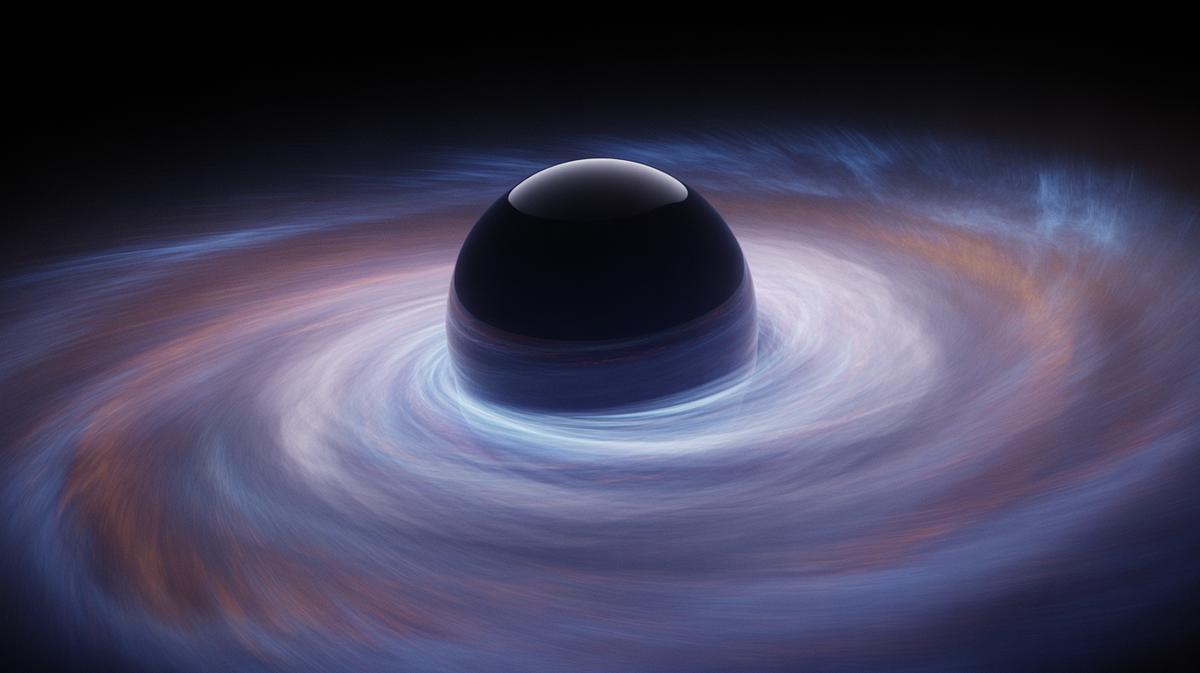
Understanding the Kerr Black Hole: The Rotating Giants of Gravity
In the vast cosmic tapestry, black holes represent some of the most enigmatic and extreme objects. While the simplest black hole, described by Karl Schwarzschild, is static and non-rotating, the universe is far more dynamic. The vast majority of observed black holes are believed to be rotating, a phenomenon described by the Kerr black hole solution to Einstein’s field equations.
💡 Key Takeaways
- Kerr black holes are rotating black holes, described by the Kerr metric, a precise solution to Einstein’s field equations.
- Their rapid rotation drags spacetime around them, creating a unique region called the ergosphere, where objects cannot remain static.
- Energy can theoretically be extracted from the ergosphere through mechanisms like the Penrose process, potentially powering energetic astrophysical phenomena.
- Spinning black holes are believed to be prevalent in the universe and are crucial for understanding quasars and gravitational wave sources.
“Kerr black holes aren’t just theoretical curiosities; their intricate spin dynamics are fundamental to understanding the universe’s most energetic phenomena, from powerful quasars to the ripples of gravitational waves.”
— Astrid Bellweather, Astrophysicist & Science Communicator
Unlike their Schwarzschild counterparts, which are defined solely by their mass, Kerr black holes possess two fundamental properties: mass and angular momentum. This rotation profoundly alters the fabric of spacetime around them, creating a more complex and fascinating gravitational landscape.
✨ The Genesis of Rotation
How do black holes acquire rotation? It’s primarily through their formation and evolution:
- ✅ Stellar Collapse: When a massive star collapses to form a black hole, it conserves its angular momentum. Just as a spinning ice skater pulls their arms in to spin faster, the collapsing star’s rapid contraction amplifies its initial rotation.
- ✅ Accretion Disks: Black holes grow by accreting matter from their surroundings. This matter typically forms an accretion disk, spiraling inward. As material falls into the black hole, it imparts its angular momentum, causing the black hole to spin up over cosmic timescales.
- ✅ Mergers: The collision and merger of two black holes, or a black hole and a neutron star, can also result in a single, more massive, and often rapidly spinning black hole.
In This Article
- → Understanding the Kerr Black Hole: The Rotating Giants of Gravity
- — 💡 Key Takeaways
- — ✨ The Genesis of Rotation
- → The Ergosphere: A Vortex Where Spacetime Twists
- — ⚙️ Defined by Frame-Dragging
- → Frame-Dragging: Warping Spacetime Itself
- — 🌀 The Mechanics of Spacetime Distortion
- → Observational Evidence and Astrophysical Significance
- — 🔭 Detecting the Unseen Spin
- — 🌌 Cosmic Influence
- → Future Research and Unanswered Questions
- — 🚀 Pushing the Boundaries of Understanding
The Ergosphere: A Vortex Where Spacetime Twists
One of the most remarkable features unique to a spinning black hole is the ergosphere. This isn’t a solid surface, but rather a region of distorted spacetime where even light is compelled to move in the direction of the black hole’s rotation.
⚙️ Defined by Frame-Dragging
The ergosphere exists outside the event horizon but inside a boundary called the static limit. Within this region, the black hole’s immense rotation literally “drags” spacetime along with it. This effect, known as frame-dragging, is so powerful that it forces anything within the ergosphere to co-rotate with the black hole, regardless of its own initial velocity or direction.

- ➡️ Beyond Escape: While objects within the ergosphere can still escape the black hole’s gravitational pull (unlike inside the event horizon), they cannot remain stationary relative to a distant observer. They are swept along by the rotating spacetime.
- ➡️ The Penrose Process: This unique property allows for a theoretical process known as the Penrose process. Particles entering the ergosphere can split, with one part falling into the black hole and the other escaping with more energy than it originally had, effectively extracting rotational energy from the black hole. This mechanism is thought to power some of the most energetic phenomena in the universe.
For more on how gravity warps the fabric of existence, see our in-depth article on Black Hole Spacetime: Navigating Gravity’s Ultimate Warp.
Frame-Dragging: Warping Spacetime Itself
The concept of frame-dragging, also known as the Lense-Thirring effect, is a direct prediction of Einstein’s theory of general relativity and is most pronounced around Kerr black holes. It describes how a massive, rotating object literally drags the very fabric of spacetime around itself, much like a spinning ball in a thick syrup would drag the syrup along.
🌀 The Mechanics of Spacetime Distortion
Imagine dropping a small stone into a vortex of water. The stone is pulled along by the water’s rotation. Similarly, anything near a spinning black hole – including light and matter – is forced to follow the rotational motion of spacetime itself. This isn’t a force in the traditional sense, but a curvature of spacetime that dictates the paths of objects within it.
- 💡 Impact on Orbits: For objects orbiting a spinning black hole, frame-dragging causes their orbital plane to precess, or wobble. Satellites around Earth also experience a tiny amount of frame-dragging due to our planet’s rotation, a phenomenon meticulously measured by experiments like Gravity Probe B.
- 💡 Jets and Accretion: Frame-dragging is crucial to understanding the powerful jets of plasma emitted by active galactic nuclei (AGN). The intense magnetic fields anchored in the accretion disk around a spinning supermassive black hole get twisted and amplified by the frame-dragging effect, launching matter at near-light speeds far into space.
This dynamic influence of rotation is a key aspect of how these cosmic giants shape their surroundings. Learn more about their broader impact in our article, Rotating Black Holes: Understanding Cosmic Influence.
Observational Evidence and Astrophysical Significance
While we cannot directly “see” a spinning black hole, their presence and dynamic effects are profoundly evident across the universe. The study of Kerr black holes is not merely theoretical; it underpins much of modern astrophysics.
🔭 Detecting the Unseen Spin
Scientists infer the spin of black holes through various observational techniques:
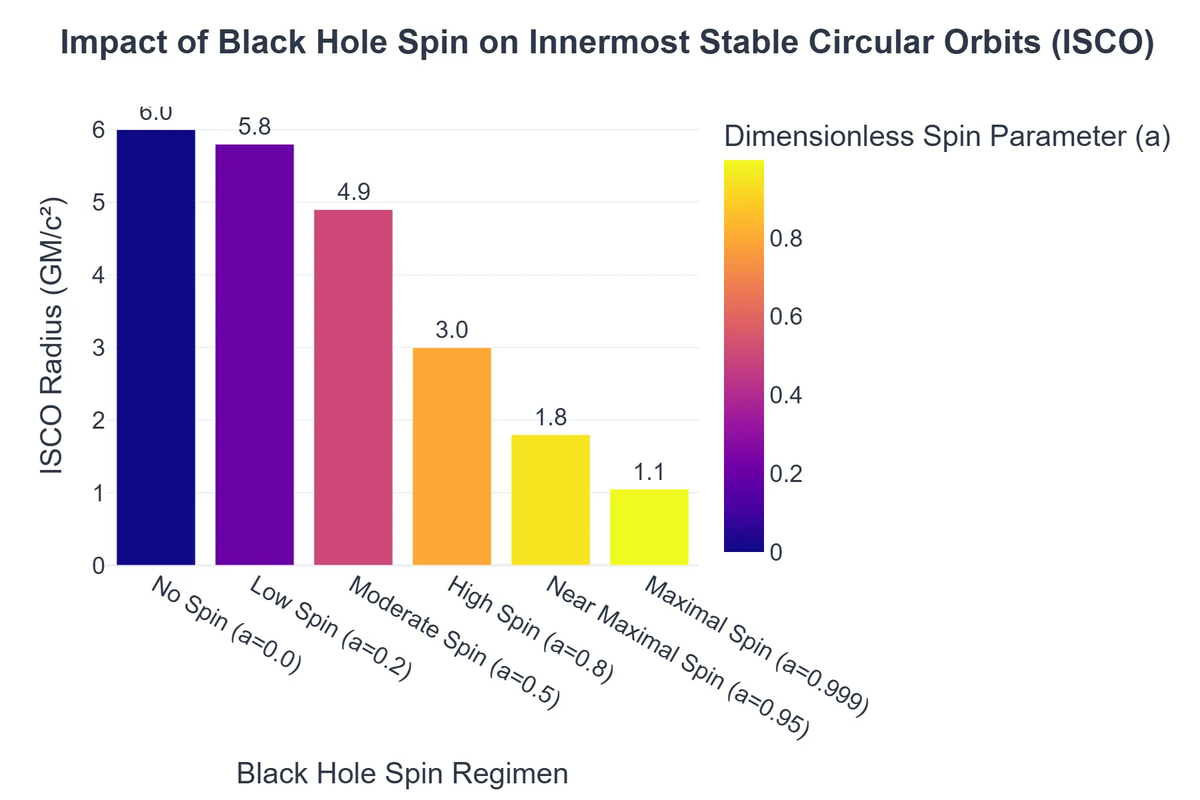
- ✅ Accretion Disk Spectra: Matter spiraling into a black hole heats up to extreme temperatures, emitting X-rays. The inner edge of the accretion disk depends on the black hole’s spin. Faster-spinning black holes allow matter to orbit closer before plunging, producing distinct spectral signatures that reveal their spin rate.
- ✅ Quasi-Periodic Oscillations (QPOs): Fluctuations in the X-ray brightness from accretion disks can exhibit regular “beats” or QPOs. The frequencies of these oscillations are thought to be related to the complex dynamics near the event horizon, influenced heavily by the black hole’s spin.
- ✅ Gravitational Waves: The groundbreaking detection of gravitational waves from merging black holes by LIGO and Virgo has provided direct evidence of their spin. The waveform of these gravitational ripples carries information about the masses and spins of the merging black holes. For instance, the merger of two highly spinning black holes produces a distinct gravitational wave signature. Research continues to refine our understanding of these dynamics, as explored in studies like “Spinning black hole in a fluid” published in Physical Review D (Phys. Rev. D).
🌌 Cosmic Influence
The dynamics of spinning black holes are fundamental to understanding:
- 💡 Galaxy Evolution: Supermassive Kerr black holes at the centers of galaxies influence galaxy formation and evolution through feedback mechanisms, where energy extracted from the black hole’s rotation can heat and expel gas, regulating star formation.
- 💡 Quasars and Blazars: These incredibly luminous active galactic nuclei are powered by accretion onto supermassive spinning black holes, with the frame-dragging effect playing a crucial role in collimating their powerful relativistic jets.
- 💡 Fundamental Physics: Studying the extreme environments around Kerr black holes provides a unique laboratory to test the limits of general relativity and explore new physics beyond our current understanding.
For a broader exploration of these cosmic enigmas and their overarching impact on the cosmos, dive into Cosmic Queries: Probing the Mysteries of the Universe.
Future Research and Unanswered Questions
The study of Kerr black holes remains a vibrant field of astrophysical and theoretical research. While general relativity provides a robust framework, the extreme conditions near these objects offer fertile ground for exploring new physics.
🚀 Pushing the Boundaries of Understanding
Current research focuses on several key areas:
- ✅ Black Hole Spectroscopy: Analyzing the “ringdown” phase of merging black holes via gravitational waves allows scientists to probe the specific “modes” of oscillation, which are unique to a Kerr black hole’s mass and spin. This is a powerful test of general relativity.
- ✅ Quantum Gravity: The singularity at the heart of a black hole remains a major challenge. Understanding the quantum nature of gravity is essential to resolve this singularity and provide a complete picture of black hole interiors. Theoretical work, such as that on “Kerr Black Hole Dynamics from an Extended Polyakov Action” (arXiv:2503.20538), explores advanced mathematical frameworks.
- ✅ Extreme Spacetime Environments: Further exploration of the ergosphere and frame-dragging effects under various conditions, including in binary systems or with infalling matter, continues to refine our models and predictions.
The ongoing advancements in gravitational wave astronomy and X-ray observations promise to unlock even more secrets about these rotating titans, helping us to better understand the fundamental laws governing our universe.
Recommended Video
What is a Kerr black hole?
A Kerr black hole is a rotating black hole, precisely described by the Kerr metric within General Relativity. Unlike non-spinning (Schwarzschild) black holes, its rotation significantly influences the surrounding spacetime.
How does rotation affect a black hole’s properties?
Rotation dramatically changes a black hole’s spacetime. It creates an ‘ergosphere’ outside the event horizon, where spacetime is dragged so intensely that nothing can remain static relative to a distant observer. It also affects the shape of the event horizon and the nature of the singularity.
Can energy be extracted from a spinning black hole?
Yes, theoretically, energy can be extracted from a Kerr black hole’s ergosphere through processes like the Penrose process. This mechanism allows particles entering the ergosphere to emerge with more energy than they had, with the extra energy drawn from the black hole’s rotational energy.
Are spinning black holes common in the universe?
Astrophysical observations and theoretical models suggest that most black holes, especially supermassive ones at galactic centers, are spinning. They acquire angular momentum by accreting matter and merging with other objects over cosmic timescales.