


In the annals of `astronaut history` and `human spaceflight`, few names resonate with the pioneering spirit of the Apollo era quite like Walter Cunningham. A pivotal figure in NASA’s ambitious quest to land humans on the Moon, Cunningham was an astronaut whose contributions helped lay the essential groundwork for humanity’s greatest voyages beyond Earth.
💡 Key Takeaways
- Walter Cunningham was a key astronaut on Apollo 7, the first crewed Apollo mission.
- Apollo 7 validated the Command and Service Module, crucial for later moon landings.
- Cunningham’s work significantly contributed to the success and safety of the Apollo program.
- He remained a vocal advocate for space exploration and private enterprise after his NASA career.
“Cunningham’s work on Apollo 7 wasn’t just a test flight; it was the essential, unsung overture to humanity’s greatest leap. Without that meticulous dry run, the moon might have remained just a distant dream.”
— Astrid Bellweather, Astrophysicist & Science Fiction Consultant
This comprehensive guide delves into the remarkable life and career of Walter Cunningham, with a particular focus on his critical role aboard `Apollo 7` – the mission that breathed new life into the Apollo program and paved the way for subsequent lunar landings. We’ll explore his journey from military aviator to space pioneer, the challenges and triumphs of his historic mission, and his enduring legacy in `NASA history`.
In This Article
- — 💡 Key Takeaways
- → The Formative Years: From Fighter Pilot to NASA Astronaut
- → Apollo 7: The Mission That Rescued a Program
- — 🚀 The Crew and Their Courageous Task
- — 🛠️ Apollo 7’s Pivotal Achievements
- → Paving the Way to the Moon: Cunningham’s Indirect Lunar Journey
- → Life After Apollo: A Legacy Beyond Orbit
- → Walter Cunningham’s Enduring Legacy
- → Conclusion: Remembering a Space Pioneer
The Formative Years: From Fighter Pilot to NASA Astronaut
Born in Creston, Iowa, in 1932, R. Walter Cunningham’s path to the stars was forged through a combination of intellect, discipline, and an adventurous spirit. His early life was marked by a commitment to service and education, traits that would define his future endeavors.
- ✅ Military Service: Cunningham served with distinction in the U.S. Marine Corps, flying 54 missions as a night fighter pilot during the Korean War. His experiences honed his precision, courage, and ability to perform under pressure – qualities indispensable for an astronaut.
- ✅ Academic Pursuits: After his military service, he pursued higher education, earning both a Bachelor of Arts and a Master of Arts in Physics from UCLA. He later completed his Ph.D. coursework in Physics. This strong scientific background made him an ideal candidate for NASA’s burgeoning space program.
- ✅ Selection as an Astronaut: In 1963, Walter Cunningham was selected as one of the third group of NASA astronauts. This cohort included future Moonwalkers and space station commanders, marking a significant expansion of the astronaut corps as the Apollo program gathered momentum.
Apollo 7: The Mission That Rescued a Program

The `Apollo 7` mission, launched in October 1968, was not just another spaceflight; it was a make-or-break moment for NASA and the entire Apollo program. Following the tragic Apollo 1 fire in January 1967, which claimed the lives of Gus Grissom, Ed White, and Roger Chaffee, public and political confidence in NASA was severely shaken. Apollo 7 was the critical first manned flight after the disaster, tasked with testing the redesigned Command/Service Module (CSM) in Earth orbit.
🚀 The Crew and Their Courageous Task
The crew of Apollo 7 consisted of three highly skilled and resilient astronauts:
- ➡️ Wally Schirra (Commander): A veteran of Project Mercury and Gemini, Schirra was the only astronaut to fly in all three of NASA’s pioneering space programs.
- ➡️ Donn Eisele (Command Module Pilot): On his first and only spaceflight, Eisele played a crucial role in operating the spacecraft’s complex systems.
- ➡️ Walter Cunningham (Lunar Module Pilot / Science Pilot): As the Lunar Module Pilot, Cunningham was responsible for conducting various systems tests and scientific observations, despite the absence of an actual Lunar Module on this specific mission. His role was critical in evaluating the CSM’s performance.
Their mission was to thoroughly test the Command and Service Module (CSM) in space for nearly 11 days, verifying its systems, propulsion, life support, and rendezvous capabilities. The stakes were incredibly high; any significant failure could have jeopardized the entire lunar landing effort.
Walter Cunningham: Apollo Program Contributions and Lunar Context
Pros
- ✔Pivotal role in validating the Apollo Command and Service Module (CSM) during Apollo 7.
- ✔Helped pave the way for later lunar missions by proving spacecraft readiness in Earth orbit.
- ✔Contributed significantly to early human spaceflight advancements in the Apollo era.
Cons
- ✖Apollo 7 was an Earth-orbital mission; Cunningham did not personally travel to the Moon.
- ✖His mission, while critical, received less public attention than lunar landing missions.
- ✖His legacy is often overshadowed by astronauts who walked on the lunar surface.
🛠️ Apollo 7’s Pivotal Achievements
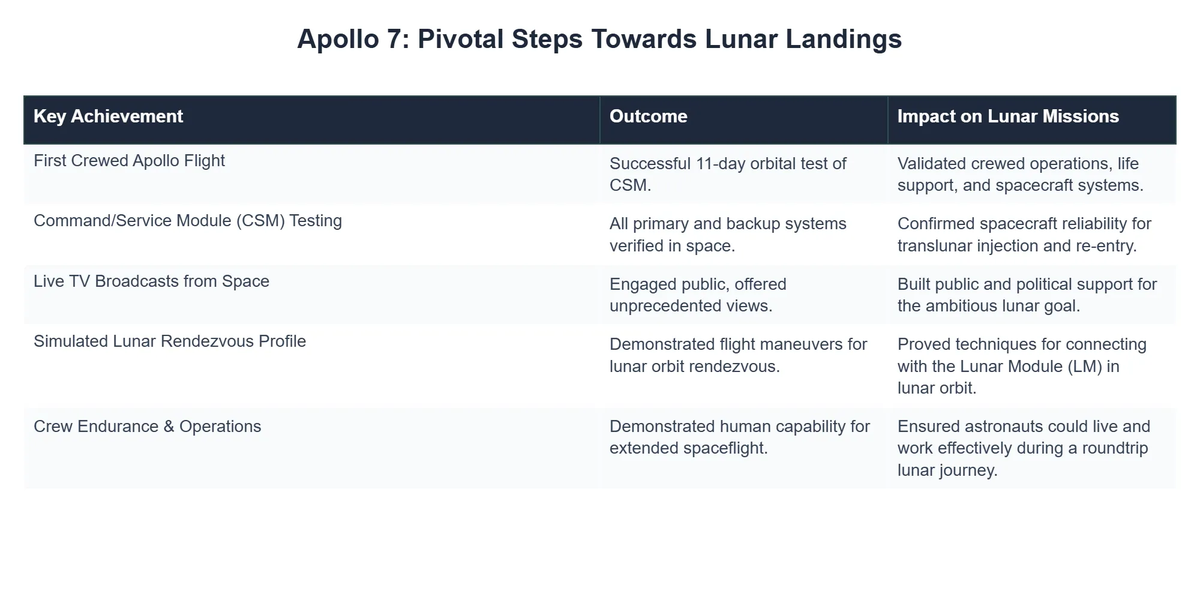
Over 163 orbits of Earth, the Apollo 7 crew successfully achieved all their primary objectives, demonstrating the CSM’s readiness for lunar missions:
- ✅ First Live TV Broadcasts from Space: A historic moment, captivating audiences worldwide and bringing the reality of spaceflight into homes.
- ✅ Successful Engine Firings: The Service Propulsion System (SPS) engine, crucial for lunar orbit insertion and translunar injection, was fired eight times flawlessly.
- ✅ Rendezvous and Docking Simulation: Though no actual docking occurred, the crew simulated rendezvous maneuvers with the spent Saturn IVB upper stage, practicing techniques vital for future Apollo missions.
- ✅ System Validation: Every system, from navigation to environmental control, underwent rigorous testing, providing invaluable data for engineers on the ground.
The success of `Apollo 7` restored faith in the program, proving that the redesigned spacecraft was safe and reliable. This triumph directly cleared the path for Apollo 8’s groundbreaking journey to the Moon in December 1968, and ultimately, for Apollo 11’s historic landing.
Paving the Way to the Moon: Cunningham’s Indirect Lunar Journey
While Walter Cunningham himself did not walk on the Moon, his role on Apollo 7 was undeniably a crucial step in humanity’s lunar journey. Without the rigorous testing and successful validation performed by Cunningham, Schirra, and Eisele, the subsequent missions that reached the Moon would have been impossible. Their courage in flying the first crewed mission after the Apollo 1 tragedy instilled the confidence needed to push forward with an accelerated lunar timeline.
To understand the full scope of this accomplishment, it’s worth exploring other monumental steps in space exploration, such as the achievement of the First Astronauts on the Moon: Apollo 11 Crew, which directly benefited from Apollo 7’s success. For those interested in the vehicles that made such feats possible, our article on Historic Spacecraft: The Pioneers of Space Exploration offers more insights.
Life After Apollo: A Legacy Beyond Orbit
Walter Cunningham retired from NASA in 1971, but his contributions to science and public understanding of space did not end there. He transitioned into various roles that leveraged his unique experiences and insights:
- 💡 Business and Investment: Cunningham had a successful career in the private sector, holding executive positions in engineering, electronics, and venture capital firms.
- 💡 Author and Speaker: He became a prolific author and speaker, sharing his experiences and perspectives on space exploration. His book, “The All-American Boys,” offers a candid look at the astronaut program and life at NASA. For enthusiasts looking to dive deeper, a wide array of Space history books provide rich narratives of this era.
- 💡 Media Commentary: Cunningham remained a respected voice in the space community, often providing commentary and analysis on space policy, new missions, and the future of exploration.
His post-NASA career exemplified a commitment to applying the lessons learned from the challenges of spaceflight to other fields, always with an eye toward innovation and progress.
Walter Cunningham’s Enduring Legacy
Walter Cunningham’s place in `NASA history` is secure. He was not just an astronaut; he was a trailblazer who embodied the courage, ingenuity, and determination that defined the Apollo era. His role on Apollo 7 provided the crucial validation needed for the human journey to the Moon to continue.
His passing in January 2023 marked the end of an era, as he was the last surviving crew member of Apollo 7. However, his contributions live on, inspiring new generations of scientists, engineers, and explorers. The artifacts and memories tied to missions like Apollo 7, including Apollo mission memorabilia, continue to tell the story of humanity’s extraordinary reach for the stars.
For more insights into the broader context of space exploration, we invite you to explore Cosmic Queries: Probing the Mysteries of the Universe.
Recommended Video
Conclusion: Remembering a Space Pioneer
Walter Cunningham’s journey from a Marine fighter pilot to a pivotal Apollo astronaut is a testament to the extraordinary individuals who propelled humanity into space. His unwavering dedication during the critical `Apollo 7` mission not only ensured its success but also solidified the foundation for every subsequent lunar mission. He leaves behind a legacy of courage, scientific rigor, and an enduring commitment to exploration that continues to inspire.
His contributions are an integral part of our shared `astronaut history`, reminding us that even the greatest leaps require meticulous preparation and unwavering bravery. As we continue to probe the mysteries of the universe, the spirit of pioneers like Walter Cunningham remains a guiding light.
Frequently Asked Questions
Who was Walter Cunningham?
Walter Cunningham was an American astronaut, physicist, and entrepreneur, best known as the Lunar Module Pilot on Apollo 7, the first crewed flight of the Apollo Command/Service Module.
What was the significance of the Apollo 7 mission?
Apollo 7 was a critical Earth-orbital test flight that successfully demonstrated the spaceworthiness of the Apollo Command/Service Module, proving it was ready for future lunar missions.
Did Walter Cunningham walk on the moon?
No, Walter Cunningham did not walk on the moon. His mission, Apollo 7, was an Earth-orbital test flight designed to validate the Apollo spacecraft, not to land on the lunar surface.
What did Cunningham do after his NASA career?
After leaving NASA, Cunningham held various executive positions in business and continued to be a prominent voice advocating for space exploration and free-market principles.